Choosing a truly non-slip kitchen floor is less about the material’s brand name and more about understanding the certified safety science behind its performance.
- Slip resistance is a measurable standard (R-Rating/DCOF), not just a « textured feel. » An R10 rating is the minimum for a residential kitchen.
- True safety also depends on impact absorption from materials like rubber and eliminating trip hazards from uneven thresholds between rooms.
Recommendation: Audit your kitchen not just for slip risk, but for a complete safety system including floor transitions, lighting, and ergonomics.
The clatter of a dropped plate on a tile floor is startling. The sound of a fall is life-changing. For many homeowners living with dangerously slick kitchen tiles, this background anxiety is a constant companion. When deciding to replace a floor, the immediate goal is to find a « non-slip » alternative. Many rush to install textured vinyl or linoleum, believing any new surface is an automatic improvement. This common approach focuses on the material’s name but often overlooks the real physics of friction that prevent a fall.
But what if the secret to a genuinely safe kitchen floor isn’t just the material itself, but a complete safety system? This system is built on three pillars: a surface with a certified friction rating, seamless and level transitions to adjacent rooms, and a specialized maintenance routine that preserves the floor’s essential grip. It means thinking less like a decorator and more like a safety engineer, focusing on measurable performance over simple aesthetics.
This guide moves beyond generic advice to give you the knowledge of a flooring safety consultant. We will decode the technical ratings that define slip resistance, compare materials for their ability to cushion a fall, and reveal the hidden hazards—like thresholds and improper cleaning—that can turn an expensive new floor into a brand-new risk.
By understanding these critical elements, you can make an informed choice that delivers true peace of mind. The following sections break down each component of this safety system, providing the objective data needed to select the best and safest flooring for your home.
Summary: A Consultant’s Guide to Safer Kitchen Flooring
- What Does « R10 Slip Rating » Mean and Why Do You Need It?
- How to Apply Non-Slip Treatments to Existing Tile Without Ruining the Look?
- The « High Threshold » Mistake That Turns New Flooring Into a Trip Hazard
- Cork vs Rubber: Which Flooring Cushions Falls Better?
- How to Clean Non-Slip Floors Without Clogging the Texture?
- Why Standard Cane Tips Fail on Wet Tile and Ice?
- Carpet vs Hardwood: Which Is Safer for Shuffling Gaits?
- How to Identify and Mitigate Domestic Risks Beyond Falls in a Senior Home?
What Does « R10 Slip Rating » Mean and Why Do You Need It?
In the world of safety flooring, « non-slip » is not a subjective feeling; it is a quantifiable, scientific measurement. The most common standard you will encounter is the « R » rating, which stands for « Rutsch, » the German word for slip. This rating is determined by a ramp test where an operator in safety boots walks on an oil-covered flooring sample that is gradually inclined until they slip. The angle of the ramp at the moment of the slip determines the R-rating. For a residential kitchen, where water, grease, and other spills are common, an R10 rating is the recommended minimum.
An R10-rated floor has been tested to provide adequate grip on an incline of 10° to 19°. This is a significant step up from an R9 rating, which is only suitable for dry, indoor areas like living rooms or bedrooms. The importance of this cannot be overstated, as a fall in a kitchen is often more dangerous due to the presence of hard surfaces and sharp corners. In fact, data from the CDC shows that over 37% of falls result in an injury requiring medical treatment, making the initial investment in a properly rated floor a critical preventative measure.
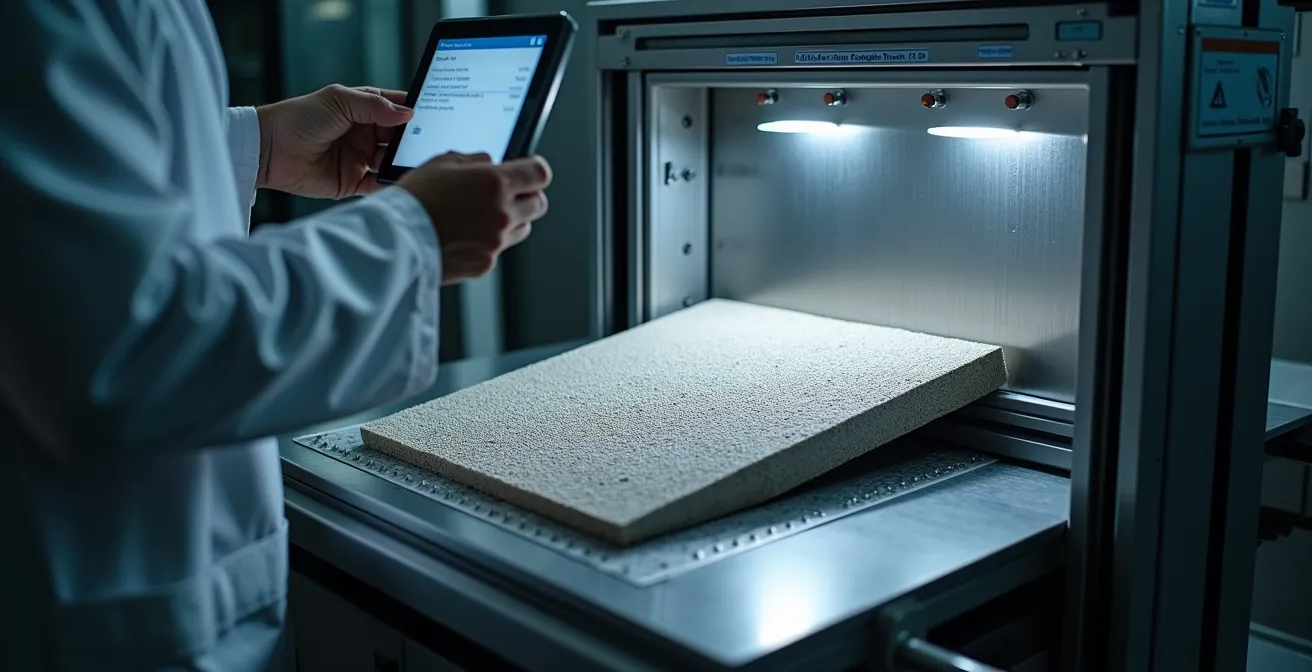
Another key metric is the Dynamic Coefficient of Friction (DCOF), which measures the friction of a surface as an object is already in motion across it. A higher DCOF means better slip resistance. The table below shows how R-ratings generally correspond to DCOF values and their appropriate applications. As you can see, R10 provides a DCOF that is specifically suited for the demands of a home kitchen.
| Rating | Incline Angle | Application | DCOF Equivalent |
|---|---|---|---|
| R9 | 6°-10° | Indoor dry areas | 0.30-0.39 |
| R10 | 10°-19° | Residential kitchens | 0.40-0.49 |
| R11 | 19°-27° | Areas with water spillage | 0.50-0.59 |
| R12 | 27°-35° | Commercial kitchens | 0.60+ |
Ultimately, when shopping for new flooring, you must ask for the product’s technical data sheet. If the seller cannot provide a certified R-rating or DCOF value, you should consider it an unrated surface and assume it is not safe for a kitchen environment.
How to Apply Non-Slip Treatments to Existing Tile Without Ruining the Look?
For homeowners who are not ready for a full floor replacement, anti-slip treatments can be a viable solution to improve the safety of existing ceramic or porcelain tiles. These treatments work in two primary ways: by adding a textured coating to the surface or by using an acid-based solution to create microscopic pores, a process known as micro-etching. While effective, the main concern is often whether these treatments will permanently alter the tile’s appearance, making it look cloudy, dull, or unnatural.
The key to a successful application without aesthetic compromise is diligent testing and professional-grade products. Coatings, like those containing urethane and an aggregate, add a clear, textured layer. They are highly effective but can slightly alter the sheen and may require reapplication over time. Micro-etching treatments, on the other hand, chemically alter the tile surface itself to increase its DCOF. When done correctly, the visual change is minimal to nonexistent when the tile is dry, with the effect becoming apparent only when the surface is wet. The microscopic pores help break the surface tension of water, allowing shoe soles to make better contact with the tile.
Regardless of the method, a patch test is non-negotiable. Always test the treatment on a spare tile or in an inconspicuous area, like inside a pantry or under an appliance. Allow it to cure fully (24-48 hours) and then evaluate its appearance in different lighting conditions (natural, artificial) and test its slip resistance with wet hands or shoes. This step prevents costly and irreversible mistakes on your main floor.
Case Study: Preserving Aesthetics with Micro-Etching
A small cafe with visually appealing ceramic tile flooring in its kitchen faced a common dilemma: improving safety without a costly renovation that would ruin the look. After testing several options, they chose a professional micro-etching treatment. The solution was applied to the existing tiles, creating microscopic texture that was invisible to the naked eye. The treatment successfully raised the floor’s slip resistance to meet commercial safety regulations, all while maintaining the tile’s original color and glossy appearance, proving that safety and aesthetics can coexist.
When applied correctly, these treatments can be an excellent and cost-effective way to upgrade your kitchen’s safety profile. However, for a lasting and guaranteed result, choosing a floor manufactured with an inherent R10+ rating remains the most reliable long-term solution.
The « High Threshold » Mistake That Turns New Flooring Into a Trip Hazard
A perfectly slip-resistant floor can be rendered unsafe by one of the most overlooked details in a flooring project: the threshold. A threshold differential—even a small height difference of a quarter-inch (about 6mm) between the kitchen floor and an adjacent room—can create a significant trip hazard. This is especially dangerous for seniors or individuals with a shuffling gait, as they are less likely to lift their feet high enough to clear the obstruction. The consequences are severe, with the CDC reporting over 3 million emergency department visits annually due to falls among older adults.
This hazard often arises when a thick new flooring material, like luxury vinyl plank or engineered hardwood, is installed on top of an existing floor without proper subfloor preparation. The transition strip used to bridge the two floor levels creates a small but dangerous ramp or bump. A truly safe installation requires that the two adjoining floors are perfectly flush. Achieving this may involve removing the old flooring or adjusting the subfloor height to create a seamless, level surface across the entire home.
The responsibility for a safe transition lies in proper planning before the first plank is laid. As flooring experts from the Eco-Grip Technical Team note, the foundation is everything:
For new construction projects, the subfloor needs to be sloped correctly toward all drains before installing the finished floor, and it’s important that the subfloor is both smooth and dry.
– Eco-Grip Technical Team, Eco-Grip Installation Guidelines
While this advice is for commercial settings, the principle is universal: the final surface is only as good as the subfloor beneath it. When hiring a contractor, you must explicitly discuss the goal of a zero-height transition. This may add to the project’s cost and complexity, but it is an essential investment in fall prevention. A beautiful, high-friction floor that creates a trip hazard at every doorway is a failure in home safety.
Before signing any contract, walk through your home and identify all transition points. Discuss with your installer exactly how they plan to make each one perfectly flat. Insisting on this detail is as important as choosing the right R-rated material.
Cork vs Rubber: Which Flooring Cushions Falls Better?
While slip resistance is crucial for preventing falls, another key aspect of a safe flooring system is its ability to absorb impact and reduce the severity of injury *if* a fall does occur. This is particularly vital in homes with seniors, as falls are the primary cause of debilitating hip fractures. Research shows the shocking reality that nearly 83% of hip fracture deaths in 2019 were caused by falls. When choosing a floor, we must consider not only friction but also cushioning. The two leading materials in this category are cork and rubber.
Cork flooring is known for its natural softness and sound-dampening qualities. Its unique cellular structure, composed of millions of tiny air-filled pockets, acts as a natural shock absorber. It provides a comfortable « give » underfoot that is much more forgiving than ceramic tile or stone. However, while it offers good cushioning, it can be susceptible to damage from heavy impacts or sharp objects and may not be ideal for very high-traffic kitchen areas.
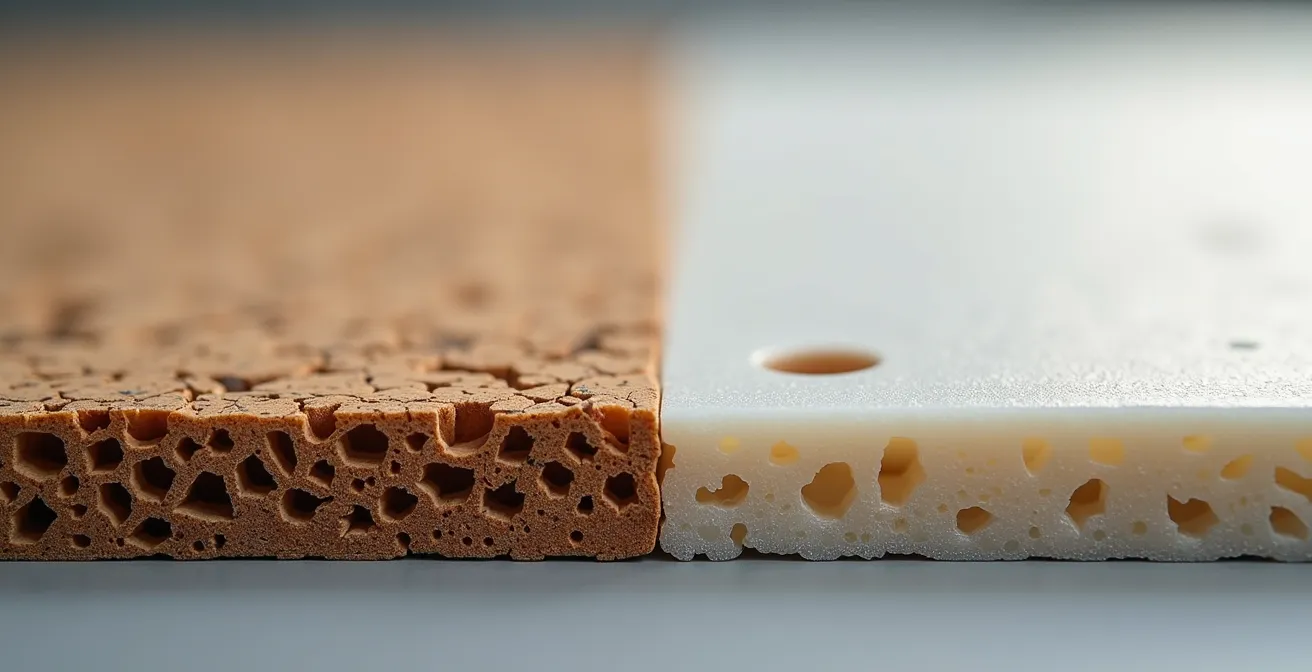
Rubber flooring, often associated with commercial gyms and playgrounds, is arguably the superior choice for impact absorption. Its elastomeric properties allow it to compress upon impact and then return to its original shape, effectively dissipating the energy from a fall. Modern rubber flooring is available in a wide variety of colors and patterns, including options made from recycled materials that are both durable and eco-friendly. It is highly resilient, water-resistant, and provides excellent natural slip resistance.
Case Study: Rubber Flooring for Impact and Fatigue Resistance
Eco-Grip’s rubber-based flooring, made from 98% recycled materials, is a prime example of a material designed for both safety and ergonomics. Its flexible composition not only provides superior impact resistance to cushion falls but also delivers anti-fatigue properties. In commercial settings where staff stand for hours, it has been shown to protect employees’ feet, legs, and lower back from strain, demonstrating that a floor can offer protection against both acute injuries from falls and chronic pain from standing.
For maximum safety, especially in a home with a high fall risk, rubber flooring presents the most robust solution, combining high friction with unparalleled impact absorption. It addresses both sides of the fall safety equation: prevention and protection.
How to Clean Non-Slip Floors Without Clogging the Texture?
A high-friction, textured floor is only effective as long as its texture is clean and exposed. The very feature that provides grip—the microscopic peaks and valleys of the surface—can also trap dirt, grease, and cleaning-product residue. Over time, this residue buildup can fill in the texture, creating a smooth, slick film that completely negates the floor’s safety features. The most common mistake is using the wrong type of cleaner, such as all-in-one « mop and shine » products, which are designed to leave a glossy film behind.
The correct maintenance routine for a non-slip floor is counterintuitive for those accustomed to traditional mopping. The key is to use a pH-neutral cleaner that leaves no residue and to employ mechanical agitation to lift dirt out of the texture. A simple mop and bucket often just pushes dirt around and leaves behind a film of dirty water. Instead, a deck brush or a medium-bristle brush is essential for scrubbing the surface and dislodging trapped grime. For best results, work in small sections, apply the diluted cleaning solution, scrub with the brush, and then remove the dirty water with a wet vacuum or a clean, well-wrung mop.
This experience is backed by professionals who manage high-traffic commercial kitchens, as one restaurant owner shared:
After switching to pH-neutral cleaners and implementing a mechanical brush cleaning system, our kitchen floors maintained their slip resistance rating for over three years. The key was avoiding film-forming products and maintaining a consistent cleaning schedule with proper agitation techniques.
– Restaurant Owner’s Experience, RCA Contractors
If your floor’s texture is already clogged, a deep restoration may be necessary. This typically involves using a high-alkaline degreaser, allowing it to dwell on the surface, agitating with a brush, and thoroughly extracting the solution. The following steps outline a professional deep cleaning process:
- Remove all loose debris with a stiff-bristle broom or vacuum.
- Apply a high-alkaline degreaser, diluted according to manufacturer instructions.
- Let the solution dwell for 5-10 minutes, but do not allow it to dry on the surface.
- Agitate the entire area with a medium-bristle brush, using circular motions.
- Extract the dirty solution using a wet vacuum for best results, or a clean mop and fresh water.
- Rinse the floor thoroughly with clean water to remove all chemical residue.
- Switch to a pH-neutral cleaner for all future routine maintenance.
By adopting the right tools and chemicals, you ensure that your investment in a safe floor continues to protect you and your family for years to come. A clean floor, in this context, is a floor that retains its original, life-saving friction.
Why Standard Cane Tips Fail on Wet Tile and Ice?
For many individuals who use a cane for stability, the device provides a reliable sense of security. However, that confidence can be shattered the moment the cane tip encounters a smooth, wet surface like a puddle on a kitchen tile floor. The reason for this sudden failure lies in the physics of hydroplaning. A standard, smooth rubber cane tip on a non-porous, wet surface can trap a thin layer of water between itself and the floor. This film of water prevents direct contact, causing the tip to lose a significant amount of friction and slip as if it were on ice.
The effect is not just a feeling; it is a measurable phenomenon. Research using the British Pendulum Tester, a device validated by over 3,500 real-world tests to measure slip resistance, provides stark evidence. As documented in studies on floor safety, these tests reveal a critical vulnerability. The findings show that a standard cane tip can lose up to 70% of its friction on a wet, smooth surface. This dramatic loss of grip is often unexpected and can directly lead to a fall, even for an experienced cane user.
This highlights a crucial weakness in a home’s safety system. If a resident relies on a mobility aid, the floor must be chosen to support that aid, especially in wet conditions. The solution is not just a better cane tip (though specialized, multi-pronged « ice tips » exist). The most effective solution is a floor designed to mitigate hydroplaning. Floors with a high-friction, micro-textured surface are essential. These surfaces feature tiny channels that work to whisk water away from the point of contact, allowing the cane tip (and shoe soles) to connect directly with the flooring material. An R10 or higher-rated floor is specifically designed with this type of surface profile.
Therefore, when selecting a kitchen floor for a household where a cane or walker is used, you are not just choosing a surface for walking; you are choosing the foundation upon which a critical piece of safety equipment must perform. The floor itself must be an active part of the solution.
Carpet vs Hardwood: Which Is Safer for Shuffling Gaits?
When considering flooring for areas adjacent to the kitchen, the debate often comes down to carpet versus hardwood. For individuals with a shuffling gait, which is common among older adults, both of these popular choices present unique safety challenges. Standard, medium-to-high pile carpet, while soft and slip-resistant, introduces a significant trip hazard. The edges of the carpet, loose threads, or transitions to other rooms can easily catch a foot that is not fully lifted, leading to a fall. Hardwood, on the other hand, eliminates the trip hazard but introduces a major slip risk, especially if it becomes wet or is highly polished.
The ideal solution must balance both trip and slip resistance. It needs to provide enough friction to prevent slipping without creating a surface that can snag a shoe. The following table breaks down the risks associated with common flooring types for individuals with a shuffling gait.
| Flooring Type | Trip Hazard Risk | Slip Risk (Dry) | Slip Risk (Wet) | Recommended Solution |
|---|---|---|---|---|
| Standard Carpet | High (edges/transitions) | Low | Medium | Not recommended |
| Hardwood | Low | Medium | Very High | Requires treatment |
| Low-pile Carpet Tiles | Very Low | Low | Low | Recommended |
| Textured Vinyl | Very Low | Low | Low-Medium | Recommended |
As the table illustrates, the best options are those that combine a low profile with a textured surface. This is where modern materials like textured luxury vinyl and, surprisingly, a specific type of carpet, excel. As the research team at Proximity Mills Flooring points out, the right implementation of carpet can be a superior choice:
Commercial-grade, low-pile, glue-down carpet tiles offer a superior solution, providing good friction while eliminating the trip hazard of traditional carpet edges and thresholds.
– Proximity Mills Flooring Research Team, Best Slip-Resistant Flooring Options Guide
This solution offers the « best of both worlds »: the friction and softness of carpet without the dangerous trip hazards of traditional broadloom. The tiles are glued directly to the subfloor, creating a seamless, stable surface that will not bunch up or have raised edges.
Ultimately, a safe home environment is a continuous surface. The flooring choice in the living room or hallway is just as important as the choice in the kitchen, as it impacts the overall risk of falls throughout the home.
Key Takeaways
- An R10 slip rating (or a Dynamic Coefficient of Friction of 0.40+) is the minimum technical standard for a safe residential kitchen floor.
- Rubber flooring provides superior impact cushioning to reduce injury severity from a fall compared to cork or hard surfaces.
- Safety is a system: it includes the floor’s texture, zero-height transitions between rooms, and a cleaning routine that prevents residue from clogging the surface grip.
How to Identify and Mitigate Domestic Risks Beyond Falls in a Senior Home?
While preventing falls is a primary concern in kitchen safety, a truly secure environment for a senior addresses a wider spectrum of risks. A holistic safety audit looks beyond slip resistance to consider factors related to visual health, cognitive support, ergonomics, and hygiene. These elements work together to create a space that is not only physically safe but also comfortable and easy to use, reducing daily strain and potential confusion.
For example, high-gloss floors and countertops can create significant glare, which can be disorienting and uncomfortable for aging eyes. Opting for matte or satin finishes on all surfaces is a simple but effective mitigation strategy. Similarly, busy or high-contrast patterns on floors or backsplashes can be confusing for individuals with dementia or cognitive impairments. A calm, uniform visual field is often safer. Ergonomics also plays a crucial role; a hard, unforgiving floor can cause significant leg and back pain during the time spent standing while cooking or cleaning. An anti-fatigue floor, like rubber or cushioned vinyl, reduces this chronic strain.
Finally, hygiene is a safety issue. Traditional tile floors with grout lines are notoriously difficult to keep clean and can harbor bacteria. Seamless flooring materials, such as sheet vinyl or professionally installed rubber, eliminate these grout lines, creating a non-porous surface that is easier to sanitize and healthier overall.
Case Study: A Holistic Approach with Altro Stronghold 30
In healthcare and commercial kitchen settings, Altro Stronghold 30 flooring is often used because it addresses multiple safety concerns at once. With its highest-possible R12 slip-resistance rating and cushioned construction, it prevents falls and reduces fatigue. Its seamless, non-porous installation eliminates grout lines where bacteria can grow. Facilities that install this type of systemic flooring report not only fewer accidents but also improved hygiene compliance and reduced physical strain on staff, demonstrating how a single material choice can mitigate a wide range of risks.
Your 5-Point Kitchen Safety Audit
- Glare & Lighting: During the brightest time of day, check for reflective glare from countertops and floors. At night, ensure lighting is even, without creating deep shadows in work areas.
- Surface Texture: Carefully pour a small amount of water on the current floor and test the slip resistance with a rubber-soled shoe. Is there a noticeable grip, or does it feel slick?
- Transition Points: Run your hand and foot over every threshold where the kitchen floor meets another room. Is there any height difference or lip, however small, that could catch a toe?
- Ergonomic Strain: Stand in the main work area (by the sink or stove) for 10 minutes. Note any emerging discomfort or pain in your feet, legs, or lower back.
- Storage Accessibility: Identify the most frequently used items (pots, plates, common food). Are they stored accessibly between your waist and shoulder height, or do you have to bend down or reach up high?
Your next step is to use this knowledge to perform a full safety audit of your own space. Evaluate your current floor not just for its look, but for its certified performance, its transitions, and the other hidden risks we’ve identified. A safer home starts with these informed decisions.