In summary:
- Shift focus from finding « accessible » venues to proactively engineering a « fatigue-proof » experience.
- Treat participant energy as a finite « energy budget » to be managed throughout the day, not just at the destination.
- Quantify and minimize the « transfer cost »—the physical and mental toll of moving from car to wheelchair or seat to seat.
- Prioritize a single, high-quality experience over a packed itinerary to reduce cognitive load and maximize enjoyment.
- Success lies in managing the entire journey, not just checking boxes at the destination.
For any group leader, planning an outing for seniors with varied mobility levels can feel daunting. The logistical challenges seem endless, from transportation to navigating public spaces. The common advice often revolves around finding venues with a « wheelchair accessible » sticker and hoping for the best. This approach, however, frequently leads to exhausted participants and frustrated organizers, as it overlooks the subtle but significant barriers that can turn a fun day out into a stressful ordeal.
The reality is that true accessibility is not a feature you find; it’s an experience you design. It goes far beyond ramps and elevators. It involves a fundamental shift in perspective: from simply selecting a destination to meticulously engineering the entire journey. This means actively managing factors like energy expenditure, the physical cost of transfers, and the cognitive load of navigating unfamiliar environments. These are the invisible hurdles that often derail an otherwise well-intentioned plan.
This guide abandons the generic checklist in favor of a strategic framework. Instead of just telling you *what* to look for, we will explore *how* to think like an inclusive travel planner. By understanding the core principles of managing fatigue and minimizing logistical friction, you can create outings that are not just accessible, but genuinely enjoyable and rejuvenating for every member of your group, regardless of their mobility level.
To help you master this approach, we will explore the critical logistical decisions and mindset shifts necessary for success. This structured guide breaks down everything from verifying venue suitability to structuring the day for maximum fun.
Summary: A Strategic Guide to Planning Inclusive Senior Outings
- How to Verify if a « Wheelchair Accessible » Venue Is Truly Senior-Friendly?
- Why Trying to « See It All » Ruins the Trip for Senior Groups?
- The Seating Mistake That Turns a Museum Visit Into an Ordeal
- Charter Bus vs Carpool: Which Is Safer for a Group of 10 Seniors?
- How to Structure an Outing Day to Minimize Fatigue and Maximize Fun?
- Wheelchair Van vs Standard Car: Which Is Better for a 2-Hour Trip?
- How to Assess Your Neighborhood Terrain Before Buying a Mobility Aid?
- How PSWs Facilitate Safe Out-of-Home Travel for Seniors with Mobility Issues?
How to Verify if a « Wheelchair Accessible » Venue Is Truly Senior-Friendly?
The term « wheelchair accessible » is often a misleadingly simple label. While it may guarantee a ramp at the entrance, it says nothing about the practical realities a senior with mixed mobility will face inside. A truly senior-friendly venue considers the entire visitor journey, from arrival to departure, anticipating needs beyond basic physical access. This means investigating factors that contribute to what can be called logistical friction—small obstacles that accumulate to cause significant fatigue and stress.
Effective verification requires a shift from a passive query (« Are you accessible? ») to an active investigation. For instance, are the automatic doors timed to allow a slower-moving wheelchair or walker user to pass through without rushing? Are glass doors and panels marked with manifestations to aid those with low vision? Is staff trained in disability awareness and prepared to offer assistance respectfully and effectively? These details define the difference between a place one can enter and a place one can comfortably experience.
A prime example of this deeper approach comes from Historic England’s comprehensive accessibility framework. Their method isn’t just a checklist of features but an evaluation of the complete user experience. It includes assessing fire evacuation procedures for disabled visitors, the availability of gender-neutral facilities for those with caregivers of a different gender, and the overall sensory environment. This holistic view is the gold standard for confirming a venue’s suitability, ensuring the environment supports, rather than hinders, a positive experience.
Ultimately, your role is to be a detective for details. A phone call to the venue with specific, targeted questions is far more valuable than relying on a website icon. Ask about the distance from the drop-off point to the entrance, the location of rest areas relative to exhibits, and the specifics of their staff assistance protocols.
Why Trying to « See It All » Ruins the Trip for Senior Groups?
A common mistake in planning group outings is attempting to create a packed, « value-for-money » itinerary. The desire to see and do everything often stems from good intentions, but for a group with mixed mobility, it backfires spectacularly. This « see it all » approach ignores a fundamental principle: the energy budget. Every participant starts the day with a finite amount of physical and mental energy, and every activity, transfer, and moment of confusion makes a withdrawal from that budget.
For seniors, this energy budget is often smaller and more easily depleted. A packed schedule creates a relentless pace that eliminates opportunities for rest and recovery, leading to exhaustion, overstimulation, and diminished enjoyment. The pressure to keep up can also cause anxiety. The focus shifts from appreciating an experience to simply enduring it. Given that research shows a significant portion of the population, including an aging demographic of over 71 million Baby Boomers, increasingly requires accessible experiences, this is a critical planning consideration.
The solution is to prioritize quality over quantity. Integrity Inc.’s ‘Spectacular Saturdays’ program provides a powerful model. Instead of cramming multiple stops, their outings focus on a single, meaningful community experience, like a trip to the zoo or a park picnic. This approach allows participants to engage at their own pace with structured options, providing a sense of autonomy without the overwhelming pressure of a rigid schedule. The result is consistently higher satisfaction and significantly reduced fatigue.

By designing an outing around one central highlight, you build in the flexibility for spontaneous rest, unhurried conversations, and genuine connection. It transforms the day from a race against the clock into a shared, relaxed experience where the journey itself is as pleasant as the destination.
The most memorable outings are often those where participants feel refreshed, not rushed. By curating a single, wonderful experience, you give your group the gift of time and presence—the most valuable commodities of all.
The Seating Mistake That Turns a Museum Visit Into an Ordeal
For a person with limited mobility, a lack of adequate seating is not a minor inconvenience; it is a barrier that can make an entire outing impossible. A common planning failure is assuming that a venue like a museum will naturally have « enough » places to rest. However, the availability, location, and type of seating are critical logistical details that must be proactively managed, not left to chance.
The key mistake is failing to map out a « rest stop route » in advance. A bench near the entrance is of little use when a participant is exhausted halfway through a long gallery. Strategic seating should be available at regular intervals—ideally every 100-200 feet—to allow for frequent, short recovery periods. Furthermore, not all seating is created equal. A low, backless stool is far less helpful than a sturdy bench with proper back support and armrests, which are crucial for helping a senior sit down and stand up safely.
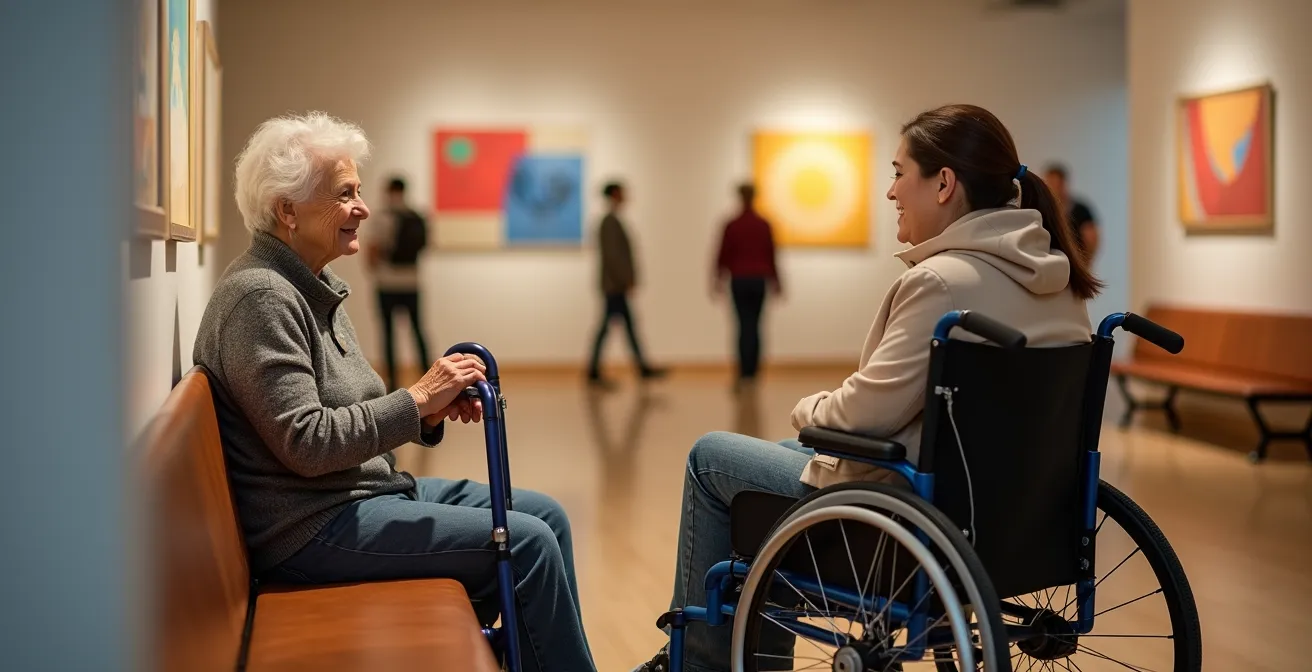
As the image above illustrates, a thoughtfully designed rest area provides more than just a place to sit; it offers a moment of genuine comfort and social connection. The specifications matter: accessible seating should ideally have a height of around 760mm with clear space underneath to accommodate those who need to stretch their legs or park a walker. The proximity of seating to restrooms is another crucial, often-overlooked detail.
Before any visit, call the venue’s accessibility coordinator and ask for a map of their seating locations. If one doesn’t exist, it’s a major red flag. By planning the route around guaranteed rest stops, you transform the environment from a potential endurance test into a welcoming and manageable space for everyone.
Charter Bus vs Carpool: Which Is Safer for a Group of 10 Seniors?
Transportation is often the first and last experience of any outing, setting the tone for the entire day. For a group of 10 seniors with mixed mobility, the choice between a coordinated charter bus and a multi-car carpool has significant implications for safety, comfort, and stress. While carpooling may seem cheaper or more flexible, it introduces numerous variables that increase risk and logistical complexity.
The primary concern is the transfer risk. A carpool with 3-4 cars could involve 6-8 transfers (from home to car, from car to destination, and back again). Each transfer is a moment of potential instability and a major expenditure from the participant’s energy budget. Assistance quality will vary between volunteer drivers, and mobility aids may be awkwardly stored or even left behind. In contrast, a charter bus with a professional driver and a wheelchair lift consolidates this risk. Participants transfer only twice, with trained assistance, and all equipment is stored centrally.
An analysis of senior group transportation by HealthLift NEMT in Arizona provides compelling evidence. Their findings showed that using charter buses equipped with wheelchair lifts reduced fall incidents by an astounding 73% compared to carpool arrangements. The centralized approach also eliminated errors in medication timing and reduced participant anxiety about logistics. The following table breaks down the key safety and logistical differences:
| Safety Factor | Charter Bus | Carpool (3-4 cars) |
|---|---|---|
| Transfer Risk | 2 transfers total (start/end) with professional assistance | 6-8 transfers with variable assistance quality |
| Equipment Storage | Centralized undercarriage storage for all mobility aids | Distributed across multiple trunks, risk of items left behind |
| Driver Vetting | Single professional driver with commercial license | Multiple volunteer drivers with varying experience |
| Group Cohesion | All participants together, easy communication | Group fragmented, coordination challenges |
| Emergency Response | Single point of contact, professional protocols | Multiple vehicles to coordinate in emergency |
Ultimately, a charter bus transforms transportation from a logistical challenge into a seamless part of the social experience. It keeps the group cohesive, allows the organizer to focus on participants rather than coordinating drivers, and provides a single, reliable point of contact in an emergency. For safety and peace of mind, it is the superior choice.
How to Structure an Outing Day to Minimize Fatigue and Maximize Fun?
A successful outing is not about the duration but the rhythm. The key to maximizing fun while minimizing fatigue is to structure the day’s energy expenditure like a bell curve: a gentle start, a peak activity in the middle, and a calm wind-down. This approach, known as an energy-conscious schedule, respects the natural ebbs and flows of stamina in a mixed-mobility group and prevents the day from ending in exhaustion.
Instead of jumping straight into the main event, the day should begin with a low-energy activity. A scenic drive to the destination or a relaxed coffee stop allows for social warming-up without physical strain. The main attraction—the museum tour, the garden walk, the theater show—should be scheduled for mid-morning to early afternoon, when energy levels are typically at their highest. This is the « peak » of your bell curve.
Following the peak activity, a dedicated and extended break is non-negotiable. Lunch should be more than just a meal; it’s a strategic recovery period. Choose a venue with ample, comfortable seating and quieter spaces for those who need to decompress. The afternoon should then transition to structured free time with clear, low-exertion options, such as « browse the gift shop OR relax in the shaded courtyard. » This provides autonomy without inducing decision fatigue. Finally, the day concludes with a gentle wind-down activity and a calm departure, avoiding any last-minute rushes. This structure includes:
- Low-Energy Start: Gentle social activity like a scenic drive or coffee (9-10 AM).
- Peak Activity: The main attraction, scheduled when energy is highest (10 AM-12 PM).
- Extended Recovery: A long lunch break with quiet spaces (12-1 PM).
- Structured Free Time: Low-exertion choices like a garden walk or a rest area (1-3 PM).
- Gentle Wind-Down: A final, calm activity like browsing a shop before departure (3-4 PM).
Your 5-Point Outing Route Audit Checklist: Engineering a Fatigue-Proof Path
- Path of Travel: List all key « contact points » on the planned route, from the vehicle drop-off to the main exhibit, restrooms, and cafe.
- Rest Stop Inventory: Audit the path between each contact point, mapping guaranteed seating locations to ensure a rest stop is available every 100-200 feet.
- Seating Suitability Check: Verify that identified seats meet senior needs: Do they have back support? Are there armrests to assist with standing? Is the height appropriate?
- Proximity & Flow Analysis: Measure the walking distance from the main activity area to the nearest accessible restroom and the nearest designated rest zone. Identify potential bottlenecks.
- Pacing Plan Integration: Use your completed audit map to build scheduled 10-minute rest stops directly into the itinerary, turning potential friction points into planned moments of recovery.
This deliberate scheduling transforms the outing from a test of endurance into a truly pleasurable experience, ensuring that participants return home with fond memories, not a sense of depletion.
Wheelchair Van vs Standard Car: Which Is Better for a 2-Hour Trip?
For a wheelchair user, the choice between a standard car and an accessible van for a two-hour trip is not just about convenience; it is a critical decision that directly impacts their energy and dignity. The hidden cost of using a standard car is the transfer fatigue. The process of moving from a wheelchair to a car seat and back again is physically demanding, often requiring significant effort from both the individual and a caregiver. This effort is a major withdrawal from their limited energy budget before the outing has even begun.
A study on the impact of transfers on senior travel revealed a stark difference. The analysis found that using a wheelchair-accessible van, which eliminates the need for transfers, preserves approximately 40% more of a person’s energy for the destination’s activities. Participants who remained in their customized wheelchairs throughout the journey also reported 60% higher satisfaction with the overall experience. Their personal wheelchair is often a highly customized piece of equipment, providing specific postural support and pressure relief that a generic car seat cannot replicate.
When deciding on transportation, consider the following factors:
- Energy Expenditure: Two 10-minute transfers can consume the energy equivalent of 30 minutes of light activity. An accessible van saves this energy for the destination.
- Medical Stability: Remaining in a prescribed, custom-fitted wheelchair reduces the risk of pressure sores and maintains proper spinal alignment, which is crucial on longer trips.
- Caregiver Proximity: A van often allows a caregiver to sit adjacent to the wheelchair user, making it easier to provide assistance with a drink, adjust a blanket, or simply offer company.
- Dignity and Comfort: Eliminating the transfer process, which can be awkward and physically exposing in public, preserves the individual’s sense of dignity and reduces anxiety.
While a standard car may suffice for a very short errand, for any trip approaching an hour or more, a wheelchair-accessible van is unequivocally the better choice. It redefines the journey from a stressful necessity into a comfortable and dignified part of the day’s adventure.
How to Assess Your Neighborhood Terrain Before Buying a Mobility Aid?
While this guide focuses on group outings, the foundation of safe community travel begins with the individual’s preparedness. A crucial, often-overlooked step is assessing one’s immediate environment *before* an outing, or even before purchasing a mobility aid. A walker that glides effortlessly on a smooth store floor may become a significant liability on a cracked sidewalk or a steep curb cut. Understanding the local terrain is essential for both the senior and the group organizer.
Encouraging participants to conduct a personal terrain audit of their own neighborhood is a proactive step towards safer group travel. This involves more than a casual stroll; it’s a systematic test of how their current (or potential) mobility aid interacts with the real world. This helps set realistic expectations for what they can handle on a group outing and informs the group leader about potential individual limitations.
A practical terrain testing protocol should include the following steps:
- Map a Test Route: Chart a 15-minute loop from their home that includes common challenges like sidewalks, curb cuts, grassy areas, and gentle slopes.
- Document Obstacles: Note specific issues like the height of curb lips, the width of sidewalk cracks, or the grade of a ramp. These are the points of logistical friction.
- Time Navigation: Measure how long it takes to cross different surfaces (pavement vs. gravel vs. grass) to establish personal speed and endurance baselines.
- Identify Rest Points: Note the exact locations where rest is needed. This data is invaluable for planning pacing on a longer group outing.
- Test Equipment Features: Check the stability of a walker’s basket, a cane’s grip on wet pavement, or a scooter’s turning radius.
By testing their equipment and endurance in a familiar environment, seniors can join group activities with a confident and realistic understanding of their capabilities. This self-knowledge is one of the most important safety tools they can bring to any community outing.
Key Takeaways
- True accessibility is an engineered experience, not a label on a building. Focus on designing a « fatigue-proof » journey.
- The « energy budget » is your most important planning metric. Prioritize a single, high-quality activity over a packed itinerary.
- Every transfer has a physical and mental cost. Centralized transport like a charter bus minimizes this « transfer cost » and significantly enhances safety.
How PSWs Facilitate Safe Out-of-Home Travel for Seniors with Mobility Issues?
For many seniors with significant mobility challenges, the presence of a professional Personal Support Worker (PSW) is the deciding factor that makes community participation possible. A PSW is far more than a helper; they are a trained facilitator, a safety expert, and a discreet advocate who manages the logistical and personal challenges that can cause immense anxiety. Their role is to absorb the « cognitive load » of the outing, allowing the senior to simply enjoy the experience.
PSWs are trained in safe transfer techniques, medication management, and recognizing early signs of fatigue or distress. A study from the Mid-Atlantic ADA Center highlights their impact, finding that senior groups accompanied by trained PSWs experienced 85% fewer medical incidents and reported 90% higher participant satisfaction. This is because PSWs act in real-time to mitigate logistical friction, whether it’s requesting a restaurant to move a table for better access or finding a quiet corner when a participant becomes overstimulated.
One of the most crucial but least discussed functions of a PSW is the preservation of dignity. Public outings can present potentially embarrassing situations related to toileting or personal care. A professional is equipped to handle these moments with grace and discretion. As noted in Cornell University’s accessibility guidelines:
PSWs are trained to handle potentially embarrassing situations with professionalism and discretion. They often carry a ‘dignity kit’ with wipes and change of clothes, managing situations without drawing attention
– Cornell Human Resources Accessibility Guidelines, Accessible Meeting and Event Checklist – Cornell University
This level of support frees the senior from the fear of « what if, » which is often the biggest barrier to leaving home. It also relieves family members or volunteer organizers from responsibilities they may not be equipped to handle.
Incorporating PSWs into your planning, or ensuring participants who need one have access, is not an added luxury. It is a fundamental component of creating a truly inclusive, safe, and stress-free outing for those with the most complex needs.