
Choosing a mobility aid is not about admitting weakness; it’s about gearing up for adventure.
- Your neighborhood terrain—not just your medical condition—dictates the best equipment for you.
- Proper fitting is a non-negotiable step to prevent secondary injuries and maximize performance.
Recommendation: Start by performing a detailed assessment of your most common outdoor routes before you even consider a specific product.
The transition to using a mobility aid can feel daunting, a sign that the world is shrinking. For many seniors finding walking more difficult, the response is often to stay inside, where the environment is predictable and safe. The common advice revolves around preventing falls, a crucial but fear-centric approach that can inadvertently reinforce the very isolation it aims to prevent. We are told to talk to our doctors and choose a device, but the conversation often stops there.
But what if we reframed the entire concept? What if choosing a cane or a walker wasn’t a concession to limitation, but a strategic selection of performance gear? Like a hiker choosing the right boots for a rugged trail, selecting a mobility aid is about equipping yourself to master your outdoor environment. This is not about simply getting around; it’s about reclaiming your territory with confidence and technical skill. This approach shifts the focus from what you can no longer do to what you can now achieve with the right tool.
This guide will walk you through the technical process of selecting the right outdoor mobility gear. We’ll start by understanding the psychological cost of staying indoors, then move to a tactical assessment of your environment, the critical biomechanics of a proper fit, and the specific equipment features that turn a simple device into a key for unlocking the world outside your door.
To navigate this technical selection process, this guide is structured to build your expertise step-by-step. The following summary outlines the key stages we will cover, from initial assessment to advanced customization.
Summary: Your Technical Guide to Outdoor Mobility Gear
- Why Staying Inside Due to Mobility Issues Destroys Mental Health?
- How to Assess Your Neighborhood Terrain Before Buying a Mobility Aid?
- The Fitting Error That Causes Back Pain When Using a New Device
- Renting vs Buying: Which Makes Sense for Short-Term Recovery?
- When to Upgrade From a Cane to a Walker: The Safety Signals to Watch
- Solo Routine vs Group Classes: Which Works Best for Introverted Seniors?
- Why « Travel Is Too Dangerous » Is a Myth That Shrinks Your World?
- Which Adjustable Cane Accessories Prevent Slips on Icy or Wet Surfaces?
Why Staying Inside Due to Mobility Issues Destroys Mental Health?
The decision to avoid going outside due to mobility concerns initiates a destructive feedback loop. This isn’t just about missing a bit of fresh air; it’s a psychological spiral known as the « fear-avoidance cycle. » The initial fear of a potential fall is a powerful motivator for inaction. According to data from the CDC, more than 1 out of 4 people ages 65 and older has a fall each year, making this fear entirely rational. However, the response to this fear—activity avoidance—is what truly causes harm.
When you stop walking on varied surfaces, your muscles begin to decondition. Your sense of balance, a skill that requires constant practice, starts to degrade. Paradoxically, staying inside to avoid a fall makes you physically less capable of preventing one. As an analysis of this phenomenon points out, this deconditioning increases the actual risk of falling, which in turn reinforces the initial fear. The world feels more dangerous, the desire to stay home grows stronger, and the cycle tightens its grip, leading to social isolation, depression, and a profound loss of independence.
Breaking this cycle requires a tool, a piece of gear that restores confidence by providing real, tangible stability. A properly chosen mobility aid isn’t a symbol of decline; it’s the key that unlocks the door to the outside world and shatters the fear-avoidance cycle. It allows you to re-engage with the very activities that maintain your physical strength and mental well-being, turning a vicious circle into a virtuous one where activity builds capacity and confidence.
How to Assess Your Neighborhood Terrain Before Buying a Mobility Aid?
Before you even look at a single product, you must become a technician of your own environment. Choosing the right mobility gear is less about your diagnosis and more about the terrain you plan to conquer. A walker that glides effortlessly on a hospital’s linoleum floors may become a cumbersome trap on a cracked sidewalk or a grassy park shortcut. A thorough terrain assessment is the most critical step in your selection process.
Think like an outdoor expedition planner. Your mission is to map the challenges and opportunities in your daily routes. This involves more than a casual glance; it requires systematic data collection. Pay close attention to surface transitions, slopes, and potential obstacles. The goal is to build a « terrain profile » that will inform the technical specifications of your ideal equipment, especially the wheels. For instance, the difference between a walker and a rollator is significant here: a walker offers maximum stability but must be lifted, while a rollator with wheels provides continuous movement but requires more braking control on slopes. The type of wheel on a rollator dramatically affects its performance.
The following table illustrates how different wheel types perform on various surfaces. This data is critical for matching your gear to your specific environment.
| Wheel Type | Indoor Floors | Sidewalks | Grass/Gravel | Wet Surfaces |
|---|---|---|---|---|
| Small Solid (5-6″) | Excellent | Good | Poor | Fair |
| Large Solid (8″) | Good | Excellent | Fair | Good |
| Pneumatic (Air-filled) | Good | Excellent | Excellent | Very Good |
| Foam-filled | Good | Very Good | Good | Good |
As this comparative performance data shows, a rollator with small, solid wheels is a poor choice for anyone wanting to cross a park, whereas one with pneumatic (air-filled) tires offers superior versatility for an adventurous user. To conduct your own assessment, use the following checklist.
Your Action Plan: Terrain Assessment Checklist
- Evaluate sidewalk conditions: Document cracks, uneven surfaces, and significant cross-slopes on your typical routes.
- Measure curb heights: Identify where curb cuts are available and where you’ll need to navigate a full curb.
- Test varied surfaces: Intentionally walk over grass patches, gravel areas, and packed dirt paths to feel the difference.
- Assess thresholds and ramps: Check the entrances to stores, your library, or friends’ homes for any barriers.
- Map weather challenges: Note areas where puddles form, ice accumulates, or leaves become slippery when wet.
The Fitting Error That Causes Back Pain When Using a New Device
One of the most common and damaging mistakes in adopting a mobility aid is improper fitting. An incorrect height setting doesn’t just reduce the device’s effectiveness; it actively creates new physical problems. A walker or rollator set too low forces you to hunch over, placing immense strain on your lumbar spine and shoulders. Conversely, a setting that is too high forces your shoulders up toward your ears, creating neck tension and reducing your control over the device. This isn’t a matter of comfort—it’s a fundamental issue of biomechanics.
The correct height for a walker or cane is determined by your posture. When you stand upright with your arms hanging naturally at your sides, the top of the handgrips should align with the crease in your wrist. This allows for a slight, 20-30 degree bend in your elbow when you hold the grips. This specific angle is crucial because it allows you to maintain an upright posture while still being able to put weight on the device for support without locking your elbow joint. Getting this right prevents the back pain that so many new users mistakenly attribute to the device itself, rather than to its incorrect setup.
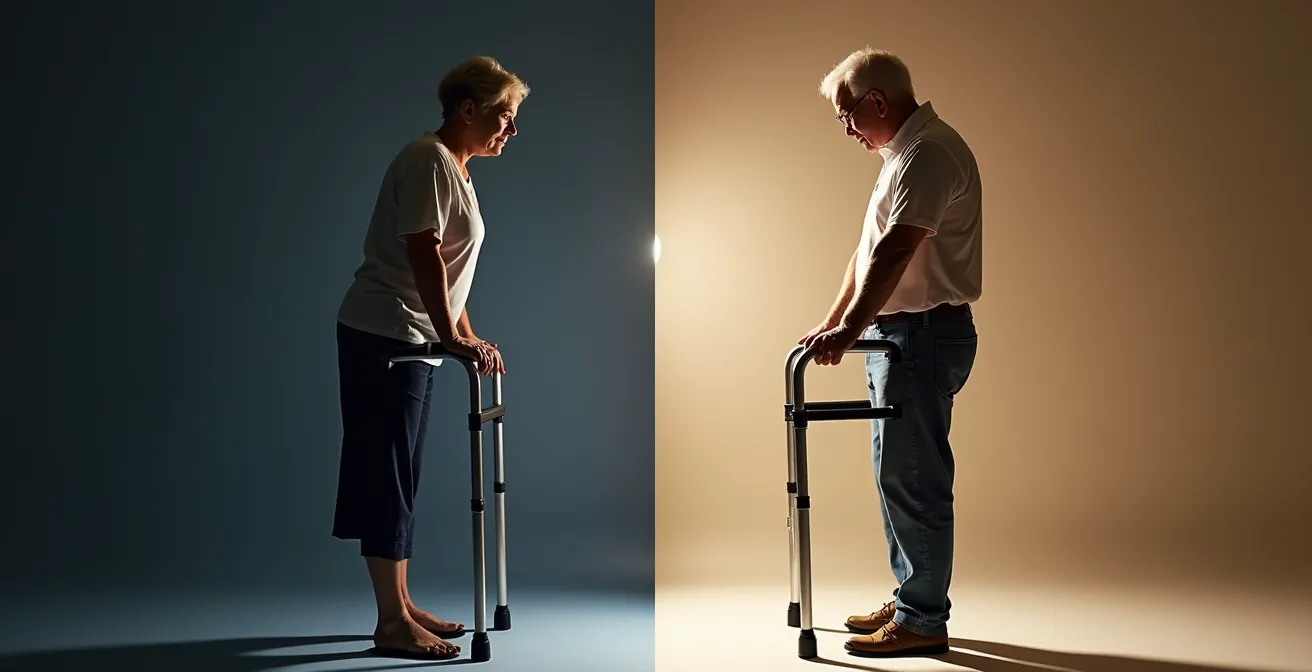
As the visual comparison shows, proper alignment is everything. It’s the difference between a tool that supports you and one that injures you. Nancy Froslie, a certified Assistive Technology Professional, emphasizes that a one-size-fits-all approach is dangerous. A proper fitting requires a mobility assessment to evaluate gait, balance, and muscle strength. This ensures the equipment is tailored to your body’s specific mechanical needs, not just a generic height chart. Don’t guess; get it professionally measured or follow the wrist-crease guideline with meticulous care.
Renting vs Buying: Which Makes Sense for Short-Term Recovery?
The decision to rent or buy a mobility aid is a strategic one, primarily driven by your expected duration of use. For short-term recovery, such as after a surgery or a temporary injury, renting is almost always the more logical and cost-effective choice. It provides immediate access to high-quality equipment without the long-term financial commitment. This is especially true for larger, more expensive items like hospital beds, patient lifts, or specialized wheelchairs.
Renting offers flexibility. As your recovery progresses, your needs may change. You might start with a walker and transition to a cane. Renting allows you to swap out equipment easily to match your current functional level. Furthermore, rental companies are typically responsible for maintenance and repairs, removing that burden from you during a period when your focus should be on healing. The upfront cost is significantly lower, and it prevents you from being left with a bulky piece of equipment you no longer need once you’ve recovered.
However, the rental market requires due diligence. You are entrusting your safety to a piece of equipment that others have used. It’s crucial to partner with a reputable company. Before signing any rental agreement, you must ask a series of critical questions to ensure the equipment is safe, sanitary, and reliable. A professional provider will have clear, confident answers to these inquiries.
To ensure you make an informed choice, here are five essential questions to ask any rental company:
- What is your sanitization process between rentals?
- Do you offer emergency replacement if the device breaks down?
- What are the delivery and pickup logistics and associated fees?
- Is insurance available to cover potential damage or loss during the rental period?
- Can any portion of the rental fees be applied toward the purchase price if I decide to keep the device?
When to Upgrade From a Cane to a Walker: The Safety Signals to Watch
The progression from a cane to a walker is a critical safety decision, not a sign of failure. A cane is excellent for providing a single point of support to aid balance or relieve pressure from one leg. However, it has its limits. The most important safety signal that it’s time to upgrade is when you find yourself consistently seeking a second point of support. This is what medical professionals call the « third point of contact » rule.
If you’re using a cane but also find yourself reaching for walls, touching furniture, or leaning on shopping carts as you move, your cane is no longer providing sufficient stability. As a guideline from the American Academy of Family Physicians highlights, this behavior is a clear indicator that one additional contact point is no longer sufficient for safe mobility. A walker provides a much wider and more stable base of support, effectively creating a « mobility zone » around you. Ignoring these signals and continuing with only a cane when you need more support drastically increases your fall risk.
Other signals include a change in gait, such as shuffling, or a noticeable decrease in endurance where you feel fatigued after short distances. Pain in your supporting wrist or arm can also indicate that you’re putting too much weight on the cane. It’s crucial to view this upgrade proactively. In fact, some research indicates that early walker adoption can significantly lower the chance of a fall by providing support before a crisis occurs. This is not giving in; it is gearing up for a higher level of safety and confidence, allowing you to continue your outdoor activities with a more appropriate tool for the job.
Solo Routine vs Group Classes: Which Works Best for Introverted Seniors?
Staying active isn’t just a physical challenge; it’s a psychological one. For seniors who identify as introverted, the common advice to « join a group class » can be more draining than energizing. The pressure of social interaction can become a barrier to the activity itself. The key for an introverted person is not to force extroversion, but to find a sustainable model of activity that respects their social energy levels. A hybrid approach often works best, combining the comfort of solo routines with low-stakes group activities.
The foundation of this model is a consistent solo routine. This could be a daily morning walk, home exercises, or gardening. These activities build a reliable baseline of fitness and movement without any social demands. They provide consistency and a sense of personal accomplishment. However, complete isolation is not the goal. The « hybrid » part involves strategically adding a small dose of community.
A highly effective concept for this is « parallel play, » a term borrowed from child psychology. It describes being active in a space with others without the pressure of direct interaction. For introverted seniors, this can be a game-changer. Activities like walking in a public park, visiting a museum, or joining a bird-watching club allow for a sense of community presence while the focus remains on an external task, not small talk. These activities often have natural endpoints, giving the individual full control over the duration of their social exposure. By combining a daily solo routine with one or two « parallel play » group activities per week or month, introverts can gain the health benefits of both movement and community without feeling depleted.
Why « Travel Is Too Dangerous » Is a Myth That Shrinks Your World?
The belief that travel becomes too dangerous with age or mobility challenges is one of the most pervasive myths that needlessly shrinks a person’s world. While travel does require more planning, modern technology and the right mindset can make it not only possible but also profoundly rewarding. The danger is not in the travel itself, but in a lack of preparation. With the right strategy, you can achieve environmental mastery, whether your destination is across town or across the country.
The first step in debunking this myth is to replace fear with data. Before you go, become an « accessibility detective. » Call hotels, restaurants, and attractions directly. Do not rely on vague website descriptions like « accessible. » You need specific, measurable information. Ask questions like, « What is the exact width of the bathroom doorway? » and « How many steps are there to enter the building, and is a ramp available? » This pre-travel intelligence gathering turns unknown variables into a concrete plan of action, eliminating surprises and building confidence.
The second key is understanding that modern mobility aids are no longer cumbersome medical devices; they are sophisticated pieces of travel-ready performance gear. There are now ultra-lightweight carbon fiber rollators that weigh less than 11 pounds and fold with one hand. Folding mobility scooters with airline-approved lithium batteries can break down to the size of a suitcase. Collapsible canes can fit in a purse or backpack. These innovations are designed specifically to overcome the traditional barriers of travel. The world isn’t too dangerous; our old ideas about equipment are simply outdated.
Here is a short script of essential questions to ask when doing your pre-travel accessibility check:
- What is the exact height of the shower lip or tub edge?
- Are there any steps to enter the building, and if so, how many?
- What is the width of the narrowest doorway I’ll need to pass through?
- Is there a ramp available, and can you describe its slope?
- How far is the accessible parking from the main entrance?
- Are there grab bars in the bathroom, and where are they positioned?
Key Takeaways
- Treat your mobility aid as performance gear, not a medical device.
- Your local terrain—sidewalks, grass, curbs—is the most important factor in your selection.
- An improper fit is not just uncomfortable; it’s a direct cause of secondary back and shoulder injuries.
Which Adjustable Cane Accessories Prevent Slips on Icy or Wet Surfaces?
For a cane user, the point of contact with the ground—the tip—is the most critical safety component, especially in adverse weather. A standard rubber tip that works perfectly on dry pavement can become a dangerous liability on a wet tile floor or an icy sidewalk. Customizing your cane with a specialized tip is a technical upgrade that provides a massive return in safety and confidence. It’s the equivalent of putting winter tires on your car.
There are several categories of high-performance cane tips designed for specific surfaces. For general stability, a quad-tip base provides a much larger footprint, standing on its own and reducing the risk of slipping on uneven ground. For winter conditions, the essential accessory is a retractable ice-tip. This device features a metal spike or claw that can be flipped down to bite into ice and packed snow, providing crucial traction. When you go indoors, it flips back up to prevent damage to floors.

For all-weather, all-terrain versatility, a pivoting or flexible tip is an excellent innovation. These tips have a broad, flexible base that stays in full contact with the ground even when the cane is held at an angle. This maximizes grip on wet, slippery, or uneven surfaces, mimicking the action of a human ankle. The choice of tip is a technical decision that should be based on your climate and the surfaces you most frequently encounter.
The following data provides a clear comparison of how these specialized tips perform under different conditions, a crucial factor in your decision-making.
| Tip Type | Dry Pavement | Wet Tile | Ice/Snow | Carpet | Replacement Frequency |
|---|---|---|---|---|---|
| Standard Rubber | Good | Fair | Poor | Good | 6-12 months |
| Quad-Tip Base | Excellent | Good | Fair | Fair | 12-18 months |
| Ice-Tip (Retractable Spike) | Good | Good | Excellent | Poor | 2-3 years |
| Pivoting/Flexible | Very Good | Very Good | Good | Excellent | 8-12 months |
As this analysis of cane tip performance demonstrates, relying on a standard tip in winter is a significant risk. Investing in a specialized accessory is a small price for a dramatic increase in safety.
By viewing your mobility aid as a piece of high-performance equipment and making informed, technical choices based on terrain, fit, and customization, you are not just preventing falls. You are actively equipping yourself for the adventure of an active, engaged life. The next step is to apply this technical mindset to your own situation and select the gear that will open your front door to the world.