
Successfully retrofitting a multi-story home for aging in place requires a systemic architectural plan, not just a series of isolated modifications.
- Prioritizing a ground-floor master suite often provides a more sustainable and valuable solution than relying solely on stair-navigation devices.
- True accessibility lies in understanding spatial requirements, such as turning radiuses and clear door widths, which standard homes often lack.
Recommendation: Begin with a comprehensive home assessment to create a phased, budget-conscious master plan that addresses current and future mobility needs.
The family home, filled with decades of memories, often becomes a significant challenge as we age. For seniors in two-story houses, the very architecture that once defined the home’s character—the central staircase—can become the primary obstacle to living safely and independently. The common response is to look for quick fixes: a stairlift, better handrails, or simply avoiding the second floor altogether. This approach, however, often overlooks the fundamental issue: the house is no longer functioning as a cohesive, safe system for its inhabitant.
True aging-in-place retrofitting goes beyond surface-level adjustments. It’s an architectural and strategic process. It involves rethinking the flow of daily life and reconfiguring space to support, rather than hinder, mobility. While assistive devices have their place, the core of a successful project lies in systemic changes like creating a fully functional ground-floor living space. This guide moves beyond the simple checklist to explore the structural and design decisions that create a truly safe, comfortable, and valuable home for the long term. We will analyze the « why » behind accessibility standards and provide a framework for creating a master plan that works for both your safety and your budget.
To provide a more immersive look into the importance of creating supportive environments, the following video touches on the vital theme of seeing individuals beyond their age.
This article provides a structured approach to this complex project. From understanding the core risks to planning a budget-conscious conversion, each section is designed to build on the last, providing you with a complete architectural perspective on making your home safe for years to come.
Summary: A Strategic Guide to Retrofitting Your Two-Story Home
- Why Stairs Become the Most Dangerous Feature After Age 75?
- How to Convert a Dining Room Into a Code-Compliant Master Suite?
- The Bathroom layout Error That Makes It Impossible to Use a Walker
- Stairlift vs Home Elevator: Which Adds More Value and Safety?
- How to Use Smart Home Monitoring to Secure a Large House?
- Why a 32-Inch Door Isn’t Actually 32 Inches Wide (and Why It Matters)?
- Home Recovery vs Rehab Facility: Which Is Safer for Stability?
- How to Create a Master Plan for Making Your Home Accessible on a Budget?
Why Stairs Become the Most Dangerous Feature After Age 75?
For most of our lives, stairs are a simple transition between levels. After 75, however, they transform into a significant daily hazard. This isn’t just a matter of decreased strength; it’s a combination of physiological changes that fundamentally alter our ability to navigate them safely. Vision, balance, and proprioception (our sense of body position) naturally decline with age. In fact, studies show that approximately one third of seniors over 65 have reduced vision, making it harder to judge step depth and identify potential trip hazards.
A single misstep can lead to a fall, which is the leading cause of fatal and non-fatal injuries among older adults. The vertical nature of stairs amplifies the consequences of even a minor loss of balance. What might be a stumble on a flat surface can become a catastrophic event on a staircase. This risk is compounded by factors like carrying objects, poor lighting, or the side effects of medications that can cause dizziness. The constant mental and physical energy required to safely use stairs can lead to fatigue and anxiety, effectively trapping an individual on one floor of their home and cutting them off from essential spaces like their primary bedroom or bathroom.
While immediate fixes like installing sturdy handrails on both sides, applying non-slip stair treads, and improving lighting with motion sensors are critical first steps, they are often just treating the symptoms. The underlying issue is that the home’s design forces a daily confrontation with its most dangerous feature. A truly effective aging-in-place strategy must therefore address the core problem: the dependency on vertical travel for daily living. This requires a shift in thinking from simply making stairs « safer » to questioning if they need to be used at all.
How to Convert a Dining Room Into a Code-Compliant Master Suite?
The most effective strategy to eliminate the daily risk of stairs is to create a fully independent living space on the ground floor. Converting a rarely used dining room or den into a master suite is often the most logical and value-adding solution. As Great Day Improvements notes in their « Aging in Place Renovations Report, » this addresses the core architectural barriers seniors face:
Two-story living, lack of shower stalls, and narrow corridors are just a few obstacles that seniors face in their current homes.
– Great Day Improvements, Aging in Place Renovations Report
However, this is not as simple as placing a bed in a room. A successful conversion is a small-scale construction project that must adhere to building codes to be safe, legal, and functional. Key requirements include an egress window (a window large enough to serve as an escape route in a fire), a closet, and proper electrical wiring. The most complex and costly part is adding a bathroom, which requires tying into the home’s existing plumbing and ventilation systems. This is where professional planning is non-negotiable.
The scope of the project can be phased to match your budget and needs. A basic bedroom conversion is the most affordable, but adding a bathroom, especially a full bath with a curbless shower, provides the greatest degree of independence and significantly increases the home’s resale value as a flexible living space. It’s crucial to consult with a contractor who is also a Certified Aging-in-Place Specialist (CAPS) to ensure the layout, fixtures, and finishes are designed for accessibility from the start.
The following table, based on an analysis from Paragon HomeCare, outlines the typical scope and investment for such a project. This helps in understanding the different levels of commitment and creating a realistic budget.
| Conversion Type | Average Cost | Time Frame | Key Requirements |
|---|---|---|---|
| Basic Bedroom Only | $5,000-$15,000 | 2-4 weeks | Egress window, smoke alarm, closet space |
| Bedroom + Half Bath | $15,000-$35,000 | 4-6 weeks | Plumbing tie-in, minimum 30 sq ft for bath |
| Full Suite with Shower | $35,000-$60,000 | 6-8 weeks | Full plumbing, waterproofing, 5ft turning radius |
The Bathroom layout Error That Makes It Impossible to Use a Walker
When designing an accessible bathroom, either as part of a new suite or by retrofitting an existing one, a common and critical error is focusing only on fixtures while ignoring spatial layout. It is possible to have a bathroom with grab bars, a comfort-height toilet, and a walk-in shower that is still functionally unusable for someone with a walker or wheelchair. The mistake is a failure to provide an adequate turning radius.
Mobility devices don’t just move forward and backward; they need space to turn around. The industry standard for accessibility, derived from ADA guidelines, calls for a five-foot (60-inch) diameter clear floor space. This « turning circle » allows a user to enter the bathroom, close the door, and maneuver to use the toilet or approach the sink and shower without being trapped in a series of multi-point turns. In many standard bathrooms, the placement of the toilet, vanity, and door swing creates obstacles that encroach upon this essential clear space, rendering the room a frustrating and dangerous trap.
To achieve this, an architect or CAPS designer might use several strategies. A wall-mounted sink, for instance, frees up floor space that a traditional vanity would occupy. Replacing a standard swing-in door with a pocket door or an outward-swinging door can instantly add critical square footage inside the bathroom. The goal is to create an open, unobstructed path between the door, toilet, and shower. This single element—the turning radius—is more important than any single fixture and is the true hallmark of a professionally designed accessible space.
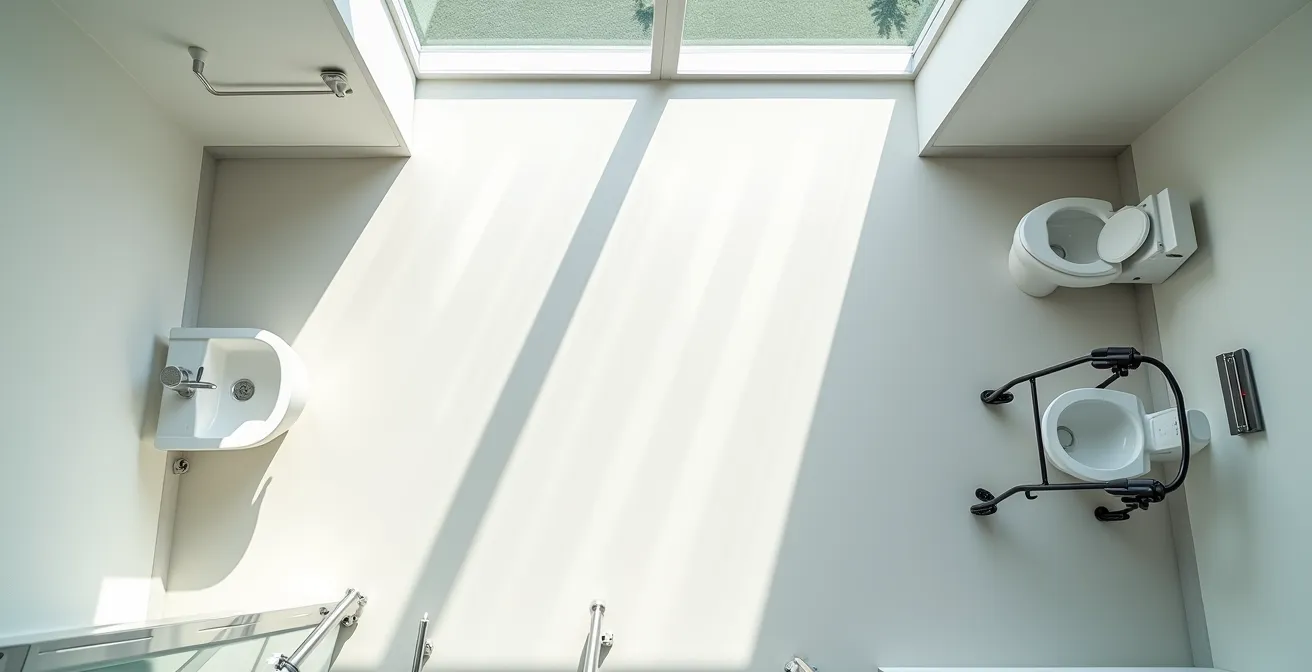
As the visual demonstrates, it’s the empty space that makes a bathroom functional. Planning for this clearance from the beginning of a renovation project prevents costly mistakes and ensures the bathroom provides genuine safety and independence, rather than just the appearance of accessibility.
Stairlift vs Home Elevator: Which Adds More Value and Safety?
When creating a ground-floor suite isn’t feasible, the focus returns to navigating the stairs. The two primary mechanical solutions are a stairlift and a residential elevator. While a stairlift is often seen as the default, more affordable option, the decision should be based on a careful analysis of long-term safety, usability, and property value.
A stairlift is a chair that travels along a rail mounted to the stair treads. It is the least invasive and most cost-effective solution for overcoming the immediate problem of stair navigation. However, it has significant limitations. The user must be able to safely get on and off the chair at both the top and bottom of the stairs, which can be a difficult transfer. It doesn’t transport a walker or wheelchair, and it can be a barrier for other family members using the stairs. From a real estate perspective, stairlifts rarely add value and are often seen as a liability that new buyers will want removed.
A home elevator, while a much larger initial investment, is a more comprehensive and permanent solution. It addresses mobility systemically. An elevator can transport a person, a caregiver, and a mobility device like a walker or wheelchair simultaneously. It provides a safer transfer on a level surface and can be used to move laundry or other heavy items between floors. Unlike a stairlift, a well-integrated home elevator can significantly increase a property’s resale value, positioning it as a luxury, multi-generational home.
The financial and spatial commitments for each option are vastly different, as the comparative data from NerdWallet below suggests. Please note that costs can vary dramatically based on your home’s structure and the model chosen, so these figures should be seen as a starting point for discussion with a professional installer.
| Feature | Stairlift | Home Elevator |
|---|---|---|
| Average Cost | $2,300 – $24,000 | $2,723 – $5,930 |
| Average Installation | $7,050 | $4,196 |
| Space Required | Existing stairway | 20-25 sq ft shaft |
| Power Outage Backup | Battery operated | Manual lowering option |
| Resale Impact | Often removed by buyers | Can add luxury value |
How to Use Smart Home Monitoring to Secure a Large House?
For seniors aging in place in a large, multi-story home, safety concerns extend beyond just falls. There’s also the risk of forgetting to turn off the stove, missing a medication dose, or a medical emergency going unnoticed. Smart home technology offers a powerful, non-intrusive layer of security and peace of mind for both the senior and their family. It allows for passive monitoring without the feeling of being watched.
Rather than a single device, an effective smart home system is an ecosystem of connected sensors and assistants. For example, doorway sensors can send an alert to a family member if the front door opens at an unusual time, or if a senior enters a room like the bathroom and doesn’t exit within a pre-set timeframe. Bed and chair sensors can notify a caregiver if a loved one gets up in the middle of the night and doesn’t return, suggesting a potential fall. Stove sensors can automatically shut off a burner if it’s been left on too long, preventing a fire. This technology works quietly in the background, preserving dignity and independence.

Furthermore, voice assistants like Amazon Alexa or Google Home are transformative for seniors with mobility challenges. They allow for hands-free control of lights, thermostats, and door locks, reducing the need to get up and move around, which in turn lowers the risk of falls. A senior can check who is at the front door, adjust the temperature, and turn off all the lights in a large house without ever leaving their chair. This is not about creating a « techy » home; it’s about using technology to solve practical, everyday safety challenges.
Your Action Plan: Key Smart Home Safety Integrations
- Install wearables that track vitals and can automatically detect a fall.
- Place sensors on medicine cabinets to confirm that prescriptions are being accessed on schedule.
- Set up bed-exit mats or sensors to get alerts for nighttime wandering or potential falls.
- Install heat and stove sensors to prevent fires from unattended appliances.
- Configure voice assistants (e.g., Alexa, Google Assistant) for hands-free control of lights, locks, and thermostats to minimize movement.
Why a 32-Inch Door Isn’t Actually 32 Inches Wide (and Why It Matters)?
One of the most common and misleading measurements in home accessibility is doorway width. Many assume a standard 32-inch door is adequate for a walker or wheelchair. This is a critical misunderstanding of how accessibility is measured. The crucial dimension isn’t the width of the door itself, but the « clear width »—the actual, usable space available for passage when the door is open to 90 degrees. This is a perfect example of why an architectural mindset is vital for successful retrofitting.
When a standard 32-inch door is open, the thickness of the door itself, plus the space taken up by the hinges and the doorknob, subtracts from the overall width. This typically leaves a clear opening of only 29 to 30 inches. While a person can walk through this, it is often too narrow for a walker and almost always impossible for a wheelchair to navigate without scraping knuckles and damaging the doorframe. This is why many homes with seemingly wide doors are, in reality, inaccessible. An analysis by the Pennsylvania Association of Realtors highlights this issue, noting that many homes’ doorways do not meet the Americans with Disabilities Act accessibility standard of 32 inches of *clear* space.
Achieving a true 32-inch or, ideally, a 36-inch clear opening often requires more than just replacing the door. The entire doorframe may need to be widened, which is a structural modification. However, there are less invasive solutions. Installing offset or swing-clear hinges can be a game-changer. These special hinges are designed to swing the door completely out of the opening, adding up to two inches of precious clear width. This simple, low-cost modification can often be the difference between a usable and an unusable doorway. Replacing traditional doorknobs with lever handles also makes doors easier to operate for those with limited hand strength.
Home Recovery vs Rehab Facility: Which Is Safer for Stability?
After a fall, surgery, or major health event, the question often arises: is it safer to recover in a clinical rehabilitation facility or at home? While rehab centers offer 24/7 medical supervision, there’s a growing body of evidence and a strong personal preference pointing towards the benefits of recovering in a familiar environment—provided the home has been properly prepared. The ultimate goal of retrofitting is to make the home the safest possible option.
The desire to remain at home is nearly universal. An often-cited AARP study confirms this, finding that 76% of adults aged 50 and above desire to stay in their homes throughout their senior years. Recovering at home allows for greater comfort, emotional stability, and a sense of control, which can positively impact the healing process. However, sending a loved one home to an unmodified two-story house is a recipe for readmission. The home itself becomes the primary risk factor. In this context, a rehab facility appears « safer » simply because it is a controlled environment, free of stairs, narrow doorways, and hazardous bathrooms.
A properly retrofitted home flips this equation. By implementing the strategies discussed—such as a ground-floor master suite, a zero-threshold shower, and clear, wide pathways—the home transforms into a personalized and superior recovery space. It allows the individual to practice navigating their own environment with the support of visiting nurses and therapists. This real-world practice is invaluable for building long-term stability and confidence. In a familiar space, there is less disorientation and a lower risk of falls associated with navigating a new, institutional setting. A safe home is not only a place for aging in place, but also the ideal center for healing and rehabilitation.
Key Takeaways
- Systemic Change Over Gadgets: True safety comes from architectural solutions like a ground-floor suite, not just adding devices like stairlifts.
- Space is the Key Feature: Usable clear space, like a 5-foot turning radius in bathrooms and 32-inch clear doorway widths, is more critical than any single fixture.
- Plan for Value, Not Just Cost: A home elevator or a full suite conversion are investments that add long-term usability and property value, unlike temporary fixes.
How to Create a Master Plan for Making Your Home Accessible on a Budget?
The prospect of a major home retrofit can be financially daunting, but it doesn’t have to be an all-or-nothing endeavor. The key to making accessibility affordable is creating a phased master plan. This architectural approach involves prioritizing modifications based on immediate needs and future possibilities, allowing you to spread the cost over time while making meaningful safety improvements at every stage.
A strategic plan typically involves three tiers of investment. The first tier focuses on low-cost, high-impact changes that can be done immediately. This includes installing grab bars in key locations, adding non-slip mats, replacing doorknobs with lever handles, and improving lighting. These initial steps can drastically reduce the risk of falls for a minimal investment. The second tier involves more significant projects, such as converting a tub to a walk-in shower or widening a critical doorway. The final tier encompasses major structural changes like a full ground-floor suite addition or the installation of a home elevator, planned for when mobility needs become more acute or when finances allow.
It’s also crucial to explore financial assistance programs. Many seniors are unaware of the resources available to them. For example, the U.S. Department of Housing and Urban Development (HUD) has programs designed specifically for this purpose. A ConsumerAffairs report highlights that the HUD’s Older Adults Home Modification Program can help pay for home modifications, offering significant grants to eligible low-income seniors. Exploring these options should be a core part of your financial planning.
Action Plan: Your Phased Budgeting Strategy
- Tier 1 (Immediate Safety – Under $1,000): Prioritize installing grab bars in bathrooms, adding high-quality non-slip mats, and replacing all doorknobs with easier-to-use lever handles.
- Tier 2 (Targeted Projects – $2,000-$15,000): Focus on one major upgrade, such as converting a bathtub to a zero-threshold, walk-in shower or widening the primary bathroom doorway using offset hinges.
- Tier 3 (Systemic Changes – $15,000+): Plan for a long-term structural solution like a ground-floor suite conversion or the installation of a home elevator, treating it as a major capital improvement.
- Funding Research: Actively investigate local, state, and federal grant programs like the HUD Older Adults Home Modification Program to offset costs.
- Professional Consultation: Invest in a one-time consultation with a Certified Aging-in-Place Specialist (CAPS) to create a detailed master plan tailored to your specific home and budget.
Transforming your home to support aging in place is one of the most proactive and empowering decisions you can make. It’s an investment in safety, independence, and peace of mind. To begin this process, the next logical step is to seek a professional home accessibility assessment to create a personalized master plan for your unique needs and property.