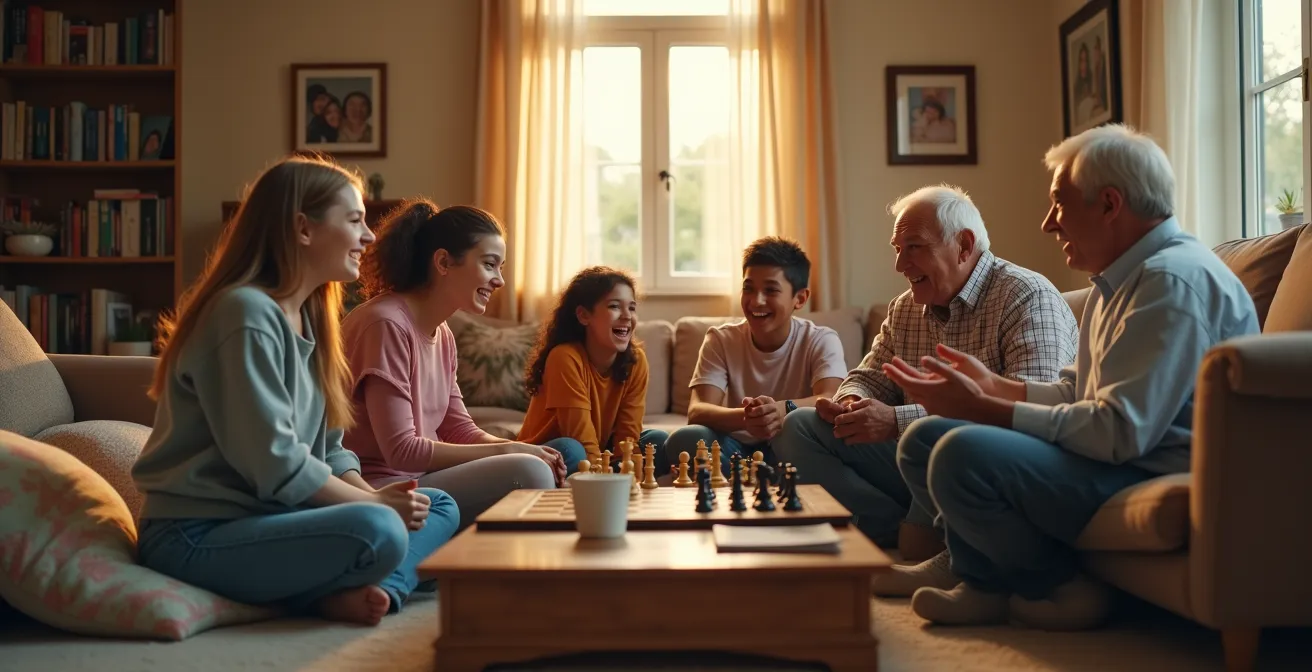
The key to connecting teens and seniors isn’t finding a common interest, but designing interactions where each generation feels seen, valued, and genuinely useful to the other.
- Shift from one-way lectures (« back in my day ») to two-way dialogues by asking engaging questions about the present.
- Embrace « reverse mentorship, » creating opportunities for teenagers to teach seniors valuable skills, from technology to modern music.
Recommendation: Start small. At your next gathering, try using a single structured storytelling prompt or sending a 30-second voice memo instead of making a call.
The scene is familiar: a family gathering, a community event, a holiday dinner. On one side of the room, seniors chat amongst themselves. On the other, teenagers are glued to their phones. The space between them is filled with an awkward silence, broken only by well-meaning but faltering attempts at conversation. We’re often told the solution is to find common ground through shared activities like board games or looking at old photo albums. But these often feel forced, failing to bridge the real gap in experience and communication styles.
The truth is, these conventional methods treat the symptom, not the cause. They focus on the *what*—the activity—without addressing the *how*—the fundamental architecture of the interaction. What if the secret to fostering genuine connection wasn’t about forcing everyone to enjoy the same thing? What if, instead, we could engineer moments of mutual vulnerability, reverse mentorship, and shared purpose that allow both teenagers and seniors to feel not just tolerated, but truly valued and understood?
This guide moves beyond generic advice to offer a practical framework for building those bridges. We will deconstruct the common errors that shut down communication and provide innovative, actionable strategies to create events where every generation leaves feeling energized and more connected than when they arrived. By focusing on the dynamics of the exchange itself, you can turn awkward silences into authentic, lasting bonds.
For those who prefer a visual summary, the following video offers a glimpse into the vibrant energy of a successful intergenerational event, perfectly complementing the practical strategies discussed in this guide.
To help you navigate these innovative strategies, this article is structured to guide you step-by-step from understanding the core principles to implementing them in your own community. Below is a summary of the key areas we will explore.
Summary: A New Blueprint for Intergenerational Connection
- How to Use Storytelling Prompts to Break the « Age Barrier » Silence?
- Why « Kids These Days » Actually Crave Wisdom From Elders?
- The « Back in My Day » Error That Shuts Down Teen Engagement
- Cooking vs Tech Help: Which Activity Bonds Generations Best?
- How Long Should an Intergenerational Event Last to Keep Energy High?
- Texting vs Calling: Which Method Builds Better Bonds With Grandkids?
- The « I’m Too Old for Gaming » Mistake That Keeps You Bored
- How to Foster a Sense of Belonging in Your Neighborhood After Retirement?
How to Use Storytelling Prompts to Break the « Age Barrier » Silence?
The most common hurdle in intergenerational gatherings isn’t a lack of things to say, but the absence of a structure to say them. Simply telling a teen and a senior to « talk » is like giving them ingredients without a recipe. The key is to build a communication architecture that invites, rather than demands, sharing. Instead of asking generic questions (« How’s school? »), which often lead to dead-end answers, using specific, emotionally resonant prompts can unlock deeper conversations.
This approach moves the goal from exchanging facts to sharing perspectives. A question like « What belief have you questioned as you’ve gotten older? » invites vulnerability from both sides and reveals shared human experiences, regardless of age. It creates a space where the elder’s wisdom isn’t a lecture, but a story, and the teen’s perspective is treated with equal weight. This is the foundation of mutual respect.
The power of this method is evident in real-world applications. A compelling example comes from the StoryCorps project, which has documented thousands of conversations across generations. One notable interview between a young dance instructor and an older participant shows how a shared activity became a conduit for profound connection. As described in the intergenerational conversation between Bill Haskell and Liv Schaffer, they discovered unexpected parallels in their experiences with grief and caregiving. The structured interview format allowed them to move beyond surface-level chat and into a space of mutual vulnerability and understanding, proving that the right questions are more important than the right activity.
Why « Kids These Days » Actually Crave Wisdom From Elders?
There’s a pervasive myth that teenagers are inherently dismissive of their elders. The reality is often the opposite: in a world defined by rapid change, economic uncertainty, and digital flux, young people are actively seeking anchors of stability and resilience. They aren’t looking for lectures, but for proof of survival. The stories of elders who navigated their own turbulent times—economic depressions, social upheavals, personal tragedies—serve as a vital psychological roadmap.
This craving for connection is not just anecdotal. Data shows a significant interest from young people in engaging with older generations. For instance, recent information from Generations United reveals that 27.4% of teens aged 16-19 actively volunteer in intergenerational programs. This demonstrates a clear, proactive desire to connect, learn, and contribute across age lines, debunking the stereotype of the apathetic teenager. It suggests that when given a meaningful opportunity, young people will show up.
The key is to frame elder wisdom not as a relic of the past, but as a timeless lesson in resilience. When a senior shares a story about overcoming a challenge, they are providing a powerful, real-world case study that a textbook or a YouTube video cannot replicate. This insight is perfectly captured by a leading organization in the field.
In a world of rapid change and economic uncertainty, teens are looking for proof of resilience. Stories from elders about how they navigated their own periods of uncertainty act as a psychological roadmap.
– Generations United, Because We’re Stronger Together Report
This reframes the act of sharing memories. It’s not about reminiscing for one’s own sake; it’s about offering a gift of perspective and strength to a generation navigating its own set of challenges. When a teen hears how their grandparent handled their first heartbreak or found a job during a recession, they are receiving a powerful message: « You will get through this, too. »
The « Back in My Day » Error That Shuts Down Teen Engagement
Perhaps the single most common communication-killer in intergenerational settings is the « Back in My Day » monologue. While often well-intentioned, this approach frames the past as inherently superior and implicitly criticizes the present. It creates a dynamic of judgment, not connection, and immediately puts teenagers on the defensive. Phrases like « We had to walk five miles to school » or « Kids today don’t know real music » don’t open doors; they build walls.
The solution is a simple but profound shift in framing: turn a statement into a question. Instead of declaring how things were, inquire about how things are now and then offer your own experience as a point of comparison. This transforms a lecture into a legacy-as-dialogue. For example, instead of « We didn’t have phones and we survived, » try « Show me your favorite app. It’s amazing what they can do. When I was your age, my favorite hangout spot was the old diner on Main Street. » This validates their world while creating an opening to share your own.
A successful program by PBS documented how this reframing led to dramatic results. The Clinton Street Senior Center and Pleasantville High School collaboration showed that when seniors learned to ask questions like, « What’s the best and worst part about how you get around today? » teen engagement soared. The following table illustrates just how powerful this shift can be, turning potential conflict into genuine conversation.
| Traditional ‘Back in My Day’ Approach | Bridge-Building Alternative | Teen Response Rate |
|---|---|---|
| ‘We had to walk 5 miles to school’ | ‘What’s your daily commute like? Mine used to be…’ | 68% more engaged |
| ‘Kids today don’t know real music’ | ‘What music speaks to you? Here’s what moved me at your age…’ | 74% more responsive |
| ‘We didn’t have phones and survived’ | ‘Show me your favorite app – I’ll share my favorite teen hangout spot’ | 82% continued conversation |
This data clearly shows that an inquisitive, respectful approach doesn’t just feel better—it works better. It acknowledges that while times change, the core human experiences of commuting, enjoying music, and socializing remain universal.
Cooking vs Tech Help: Which Activity Bonds Generations Best?
The debate over the « best » intergenerational activity often misses the point. It’s not about whether cooking is better than coding; it’s about the dynamic of the activity itself. The most successful interactions are built on a principle of two-way knowledge exchange or « reverse mentorship. » This occurs when both the senior and the teen have something valuable to teach and to learn. The desire for this exchange is widespread, as research from Primrose Retirement Communities reveals that 8 out of 10 adults want to spend time with individuals outside their age groups.
An activity like cooking can be a one-way lecture (« Here’s how you make my famous lasagna ») or a two-way collaboration. To make it collaborative, the senior can share a family recipe while the teen uses their tech skills to film a cooking video for a digital family cookbook or create a QR code that links to the recipe. Suddenly, both participants are experts, and both are learners. This dynamic shifts the power balance, making the teen feel capable and valued, not just like a passive recipient of instruction.

As the image above beautifully illustrates, collaboration creates a natural, shared focus. This same principle applies to countless other activities. A senior can teach a teenager how to play the guitar, and the teen can introduce the senior to music streaming services and help them create a personalized playlist. An elder can share gardening wisdom, while the youth documents the plant’s growth with time-lapse photography for a social media post. The goal is always to create a scenario where expertise flows in both directions, fostering mutual respect and a sense of shared accomplishment.
How Long Should an Intergenerational Event Last to Keep Energy High?
One of the most overlooked aspects of planning a successful intergenerational gathering is energy management. The attention spans and physical stamina of a 15-year-old and an 80-year-old are vastly different. A common mistake is planning marathon events that leave everyone exhausted and overstimulated. Shorter, more focused gatherings are almost always more effective, a principle supported by data.
For instance, research from Elder Care Alliance demonstrates that older adults participating in 90-minute intergenerational activities report higher satisfaction and even burn more calories than in longer, less structured events. This suggests an optimal « sweet spot » of around 90 minutes for a core activity, which is long enough for meaningful interaction but short enough to prevent fatigue from setting in. Keeping things concise respects everyone’s energy and leaves them wanting more, rather than wishing it was over.
A brilliant practical application of this principle is the concept of « Energy Zones, » as implemented by the Benevilla Community Center in Arizona. They structured their program for preschoolers and seniors with early dementia into distinct blocks:
- High-Focus Blocks (30 minutes): Structured activities like crafts or a sing-along that require concentration.
- Low-Focus Social Time (45 minutes): Casual interaction like sharing snacks or listening to music, allowing for free-form conversation.
- Recharge Zone (Always available): A designated quiet space where anyone can go to rest and decompress without feeling like they are leaving the event.
This model resulted in sustained engagement and reduced overwhelm for both age groups. By thinking like an event planner and managing energy flow, you can create a more inclusive and enjoyable experience for everyone, ensuring that the event ends on a high note.
Texting vs Calling: Which Method Builds Better Bonds With Grandkids?
In our digital age, the question of how to connect with younger generations often boils down to technology. Many grandparents feel pressure to make phone or video calls, but these can feel intrusive or demanding to a teenager’s schedule. Conversely, texting can feel impersonal. The most effective approach isn’t an « either/or » but a « both/and » strategy that uses different methods to build a foundation of connection gradually. The key is to start with low-pressure, high-value interactions.
This is where the « Voice Memo Bridge » strategy comes in. It combines the ease of texting with the warmth of a phone call. Instead of demanding an immediate response, a 30-60 second voice message sharing a quick memory, asking a thoughtful question, or simply saying « I was thinking of you » can be listened to at the teen’s convenience. It delivers the sound of your voice without the pressure of a live conversation. This small, consistent effort pays huge dividends. In fact, Bethesda Health Group’s intergenerational research found that teens who receive personalized ‘thinking of you’ messages from grandparents are three times more likely to initiate video calls themselves.
This method builds a « bank » of positive interactions, making a scheduled video call feel less like a chore and more like a welcome catch-up. By mixing media—a photo one day, a voice memo the next, a funny GIF another—you keep the communication fresh and adapt to the digital language that teenagers are fluent in.
Your Action Plan: The Voice Memo Bridge Strategy
- Start with ‘Observational Texts’: Send a photo of something that reminds you of them (a flower, a book, a place) with a brief message. No question required.
- Progress to Voice Memos: After a few texts, record a 30-60 second voice message sharing a short memory or asking a single, open-ended question about their day.
- Schedule ‘Earned’ Video Calls: Once you have a steady rhythm of low-pressure touchpoints, use that goodwill to request a monthly video chat. Frame it as something you’re looking forward to.
- Mix Your Media: Don’t stick to one format. Send a voice memo one day, a link to an interesting article or a funny GIF the next to keep the connection dynamic.
- Create Shared Digital Spaces: With their help, start a family group chat or a shared photo album where everyone can contribute, creating an ongoing, low-effort connection point.
The « I’m Too Old for Gaming » Mistake That Keeps You Bored
The phrase « I’m too old for that » is one of the most significant self-imposed barriers to intergenerational connection and personal growth. This is especially true when it comes to digital activities like video games. Gaming is often dismissed as a childish pursuit, but it represents one of the most powerful platforms for reverse mentorship available today. When a senior allows a grandchild to teach them how to play a game, the dynamic is completely transformed.
For a few moments, the teenager is the expert. They are the guide, the teacher, the one with all the answers. This experience is incredibly empowering for them and builds a unique bond of shared accomplishment. It also provides the senior with genuine cognitive stimulation and a window into their grandchild’s world. The story of Peter Oakley, known online as « Geriatric1927, » is a powerful testament to this. At age 79, he became a YouTube sensation by sharing his life stories, proving that seniors can not only master digital platforms but thrive on them, creating meaningful exchanges with younger viewers who helped him with the technical aspects.
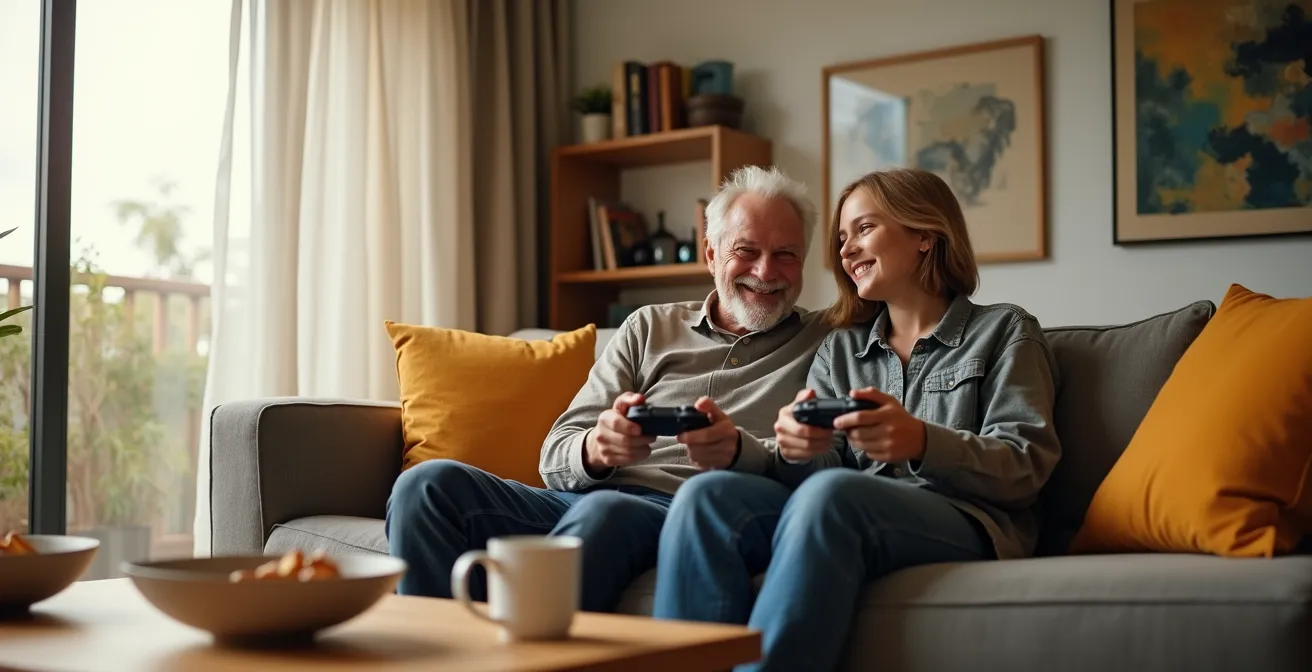
The key is to choose the right kind of game. Forget fast-paced, competitive shooters. A new genre of « cozy games » is perfect for this, focusing on collaboration, creativity, and relaxation. Here are a few excellent options for intergenerational sessions:
- Animal Crossing: A gentle game where you can visit each other’s virtual islands, fish, and decorate homes together with no time pressure.
- Stardew Valley: A collaborative farming simulator where the senior can act as the « farm strategist » while the teen handles the more complex controls.
- Minecraft (Creative Mode): An infinite digital LEGO set where you can build anything you can imagine together, without any threat of monsters or survival pressure.
By stepping out of your comfort zone and embracing the role of the student, you are not just learning a game; you are communicating a powerful message of openness, trust, and respect.
Key Takeaways
- Genuine connection is built on two-way exchange, not one-way instruction.
- Structured communication with specific prompts is more effective than generic « how are you » questions.
- Managing the energy and duration of an event is just as crucial as the activity itself.
How to Foster a Sense of Belonging in Your Neighborhood After Retirement?
The principles that create successful family gatherings—structured communication, mutual respect, and two-way exchange—are the very same ones that build strong, vibrant communities. After retirement, it can be easy to feel disconnected as daily routines change. Fostering a sense of belonging in your neighborhood requires a proactive approach, applying these intergenerational strategies on a broader scale.
Instead of waiting for connections to happen, you can become a community bridge-builder. This could mean organizing a neighborhood « skill-share » where you teach a skill like gardening or baking, and a younger neighbor teaches a workshop on using a new social media app or setting up a smart home device. It’s about creating platforms for the « reverse mentorship » and « two-way knowledge exchange » we’ve discussed. You could also initiate a local storytelling project, using the StoryCorps model to record the histories of longtime residents, with local high school students acting as the interviewers and audio editors.
Even in a virtual world, these connections are possible and powerful. The success of DOROT’s « GENuine Connections » program in Manhattan provides a compelling model. By bringing together seniors and high school students for weekly virtual workshops, they discovered common ground through structured discussions on everything from first jobs to dating. The program highlighted that teens found seniors to be « clever, caring, and wise, » which in turn helped the teens think differently about their own lives. Seniors felt valued and energized. This proves that with the right architecture, belonging can be cultivated anywhere.
Ultimately, fostering belonging is about seeing your life experience not as a closed chapter, but as a valuable resource that can be exchanged for new knowledge, new energy, and new connections. It is the act of reaching out with curiosity, not just nostalgia, that transforms a collection of houses into a true community.
By starting with one small, intentional change—whether it’s trying a voice memo, asking a better question, or suggesting a collaborative game—you can begin to transform awkward silences into the building blocks of a lasting, meaningful legacy of connection.