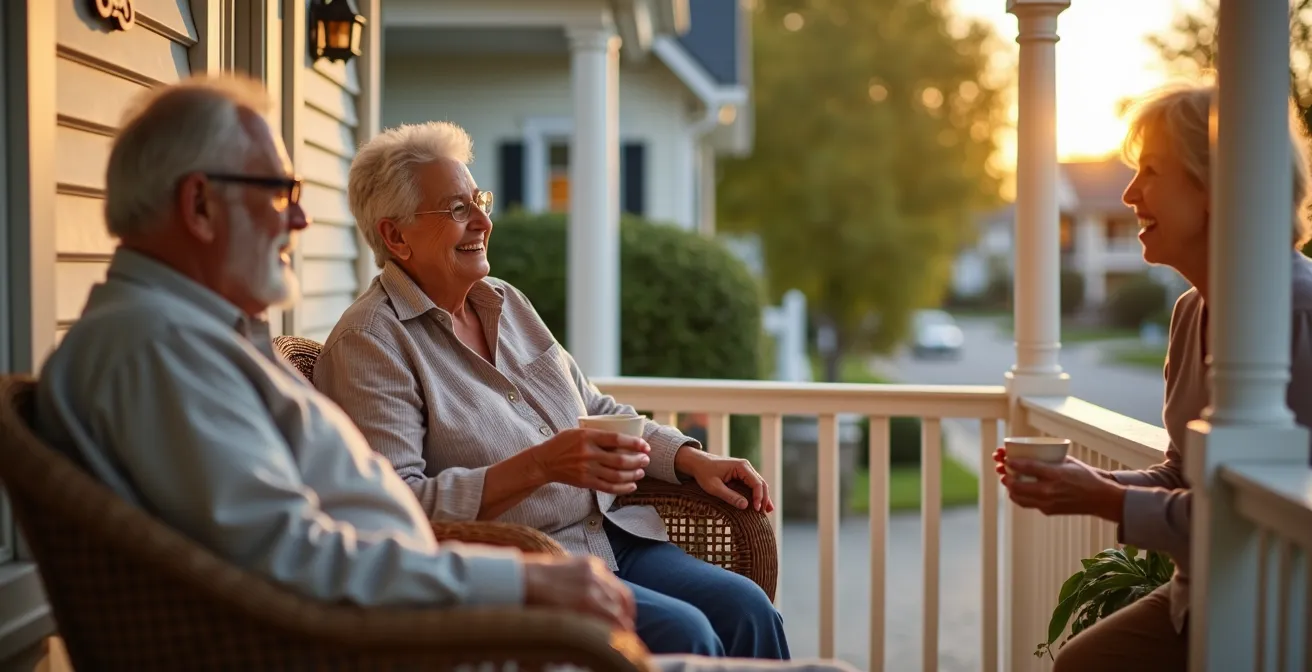
Contrary to popular belief, the key to belonging after retirement isn’t just « staying busy »—it’s about consciously creating a new, visible role for yourself within your local community.
- Invisibility stems from the loss of a professional identity, not a lack of worth. The goal is to translate your skills into a new community-based identity.
- Overcoming the « I don’t want to bother anyone » mindset is crucial. This is achieved by building « permission structures » that make helping and connecting feel natural.
Recommendation: Shift your focus from being a passive consumer of your neighborhood’s social life to becoming an active co-creator of it. Start by identifying one small, consistent role you can play, no matter how minor it seems.
The transition to retirement often comes with an unexpected silence. It’s not just the absence of a daily commute or work deadlines; it’s a social silence. The professional identity that defined you for decades—the teacher, the engineer, the nurse, the manager—is gone. Suddenly, you may feel less like a pillar of the community and more like a ghost in your own neighborhood. This sense of invisibility is a profound and common challenge, leading many to feel disconnected and adrift just when they have the most time to connect.
The standard advice often misses the mark. You’re told to join a book club, take up gardening, or travel. While these are enjoyable activities, they don’t address the core issue: the loss of a defined, valuable role that made you visible and necessary to others. You weren’t just a person; you were a resource, an expert, a colleague. The feeling of belonging doesn’t just come from proximity to others; it comes from purpose and contribution.
But what if the solution wasn’t about finding new hobbies to fill the time, but about strategically creating a new community identity? This guide moves beyond generic suggestions to offer a psychologist’s framework for actively rebuilding your presence. We will explore why you feel invisible, how to dismantle the mental barriers that keep you isolated, and how to intentionally craft a new role—as a mentor, an organizer, a connector—that makes you a vital, visible, and valued asset to your neighborhood once again.
This article provides a structured path to reclaiming your place. We’ll delve into the psychological shifts of retirement and provide concrete strategies, from choosing impactful volunteer roles to launching a simple « porch connection » campaign on your street.
Summary: A Practical Guide to Building Neighborhood Belonging
- Why You Feel Invisible Now That You Don’t Wear a Suit to Work?
- Why 40% of Retirees Experience Depression Within the First Year?
- Why Staying Inside Due to Mobility Issues Destroys Mental Health?
- The « I Don’t Want to Bother Anyone » Mindset That Erases Your Presence
- How to Choose Volunteer Roles That Put You at the Center of Community Action?
- Mentor vs Organizer: Which Role Builds Stronger Community Ties?
- How to Start a « Porch Connection » Campaign on Your Street?
- How to Set Up a « Safety Net » System to Prevent Isolation Before It Starts?
Why You Feel Invisible Now That You Don’t Wear a Suit to Work?
The feeling of invisibility after retirement is not your imagination; it’s a direct consequence of losing a powerful social anchor: your professional role. For decades, your job provided more than a paycheck. It offered a clear identity, a built-in social network, and a daily purpose. People knew who you were and what you did. This consistent, structured interaction made you visible and relevant. When the « suit » comes off for the last time, that entire framework vanishes, leaving a void that hobbies alone often cannot fill.
This isn’t just about missing colleagues. It’s about the loss of what psychologists call a « social script. » You knew how to act, who to talk to, and what was expected of you. In retirement, especially within your own neighborhood where you were previously just a resident who left for work, that script is gone. You are no longer « the lawyer down the street » but simply a neighbor, and the pathways to meaningful interaction are suddenly less clear. This abrupt shift can be deeply disorienting.
The challenge is compounded by a society that often equates productivity with value. Without the visible output of a career, it’s easy to internalize the belief that you have less to offer. This psychological shift is a major contributor to social isolation. In fact, research shows that 43% of American adults aged 60 and older report feeling lonely. The first step to combating invisibility is recognizing its source: it’s not a personal failing, but the predictable result of a major life transition. The task ahead is not to mourn the old role, but to consciously build a new one.
Why 40% of Retirees Experience Depression Within the First Year?
The primary cause of depression in early retirement is the sudden and total collapse of routine. Your work life provided a powerful, non-negotiable structure: when to wake up, where to be, what to do, and who to interact with. This daily rhythm, even when stressful, creates a sense of predictability and purpose. When it disappears overnight, you are left with a vast, unstructured expanse of time. This « freedom » can quickly morph into a disorienting void, leading to feelings of aimlessness and, for many, clinical depression.
Studies confirm this is a widespread issue, with some finding a 40% increase in self-reported depression during the first retirement years. It’s a silent health crisis driven by the loss of the three pillars of work: identity, community, and structure. Without the daily affirmation of your skills and the casual social connections of the workplace, self-worth can plummet. The empty calendar becomes a symbol of irrelevance, not liberation.

This isn’t simply a case of « the blues. » It’s a genuine psychological response to a fundamental change in your environment. The brain thrives on purpose and predictability. Without external demands to structure your day, the burden of creating meaning falls entirely on you, a task for which few are prepared. Recognizing that this struggle is a common, structural problem—not a personal weakness—is the first step toward building a new, post-retirement scaffolding that supports your mental health.
Why Staying Inside Due to Mobility Issues Destroys Mental Health?
For many seniors, declining mobility acts as an invisible cage, shrinking their world one step at a time. When leaving the house becomes a significant physical or logistical challenge, the natural, spontaneous encounters that nourish community life are severed. You no longer bump into a neighbor while getting the mail or chat with the cashier at the local market. This forced isolation is a powerful accelerator of mental health decline, directly cutting off the supply of social and environmental stimulation that the brain needs to thrive.
The link is stark and well-documented. Research shows that older adults with two or more ADL limitations were 3.8 times more likely to experience symptoms of depression. Each activity of daily living (ADL) that becomes a struggle—whether it’s walking, dressing, or simply getting in and out of a chair—can feel like another lock turning on the door to the outside world. The home, once a sanctuary, can become a prison of monotony, leading to a vicious cycle of physical decline and deepening depression.
However, being homebound does not have to mean being disconnected. The key is to shift the strategy from « going out to the world » to « bringing the world in. » Technology and creative community roles can transform your home from a place of isolation into a hub of connection. This requires a conscious effort to reimagine what « participation » looks like when your mobility is limited. You can still be a central figure in your community, but the methods of engagement must adapt.
Here are a few ways to bring the outside world to you:
- Set up a ‘digital window’ tablet that streams live feeds from a local park or town square.
- Start a neighborhood podcast from your home, interviewing neighbors over video calls.
- Become a community drop-off point for local initiatives like food drives or library book returns.
- Host virtual walking tours of places you’ve been using Google Earth with friends online.
- Create a bird-watching station by your window and share your sightings via a live webcam or a neighborhood blog.
The « I Don’t Want to Bother Anyone » Mindset That Erases Your Presence
One of the most powerful forces driving post-retirement invisibility is a single, pervasive thought: « I don’t want to be a bother. » This mindset, born from a desire to be self-sufficient and considerate, inadvertently builds a wall around you. You hesitate to ask for a small favor, to share an opinion, or to invite someone over, fearing you’ll be an imposition. The result? You slowly erase yourself from the social fabric of your own neighborhood. Your neighbors don’t see you as a bother; they simply don’t see you at all.
This reluctance to engage creates a negative feedback loop. The less you reach out, the less others reach out to you, reinforcing your feeling of being on the outside. To break this cycle, you must stop thinking in terms of « bothering » and start creating what community psychologists call « permission structures. » These are simple, low-stakes systems that give both you and your neighbors an explicit, pre-approved reason to interact. They remove the awkwardness of the « cold ask » by making helping and connecting a normal, expected part of neighborhood life.
Instead of waiting for a crisis to interact, you build the pathways for everyday connection. A permission structure can be as simple as a sign on your door or a shared online list. It’s a social tool that says, « It’s okay to connect. I’m available. You’re not imposing. » By creating these structures, you are not asking for help; you are offering an opportunity for community to happen. You are designing the role of a connector for yourself.
Your Action Plan: Creating Neighborhood Permission Structures
- Map your assets: Start a « Neighborhood Skill Bank » (a simple shared document or even a physical list on a community board). List three simple things you can offer, like « watering plants for neighbors on vacation, » « lending out garden tools, » or « offering basic tech help for smartphones. »
- Create a ‘Help Beacon’: Put a small, friendly sign on your front door or window that gives passive permission for a specific interaction. Examples: « Happy to accept packages for neighbors! » or « Dog water bowl here – feel free to use! »
- Establish a predictable presence: Choose a specific, low-effort activity and do it at the same time in the same visible place. For instance, have your morning coffee on your front porch from 9:00 to 9:15 AM every day. This makes you an approachable, familiar part of the landscape.
- Launch a ‘Question of the Week’: Place a small chalkboard or whiteboard on your property line with a fun, non-controversial question each week (e.g., « Best local coffee shop? »). This is a « social object » that invites comment and interaction without any direct conversation needed.
- Initiate a communication channel: Start a low-pressure neighborhood WhatsApp group or email list explicitly for « Quick Favors & Questions. » The first message can be, « Starting this group so we can easily ask things like ‘does anyone have a ladder I can borrow for 5 minutes?’ No obligation to respond! »
How to Choose Volunteer Roles That Put You at the Center of Community Action?
Volunteering is standard retirement advice, but its effectiveness in combating invisibility depends entirely on the role you choose. To truly reclaim your presence, you must move beyond passive, task-oriented roles (like stuffing envelopes in a back room) and seek positions that place you at the center of your community’s information and social flow. The goal is to become a connector or a resource hub, not just an extra pair of hands.
Think strategically. Where does community information live? Who are the people everyone needs to talk to? By positioning yourself in one of these nexus points, you transform from a participant into a pivotal figure. Your value becomes immediately apparent, and your interactions multiply organically. You are no longer just « volunteering »; you are actively performing a crucial community function, much like you did in your professional life. This proactive approach was seen in a group of women in East Texas who, rather than waiting for a community to accept them, built their own « Bird’s Nest » of tiny homes, creating a supportive network on their own terms and preserving their independence.
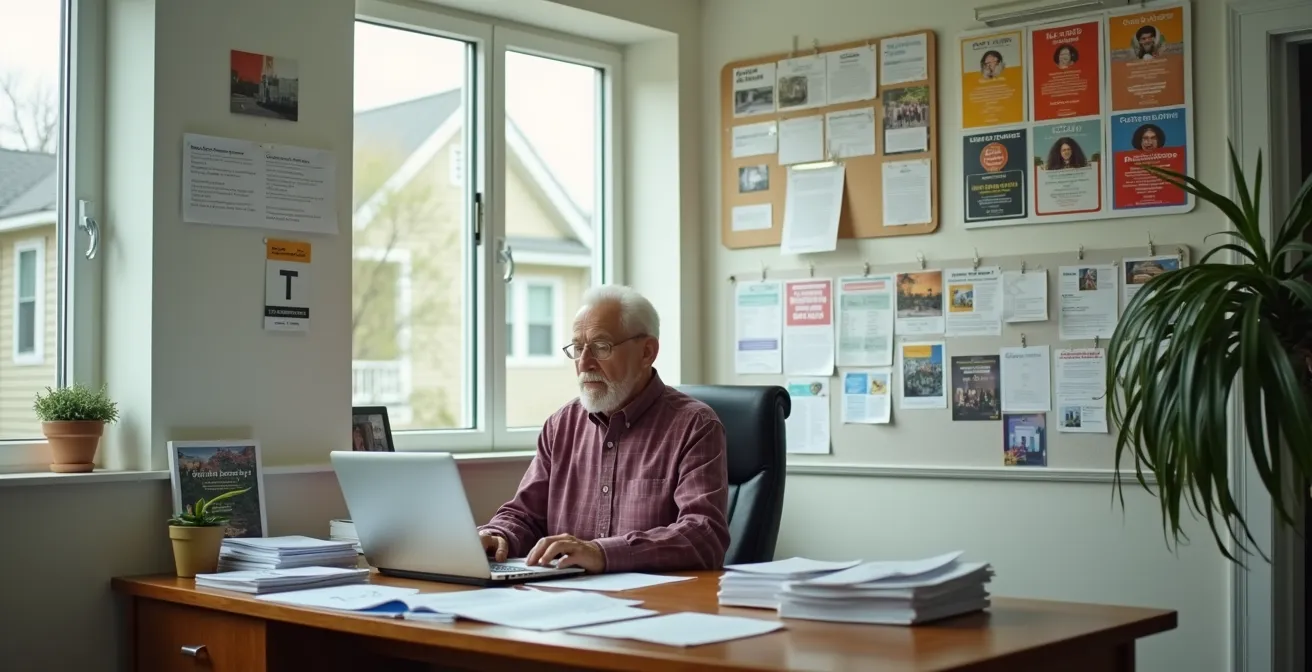
This principle of active role creation is key. Don’t just ask « how can I help? » Instead, ask « where can I position myself to be most useful and visible? » Look for roles that control information, welcome newcomers, or match needs with resources. These positions naturally build a wide network of weak ties, which are essential for feeling integrated into a community.
Consider these high-impact, central-hub volunteer positions:
- Newsletter editor for a local non-profit: You control the flow of information to hundreds of people.
- Social media manager for a community center: You become the digital voice and face of a local hub.
- Welcome coordinator for a neighborhood association: You are the first point of contact for new residents, immediately establishing you as a knowledgeable resource.
- Volunteer coordinator for an organization: You get to know everyone’s skills and needs, making you an indispensable connector.
- Grant writer for a small charity: You bring in vital resources, earning respect and demonstrating high-level value.
Mentor vs Organizer: Which Role Builds Stronger Community Ties?
Once you’ve decided to actively create a new community role, two powerful archetypes emerge: the Mentor and the Organizer. Both are invaluable for building ties, but they do so in fundamentally different ways. Choosing the right path—or a hybrid of the two—depends on your personality, energy levels, and what kind of impact you find most rewarding. Neither is inherently better, but understanding the trade-offs is crucial for sustainable engagement.
The Mentor role is about depth. You focus your time and considerable life experience on one or two individuals. This could be guiding a young entrepreneur, helping a new homeowner with their garden, or tutoring a student. The relationships are deep, personal, and highly rewarding on an emotional level. Your visibility is concentrated; you are a hero to a few, and your impact is profound but narrow. This role requires subject matter expertise and a high degree of patience and empathy.
The Organizer role is about breadth. You focus on creating the systems and events that bring many people together. You might start a weekly walking group, organize a neighborhood cleanup, or manage the community garden schedule. Your impact is broad, and your visibility is high across the entire community. You become known as the « person who makes things happen. » This role requires strong coordination skills, communication, and a willingness to manage logistics. The emotional reward comes from seeing the community thrive as a whole.
Deciding between these roles is a key strategic choice in your journey to build belonging. The following table breaks down the core differences to help you align your personal strengths with the community role that will bring you the most fulfillment and visibility.
| Aspect | Mentoring | Organizing | Hybrid Approach |
|---|---|---|---|
| Relationship Depth | Very Deep (1-2 people) | Surface-level (20+ people) | Balanced (1 deep + 10 casual) |
| Time Commitment | 2-4 hours weekly | 5-10 hours weekly | 3-5 hours weekly |
| Visibility in Community | Low to Medium | High | Medium to High |
| Skill Requirements | Subject expertise | Coordination skills | Both in moderation |
| Emotional Reward | Deep satisfaction | Broad appreciation | Varied fulfillment |
How to Start a « Porch Connection » Campaign on Your Street?
The grandest community-building strategies often begin with the smallest, most immediate space: your own front porch, stoop, or yard. A « Porch Connection » campaign is a hyper-local strategy focused on turning your private space into a low-key, public-facing « third place »—a spot that isn’t home and isn’t work, where informal community life can unfold. The goal is to create a predictable presence that makes you a familiar, approachable part of the daily streetscape.
The magic of this approach lies in its passivity. You are not actively trying to « make friends »; you are simply creating the conditions for connection to happen organically. The first step is to introduce a « social object »—a physical item that gives people a reason to pause and interact. A Little Free Library, a bowl of water for dogs, or a bench are classic examples. These objects act as conversation starters and signal that your space is open and friendly.
The next step is consistency. By being on your porch at the same time each day, even for just 15 minutes, you become a reliable feature of the neighborhood. People begin to expect you, wave, and eventually stop to chat. This slow, steady accumulation of « weak ties » is the bedrock of feeling like you belong. Case studies from retirement villages that implemented similar micro-event strategies saw a 60% increase in social interactions and a significant reduction in reported loneliness within just three months, proving the power of predictable, informal gatherings.
Here is a simple plan to launch your own campaign over five weeks:
- Week 1: Place a « social object » in your front yard (e.g., a little free library, dog water bowl, or a small chalk question board).
- Week 2: Establish a predictable presence. Sit on your porch or work in your front garden at the same time every day for a week.
- Week 3: Launch your first micro-event. Put up a small sign announcing something like « Tool Sharpening Saturday, 9-11 AM. »
- Week 4: Create a simple flyer with your weekly « porch schedule » (e.g., « Morning Coffee, 9-9:30 AM daily ») and distribute it to your ten nearest neighbors.
- Week 5: Add a second weekly event to your schedule, like « Sunset Tea Fridays, 5-6 PM, » to offer another opportunity for connection.
Key takeaways
- Invisibility after retirement is not a personal failure but a structural problem caused by the loss of a professional role and daily routine.
- The most effective way to build belonging is to consciously create a new, visible community role for yourself, shifting from passive resident to active neighborhood asset.
- Overcoming the « I don’t want to bother » mindset by creating « permission structures » is essential for fostering natural, everyday connections.
How to Set Up a « Safety Net » System to Prevent Isolation Before It Starts?
The ultimate expression of community belonging is creating systems that ensure no one falls through the cracks. As you become a more visible and connected member of your neighborhood, you are perfectly positioned to establish a « Safety Net » system. This is a proactive, non-intrusive method for neighbors to look out for one another, moving beyond random acts of kindness to a structured approach that preserves dignity while preventing isolation. It’s the final step in solidifying your role as a true neighborhood asset.
These systems are not about surveillance; they are about care. A famous example is the « Traffic Light Check-in » system used in some retirement communities. Residents place a colored card in their window each morning: green for « I’m okay, » yellow for « I’d appreciate a call or visit, » and red for « I need help. » This simple, visual cue allows neighbors to check on each other with a quick glance, respecting privacy while ensuring everyone is accounted for. This method has been shown to reduce serious isolation incidents by over 50% in communities that adopt it.
Setting up such a system makes you an organizer of community well-being. It institutionalizes the care that people are often willing to give but don’t know how to offer. There are several models, each with different levels of complexity and engagement. Choosing the right one for your street depends on the local culture and willingness to participate.
By initiating this conversation, you are doing more than just looking out for yourself; you are building a resilient, interconnected community for everyone. It is the most powerful way to ensure that your presence is not just felt, but is fundamentally essential to the well-being of your neighbors.
| System Type | Setup Complexity | Daily Effort | Privacy Level | Effectiveness |
|---|---|---|---|---|
| Traffic Light Cards | Very Low | 30 seconds | High | 85% participation |
| Time Bank Exchange | Medium | Variable | Medium | 70% engagement |
| Block Connector Network | Low | 5 minutes | High | 90% coverage |
| Daily Call Circle | Low | 10 minutes | Medium | 60% retention |
By shifting your mindset from passive resident to active creator of community, you do more than just fill your days; you build a new identity rooted in purpose and connection. The journey from feeling invisible to becoming a neighborhood cornerstone is a deliberate one. Start today by choosing one small action from this guide and putting it into practice.