
Achieving medication safety for seniors with memory loss requires building a multi-layered, redundant system, not just relying on a single tool.
- Combine high-tech alerts (smart dispensers) with low-tech visual cues (colored bowls) to create multiple safety nets.
- Address psychological barriers like procrastination and integrate medication-taking into established daily habits to reduce cognitive load.
Recommendation: Shift your focus from simply reminding to actively preventing failure points by implementing a systematic approach that includes technology, visual organization, and a human support circle.
For families caring for a senior with mild memory loss, the fear of a missed pill or an accidental double dose is a constant, quiet anxiety. You’ve likely tried the common solutions: a seven-day pillbox, setting a phone alarm, or leaving reminder notes. While these methods are a start, they are single points of failure in a situation that demands a fortress of safety. The core issue isn’t just forgetfulness; it’s the lack of a systematic process that anticipates and neutralizes risk before it leads to harm.
This is where the mindset must shift. Instead of searching for one perfect tool, the goal is to construct a redundant safety system. This is a clinical, safety-first approach that layers technology, behavioral psychology, and simple visual aids to ensure that if one layer fails, another catches the error. It moves beyond hope and memory into the realm of process and certainty. True medication adherence isn’t about the senior remembering every single time; it’s about a system so robust that it’s nearly impossible for them to forget or make a mistake.
This guide will walk you through building that system, layer by layer. We will explore how to configure technology to serve you, implement psychological triggers to your advantage, design a visually intuitive environment, and structure human support to prevent burnout. Each component is a critical piece of a comprehensive safety net designed for your peace of mind.
Summary: A Systematic Guide to Medication Safety for Seniors
- How to Set Up Smart Dispensers That Alert You When a Dose Is Missed?
- Why « I Will Remember Later » Is the Most Dangerous Sentence for Seniors?
- The Double-Dose Danger: How to Prevent It With Visual Cues?
- Blister Packs vs Pill Boxes: Which System Reduces Error Rates Best?
- How to Manage a 4-Times-Daily Schedule Without Being Housebound?
- How to Stack Mental Habits into Your Morning Routine?
- How to Reorganize Cleaning Supplies to Prevent Accidental Poisoning or Mixing?
- How to Manage Multiple Chronic Conditions Simultaneously Without Burnout?
How to Set Up Smart Dispensers That Alert You When a Dose Is Missed?
A smart dispenser is the technological cornerstone of a modern medication safety system. Its primary function is not just to dispense pills, but to create an automated « alert cascade. » This is a pre-programmed sequence of notifications that escalates from the senior to the caregiver, ensuring a missed dose is never truly missed. When setting up these devices, prioritize connectivity. A model with both Wi-Fi and cellular backup ensures that alerts are sent even if the home internet goes down, removing a critical failure point.
The configuration should be « dignity-first. » The initial alerts—a flashing light and a gentle chime—should be directed only at the senior. This gives them the agency to correct the issue themselves. Only if the dose is not taken within a specified window (e.g., 30 minutes) should the system escalate, sending a notification to a caregiver’s phone. This turns the caregiver from a constant monitor into a targeted backup, intervening only when necessary. The choice of dispenser depends heavily on the caregiver’s lifestyle, as different models cater to remote versus hands-on support.
The table below breaks down essential features based on different caregiving scenarios, helping you choose the right technology for your specific situation. This systematic selection process ensures the tool fits seamlessly into your life and provides the most effective safety net.
| Caregiver Need | Essential Features | Recommended Connectivity | Alert Type |
|---|---|---|---|
| Remote/Out-of-state caregiving | 90-day capacity, locked compartments | Cellular (no Wi-Fi needed) | App notifications + SMS |
| Tech-challenged caregivers | Simple setup, phone support | Built-in cellular | Phone calls + SMS only |
| Working caregivers | Real-time monitoring, missed dose alerts | Wi-Fi or cellular | App with dashboard |
| Multiple caregivers | Multi-user access, activity logs | Cloud-based system | Shared app access |
By treating the smart dispenser as the brain of your alert system, you establish a reliable first line of defense that operates 24/7.
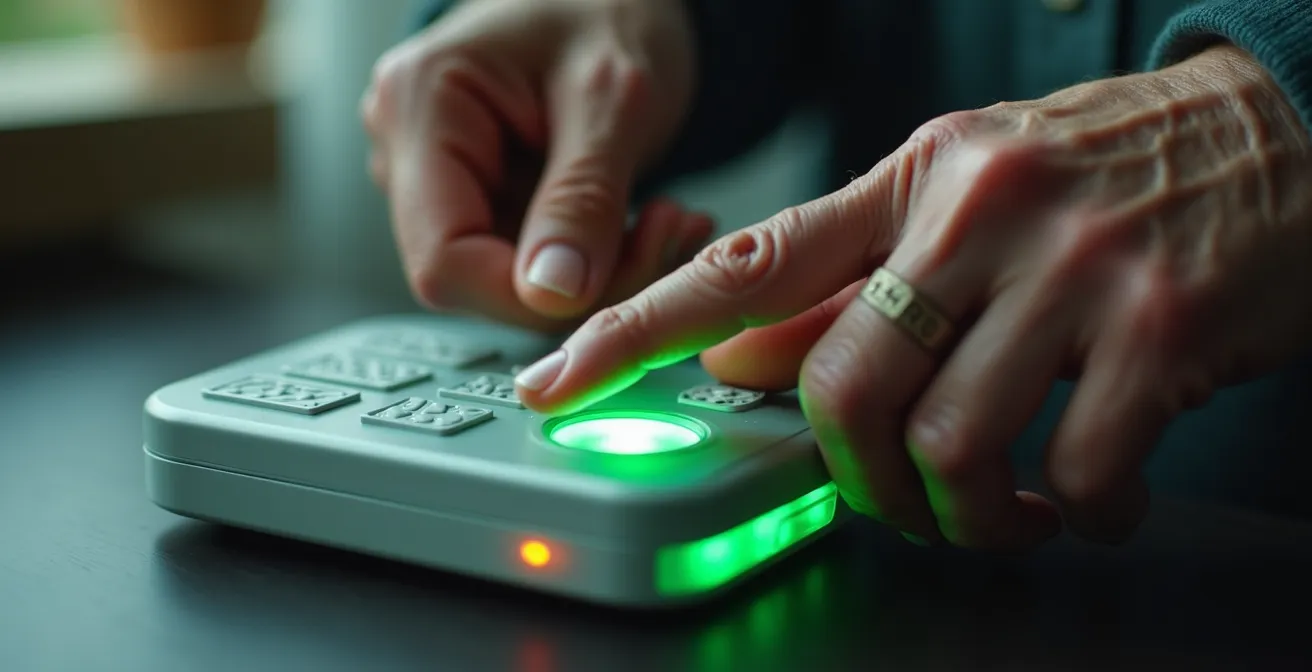
As seen here, the interaction should be simple and tactile. Large buttons and clear light indicators reduce the cognitive load on the senior, making it more likely they will respond correctly to the device’s prompts without assistance. The goal is technology that empowers, not intimidates.
Why « I Will Remember Later » Is the Most Dangerous Sentence for Seniors?
For a person with mild cognitive impairment, « I will remember later » is often a self-soothing phrase that masks an impending memory failure. It’s a cognitive trap. The intention is genuine, but the brain’s ability to retrieve that intention later is compromised. This is the single most common point of failure in non-adherence. In fact, research reveals that 73% of seniors cite poor memory as their main barrier to medication adherence. Postponement directly plays into this primary weakness.
The only effective counter-strategy is to eliminate the « later. » This requires a gentle but firm redirection from the caregiver. The goal is to short-circuit the postponement reflex by linking the thought of the medication directly to the action of taking it. This is not about nagging; it is about providing immediate support to complete a critical task before it is forgotten. Empathetic scripts that frame the action as a shared, immediate goal are far more effective than simply reminding.
The 2-Minute Rule in Practice
A case study from Caring Senior Service demonstrated a powerful method to combat this. They implemented the ‘2-minute rule’: if a senior thinks of their medication and taking it requires less than two minutes, they must do it immediately. Caregivers were trained to respond to « I’ll remember later » with scripts like, « Let’s just get it done together now, so we can both relax. » This approach, which focuses on immediate, collaborative action, reduced missed doses by a remarkable 40%. It effectively closes the dangerous gap between intention and action.
By understanding that « later » is a danger zone, caregivers can shift their approach from being a reminder to being an immediate facilitator. This proactive intervention is a crucial human layer in the safety system, preventing memory lapses from becoming medical emergencies.
The Double-Dose Danger: How to Prevent It With Visual Cues?
Just as dangerous as a missed dose is an accidental double dose, often caused by a senior forgetting they have already taken their medication. This is where the limitations of memory become a direct safety threat. While smart dispensers can lock away future doses, a robust safety system must also include simple, low-tech visual cues for daily medications that are already dispensed. These cues provide an unambiguous, at-a-glance confirmation of whether an action has been completed.
The most effective visual systems are « one-way » processes. They require a physical action that cannot be easily reversed or misinterpreted. For example, moving a pillbox from a designated « To-Do » spot to a « Done » spot creates a clear visual record. The key is consistency and simplicity. The system should require no complex thought, only a simple, repeatable physical motion that becomes second nature. These environmental designs act as an external memory, offloading the cognitive burden from the senior.
Here are several effective visual cue strategies:
- The Two-Bowl System: Use two distinctly colored bowls (e.g., red for « To-Do, » green for « Done »). The day’s pill container starts in the red bowl and is moved to the green bowl only after the medication is taken.
- The Water Glass Lock: The pillbox is placed on top of a specific water glass. Both must be moved to take the medication, and the empty glass and moved pillbox serve as the « done » signal.
- The Flip Token Method: A small board with a token (e.g., red on one side, green on the other) is placed by the medication. The token is flipped after the dose is taken.
- Left-to-Right Flow: Arrange the morning items (e.g., coffee cup, pillbox, water glass) on the counter from left to right. As each is used, it is moved to the far right, creating a visual timeline of completed actions.

An organized medication station, like the one depicted, transforms a countertop into a clear dashboard. The color-coding and physical separation of « to-do » from « done » leaves no room for ambiguity, effectively preventing the senior from questioning whether they’ve taken their pills.
Blister Packs vs Pill Boxes: Which System Reduces Error Rates Best?
The choice between pre-sorted pharmacy blister packs and manually filled pill boxes is a critical decision in designing a medication system. There is no single « best » answer; the optimal choice depends on the senior’s specific physical and cognitive abilities. With studies showing medication adherence in older patients with dementia can be as low as 17%, optimizing this physical tool is paramount. A pill box offers simplicity and larger compartments, which is ideal for individuals with arthritis or vision problems. However, it places the burden of accuracy entirely on the caregiver who fills it weekly, creating a potential point of human error.
Blister packs, on the other hand, transfer the responsibility of accuracy to the pharmacy. This significantly reduces the risk of incorrect sorting, especially with complex multi-drug regimens. However, the small print and difficulty in popping pills out can be major barriers for seniors with poor dexterity or eyesight. Analyzing the trade-offs in terms of cognitive load, dexterity, and caregiver time is essential.
The following matrix breaks down the decision-making process, helping you weigh the pros and cons for your specific situation.
| Factor | Blister Packs | Pill Boxes | Best For |
|---|---|---|---|
| Dexterity Requirements | Can be difficult to open | Easier to open compartments | Arthritis patients: Pill boxes |
| Visual Clarity | Small print labels | Large-print options available | Vision issues: Pill boxes |
| Cognitive Load | Full sheet can be overwhelming | Simple daily compartments | Mild dementia: Pill boxes |
| Accuracy | Pre-sorted by pharmacy | Requires caregiver sorting | Complex regimens: Blister packs |
| Caregiver Time | Minimal refilling needed | Weekly refilling required | Busy caregivers: Blister packs |
A Successful Hybrid Approach
Some care models, like that of ChenMed, have found success with a hybrid strategy. The pharmacy provides medications in accurate, pre-sorted blister packs. The caregiver then uses these packs as a « master supply » to quickly and easily fill a simple, large-print weekly pill box. This method combines the professional accuracy of blister packs with the daily usability of pill boxes. This approach was shown to reduce medication errors by 35% in seniors with cognitive decline while also decreasing the time and stress for caregivers.
How to Manage a 4-Times-Daily Schedule Without Being Housebound?
A complex medication schedule, especially one requiring four or more daily doses, can feel like a prison sentence, tethering a senior to their home. This is a significant quality of life issue. The burden is immense, especially when research from UCSF shows seniors with dementia take an average of 8 different medications. Freedom and independence can be maintained, however, by creating a portable, organized, and discreet medication management system.
The first step is to create a dedicated « Go-Bag. » This is more than just a Ziploc bag of pills; it’s a pre-prepared kit that anticipates every need for taking medication on the go. It should contain doses in a small, labeled pill container, a miniature water bottle, and any necessary snacks (as some medications must be taken with food). A simple medication card with photo instructions can also be included for reference, reducing anxiety.
Next, it’s crucial to work with a pharmacist. Discuss the possibility of creating a « flexibility window » for non-critical medications. For many drugs, a window of +/- 60 minutes does not impact efficacy and can provide much-needed leeway for appointments or social outings. Finally, empowering the senior with a plan makes all the difference. This includes using smartphone alarms and identifying « Community Safe Spots »—quiet, dignified places like a library corner or a peaceful café—where they can comfortably take a midday dose.
- Prepare a ‘Go-Bag’ Kit: Include a small pill case, a mini water bottle, necessary snacks, and a written schedule.
- Establish a ‘Flexibility Window’: Talk to the pharmacist about safe timing variations for non-critical drugs.
- Map ‘Community Safe Spots’: Identify quiet, comfortable public places for taking midday doses.
- Use Location-Based Alarms: Set smartphone reminders that activate when arriving at regular destinations like a community center.
- Carry Medication Cards: Create small, laminated cards with photos of the pills and simple instructions for reference.
How to Stack Mental Habits into Your Morning Routine?
The most resilient medication adherence plan is one that is woven into the fabric of a senior’s existing daily life. This is a behavioral strategy called « habit stacking, » where the new habit (taking medication) is physically and mentally linked to an old, unbreakable one (like a first sip of coffee). Instead of relying on memory, you are relying on the powerful autopilot of a long-established routine. The key is to choose an « anchor habit » that is non-negotiable and happens every single day, such as putting on glasses, the first trip to the bathroom, or sitting down in a favorite armchair for the news.
To make the link even stronger, the medication-taking moment should be paired with a unique sensory experience. This creates a powerful memory cue that is distinct from the rest of the day. For example, taking morning pills with a specific, tart cranberry juice that isn’t consumed at any other time. The unique taste becomes a powerful trigger associated solely with medication.
Sensory Stacking for Better Adherence
Research into adherence strategies has shown this method’s power. One study found that patients who used sensory-rich anchor habits—like the taste of a specific juice or the sound of the morning news—showed 30% better adherence than those relying on time-based reminders alone. The sensory input helps to cement the new behavior in the brain, making it more automatic and less dependent on active memory.
Implementing this requires a gradual « ownership transfer » from the caregiver to the senior. For the first couple of weeks, the caregiver performs the routine with the senior, using consistent verbal and physical cues. Over the next few weeks, they transition to verbal prompts only, letting the senior perform the actions. Finally, the goal is for the senior to own the routine completely, with the caregiver monitoring from a distance. This systematic handover builds confidence and lasting independence.
Action Plan: Auditing Your Habit-Stacking Routine
- Anchor Habit Identification: List 3-5 unbreakable daily actions (e.g., pouring first coffee, turning on TV) and select the most consistent one as your anchor.
- Sensory Link Setup: Inventory unique sensory items available (specific juice, a certain mug, a small bell) and pair one exclusively with the medication moment.
- Environmental Staging: Physically place the medication, the sensory item, and any tools (water glass) directly next to where the anchor habit occurs. Verify the setup is unmissable.
- Cue Consistency Check: For one week, document the exact verbal and physical cues used. Ensure they are identical every single day to avoid confusion.
- Intervention Protocol: Define a clear, « if-then » plan for intervention. (e.g., « If medication is not taken 10 minutes after the anchor habit, I will use this specific verbal prompt… »).
How to Reorganize Cleaning Supplies to Prevent Accidental Poisoning or Mixing?
A comprehensive medication safety system extends beyond the pillbox. For a senior with memory loss, the entire home environment must be considered a potential risk. Look-alike products—such as green mouthwash and green floor cleaner, or white pills and white cleaning tablets—pose a significant threat of accidental poisoning. Confusion between similarly shaped or colored containers is common. Given that statistics show over 130,000 people die from medication mistakes annually in the US, preventing such errors is a life-or-death matter.
The solution is a systematic safety audit and reorganization of the home. The guiding principle is to create extreme and unambiguous separation between what is safe to ingest and what is not. This involves more than just putting things in different cupboards; it requires creating clear visual zones and physical barriers.
Here is a safety protocol to follow:
- Conduct a Look-Alike Audit: Go room by room and identify any products with similar packaging, colors, or shapes. Pay special attention to liquids in similar bottles.
- Create Color-Coded Zones: Use bright red tape or labels for all toxic chemicals and green for all food-safe items. This creates an instant visual language of « stop » vs. « go. »
- Use Universal Warning Symbols: Apply large, clear poison control stickers (like Mr. Yuk or a skull and crossbones) to any hazardous product that must remain somewhat accessible.
- Enforce Strict Separation: Never store cleaning products in the same cabinet or even in the same vicinity as food or medicine. Move all cleaning supplies to a designated, separate area like a utility closet or garage.
- Install Physical Barriers: Use childproof locks on all cabinets containing hazardous materials. Conversely, ensure safe items and medications are kept in easy-to-open, accessible locations to avoid frustration.
This environmental detoxification reduces the cognitive load on the senior. They don’t have to read fine print or remember which bottle is which; they can rely on simple, clear visual cues and physical separation to stay safe.
Key Takeaways
- A single tool is not enough; true safety comes from a multi-layered, redundant system combining technology, visual cues, and behavioral strategies.
- Preventing errors involves both stopping missed doses (with alerts and habits) and stopping double doses (with visual « done » signals).
- The caregiver’s role should shift from constant reminding to designing a robust system and then acting as a final, targeted backup.
How to Manage Multiple Chronic Conditions Simultaneously Without Burnout?
The challenge of medication adherence is often magnified by polypharmacy—the use of multiple medications to manage several chronic conditions simultaneously. The complexity can be overwhelming for both the senior and the caregiver. With nearly 40% of seniors taking five or more prescription drugs daily, the sheer volume of tasks—refills, appointments, sorting pills—can lead to severe caregiver burnout. A sustainable system, therefore, must include a human support layer: the « care circle. »
A care circle is a small, organized group of family, friends, and neighbors who share the load. The key to its success is moving from vague offers of « let me know if you need anything » to a structured delegation of specific, time-limited tasks. Burnout often happens when one person, the primary caregiver, feels responsible for everything. By breaking down the workload into manageable actions, it becomes easier for others to help effectively.
Building an effective care circle involves these steps:
- Create a Master Task List: Document all recurring medical tasks, including prescription refills, appointment scheduling, transportation, and weekly medication sorting.
- Break Down the Tasks: Convert each large task into specific, 30-minute actions. For example, « manage prescriptions » becomes « call in refill for drug X on Tuesday » and « pick up from pharmacy on Thursday. »
- Match Tasks to Strengths: Assign jobs based on people’s skills and location. A tech-savvy grandchild can manage online pharmacy accounts, while a nearby neighbor can handle quick pharmacy pickups.
- Use a Shared Calendar: Employ a simple shared digital calendar (like Google Calendar) to assign tasks, track completion, and send automatic reminders to helpers.
- Hold Monthly Check-ins: Schedule a brief, 15-minute monthly call with the care circle to review the schedule, redistribute tasks as needed, and ensure no single person is becoming overwhelmed.
This systematic approach to delegation transforms a vague support network into an efficient team. It protects the primary caregiver from burnout, which is essential for the long-term health and safety of the senior. The system is only as strong as the people who maintain it.
By building this multi-layered system—combining smart technology, clear visual cues, ingrained habits, and a distributed human support network—you move beyond hope and into the realm of process. This systematic approach is the most reliable path to ensuring your loved one’s safety and restoring your own peace of mind.