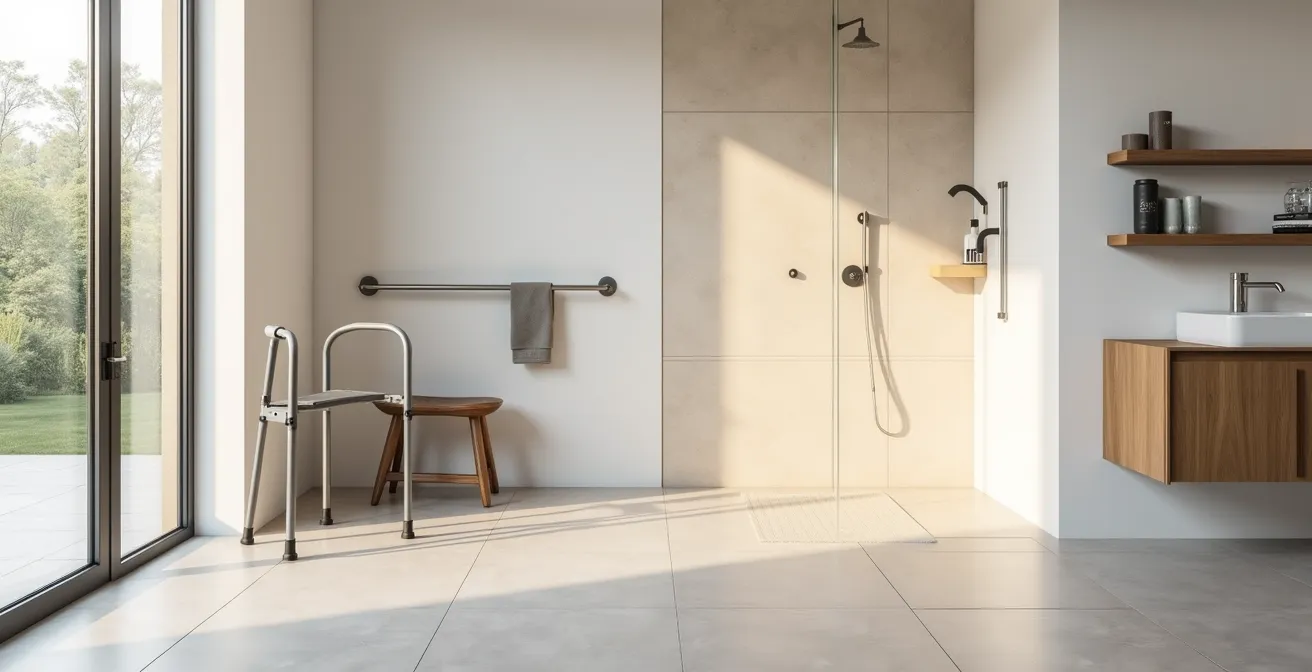
In summary:
- A leak-proof curbless shower depends on a complete water management system, not just one component.
- The linear drain’s flow rate capacity must exceed the total output of all shower heads combined.
- Proper sloping, wall waterproofing, and system-compatible materials are non-negotiable for preventing water damage.
- Safety features like anti-scald valves and correctly placed grab bars are critical for senior accessibility.
- Strategic layout planning prevents future mobility issues with walkers or wheelchairs.
The dream of a sleek, accessible curbless shower often comes with a nagging fear: water damage. You envision a seamless transition from the bathroom floor into a modern, spa-like space, but nightmares of hidden leaks, rotting subfloors, and costly repairs hold you back. Many homeowners focus on the visible elements—the tile, the glass, the fixtures—believing that meticulous caulking is the ultimate defense against water. This is a common and dangerous misconception.
The reality is that a truly waterproof curbless shower is not a collection of well-sealed parts; it is an integrated water management system. The secret to a design that will never leak lies in understanding how water is controlled from the moment it leaves the showerhead to the moment it enters the drainpipe. It involves a precise interplay of slope, flow rate, membrane compatibility, and user-centric safety design that most generic guides overlook.
Instead of just listing steps, this guide will deconstruct that system. We will explore the critical decision points that professionals use to guarantee a dry, safe, and functional space. You will learn why the drain is the heart of the system, how fixture placement impacts both safety and comfort, and how to create a layout that is truly accessible for years to come. By mastering these principles, you can move forward with your renovation project, confident in your ability to create a beautiful shower that is built to last.
This article provides a detailed breakdown of the essential elements for a successful curbless shower project. Below is a summary of the key topics we will cover to ensure your design is both beautiful and completely waterproof.
Summary: A Systemic Approach to a Leak-Proof Curbless Shower
- Why Your Curbless Shower Needs a Linear Drain to Work Properly?
- How to Select a Built-In Shower Seat That Doesn’t Collect Mold?
- The « Far Valve » Mistake That Forces You to Step Into Cold Water
- Glass Panel vs Shower Curtain: Which Is Safer for Caregiver Access?
- How to Install Anti-Scald Valves to Protect Thin Senior Skin?
- The Bathroom layout Error That Makes It Impossible to Use a Walker
- How to Set Your Water Heater to Prevent Third-Degree Burns in Seconds?
- Where Exactly Should You Install Grab Bars for Maximum Leverage and Safety?
Why Your Curbless Shower Needs a Linear Drain to Work Properly?
The single most important component in a leak-proof curbless shower is the drain. Traditional center drains require the floor to be sloped from four different directions, creating a complex, funnel-like shape that is difficult to tile and incompatible with a smooth, barrier-free entry. A linear drain, however, changes the entire equation. It only requires a single, gentle slope in one direction, making it the foundational element of a successful curbless design.
This single-plane slope is not just an aesthetic choice; it is a functional necessity for proper water management. More importantly, you must match the drain’s capacity to the shower’s output. A standard showerhead uses about 2.5 gallons per minute (GPM), but a spa-like system with multiple heads and body sprays can easily exceed that. It is crucial to select a drain with an adequate flow rate capacity. According to industry specifications, drain capacity can range from a standard 9 GPM to over 21 GPM for high-flow models. If your shower’s total output exceeds the drain’s GPM rating, water will pool and eventually escape the shower area, no matter how well your waterproofing is done.
Therefore, the selection process is a technical calculation, not a style choice. You must first calculate the total GPM of all water fixtures in the shower. Then, choose a linear drain and waterproofing system that are designed to work together and can handle that volume. This system compatibility is key—the drain flange must integrate perfectly with the waterproof membrane to create a continuous, impenetrable barrier. Ignoring this crucial relationship is the number one cause of curbless shower failures.
How to Select a Built-In Shower Seat That Doesn’t Collect Mold?
A built-in shower seat is a cornerstone of an accessible and comfortable bathroom, but if poorly designed, it can become a prime location for mold and mildew. The most common mistake is creating a flat or improperly sloped surface. Any horizontal plane in a wet environment is a liability. To prevent water from stagnating, a built-in shower seat must have a subtle but effective slope of approximately 1/4 inch per foot towards the main drain.
The construction material and method are equally important. While a tiled seat can look seamless, it introduces numerous grout lines that are porous and difficult to keep clean. A superior alternative is a solid-surface seat (like quartz or Corian) or a wall-mounted, floating seat made from a naturally water-resistant material like teak. These options minimize or eliminate grout lines, leaving fewer places for mold to take hold.
This image demonstrates a best-practice installation for a hygienic, low-maintenance shower seat.
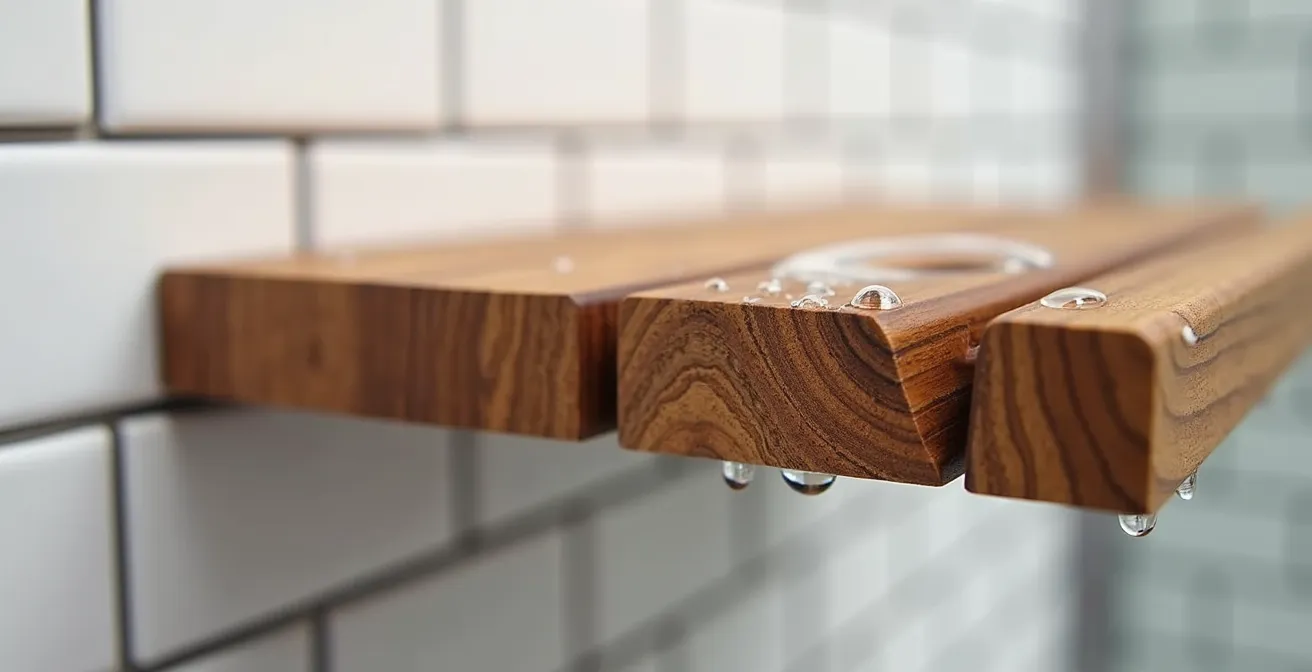
As you can see, the floating design creates a gap between the seat and the wall, which is crucial for air circulation and drying. All joints and mounting points must be meticulously sealed with 100% silicone sealant, not acrylic caulk. Silicone is waterproof and more resistant to mold growth. By focusing on slope, material selection, and proper sealing, you can create a shower seat that offers comfort and safety without compromising on hygiene.
The « Far Valve » Mistake That Forces You to Step Into Cold Water
One of the most common design oversights in shower renovations is valve placement. Traditionally, the control valve is placed directly under the showerhead. In a curbless, walk-in design, this forces the user to either reach through a stream of cold water or step directly into it to turn on the shower. This is not only uncomfortable but can be a genuine slip hazard, especially for a senior user trying to avoid a blast of icy water. This creates a poor ergonomic experience and negates some of the safety benefits of the curbless design.
The solution is to decouple the valve location from the showerhead location. The controls should be placed near the shower entrance, allowing you to turn on the water and adjust the temperature while standing completely outside the splash zone. This concept creates an ergonomic safety zone at the entrance. For new construction, this is a simple framing and plumbing adjustment. In a retrofit, there are several effective solutions to achieve the same result.
The best approach depends on your budget and existing system. The following table, based on insights from design-build firm recommendations, outlines the most common solutions for smarter valve placement.
| Solution Type | Installation Cost | User Experience | Best For |
|---|---|---|---|
| Digital Thermostatic Valve | High ($800-2000) | Pre-set temperature via app/remote | Tech-savvy users |
| Diverter with Handheld | Low ($150-400) | Test water before main shower | Budget-conscious retrofits |
| Entry-side Placement | Medium (varies) | Reach from outside splash zone | New construction |
| Recirculation Pump | Medium ($500-1200) | Instant hot water | Tankless heater systems |
Ultimately, planning the valve location with the user’s first step in mind is a hallmark of a thoughtful, safety-conscious design. It’s a small detail that makes a significant difference in daily comfort and safety.
Glass Panel vs Shower Curtain: Which Is Safer for Caregiver Access?
Containing water in a curbless shower is a critical part of the water management system. While a full glass enclosure seems like the most effective barrier, it can create a significant obstacle for caregiver assistance. With over 230,000 nonfatal bathroom injuries reported annually by the CDC in the U.S., designing for potential assistance is a forward-thinking safety measure. A fixed glass panel can make it nearly impossible for a caregiver to help someone shower without getting completely soaked or being forced into an awkward, unsafe position.
A shower curtain offers maximum accessibility but is less effective at water containment and can feel flimsy. The optimal solution is often a hybrid approach: a half-height (or 3/4-height) fixed glass panel combined with a high-quality, weighted shower curtain on a ceiling-mounted track. This design directs the majority of splashes toward the drain while leaving the upper portion open.
This configuration provides a « splash guard » for the caregiver, allowing them to reach over the panel to assist while remaining dry and stable.
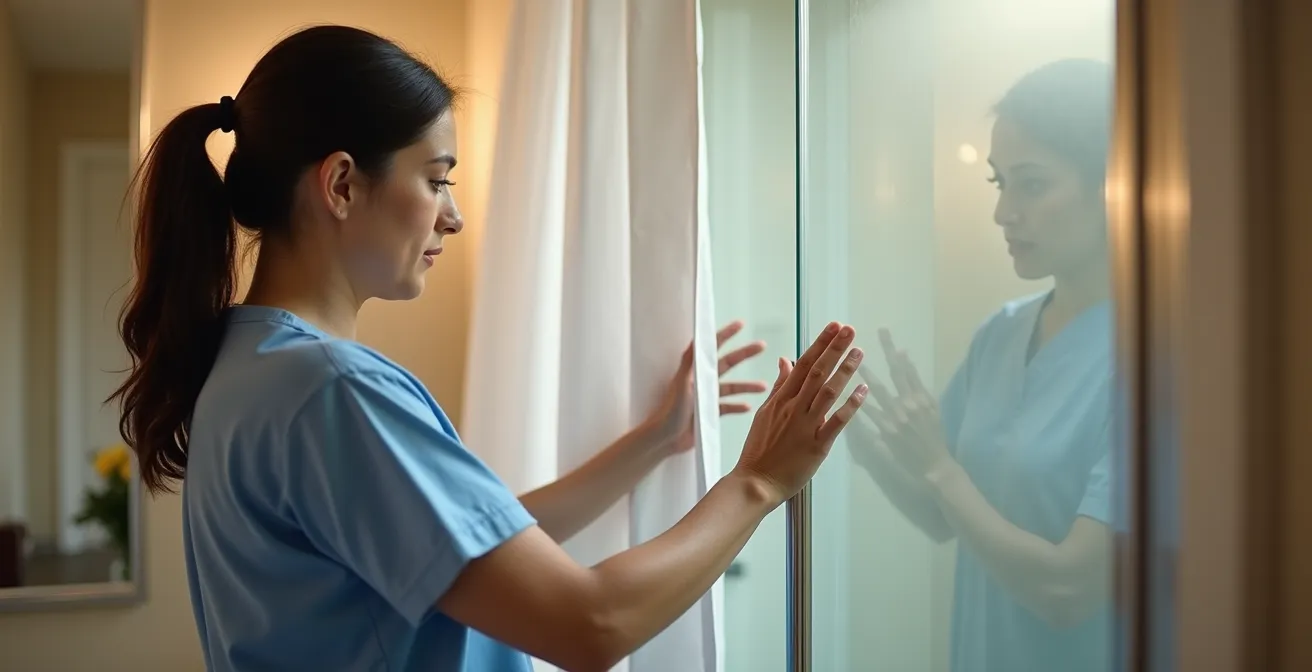
As shown, this setup strikes the perfect balance. The fixed panel provides a solid, durable barrier where water is most likely to hit, while the curtain allows for flexible, unimpeded access when needed. This is a far safer and more practical solution for an « aging in place » design than a full glass door that can trap a user in an emergency or a simple curtain that allows water to escape easily. It’s a design that acknowledges the potential need for future care without sacrificing daily functionality.
How to Install Anti-Scald Valves to Protect Thin Senior Skin?
One of the most dangerous and invisible threats in a bathroom is hot water scalding. As we age, our skin becomes thinner and more fragile, and our reaction times may slow. This combination dramatically increases the risk of severe burns from tap water that would be merely uncomfortable for a younger person. A sudden pressure change elsewhere in the home—like a flushing toilet or a running dishwasher—can cause the cold water supply to the shower to drop, leading to a surge of dangerously hot water. This is known as thermal shock.
At 140°F (60°C), it takes just five seconds of exposure to cause a third-degree burn on an adult; for a senior, that time can be less than two seconds. To prevent this, every shower, especially one designed for a senior, must be equipped with an anti-scald valve. There are two main types: pressure-balancing valves and thermostatic mixing valves. Pressure-balancing valves are the most common and detect changes in water pressure, automatically adjusting to maintain a consistent temperature. Thermostatic valves are more advanced, sensing and controlling the actual water temperature.
Experts emphasize the importance of controlling temperature at the point of use. As the team at RespectCareGivers advises in their guide:
It is important to keep the water in the heater at a higher temperature (140°F+), while using a lower temperature at the point of bathing or washing (110° – 120°)
– RespectCareGivers, How to Adjust an Anti-Scald Valve Guide
This two-part strategy—high temperature in the tank to prevent bacteria and a precisely controlled, lower temperature at the tap—is the gold standard for safety. Installing and correctly calibrating an anti-scald valve is not a luxury; it is an essential safety device in any modern, accessible bathroom.
The Bathroom layout Error That Makes It Impossible to Use a Walker
A curbless shower is only truly accessible if the user can actually get to it. A critical layout error is designing a bathroom that feels spacious to an able-bodied person but becomes an impassable maze for someone using a walker or wheelchair. The most common mistake is failing to account for clear floor space and turning radiuses. An inward-swinging door, a vanity that creates a narrow « choke point, » or a toilet placed too close to the shower entrance can render the entire room unusable for someone with mobility aids.
To avoid this, the layout must be planned according to universal design principles, which often align with ADA (Americans with Disabilities Act) guidelines. According to the ADA 2010 Standards, a shower must have a minimum clear floor space of 36×36 inches, but for practical maneuverability, a 60-inch turning diameter is the gold standard. This allows a wheelchair user to make a 360-degree turn. While not always possible in a small bathroom, you must prioritize creating this clear space in front of the shower and toilet.
This means considering every fixture’s placement in relation to traffic flow. Opt for a pocket door or a barn door that doesn’t swing into the room. Choose a wall-mounted or « floating » vanity to increase clear floor space and allow for future wheelchair access. The goal is to create unobstructed paths between the door, the toilet, and the shower.
Your Action Plan: Verifying a Walker-Friendly Layout
- Doorways and Paths: Replace inward-swinging doors with pocket or barn doors to free up floor space. Ensure all pathways are at least 36 inches wide.
- Maneuvering Space: Use painter’s tape to mark out a 36×51 inch clear floor space for walker maneuvering in front of the shower and toilet.
- Fixture Placement: Position the vanity and toilet to eliminate « choke points, » especially near the bathroom entrance.
- Future-Proofing: Consider using wall-mounted (floating) vanities and toilets that allow a wheelchair’s footrests to fit underneath.
- Turning Circle: If space allows, plan for a 60-inch diameter clear turning circle in the center of the room to accommodate wheelchairs.
Planning the layout with a 3D model or tape on the floor can help you visualize these clearances and prevent a costly mistake that undermines the very accessibility you’re trying to create.
How to Set Your Water Heater to Prevent Third-Degree Burns in Seconds?
The conversation about water temperature safety that begins at the shower valve actually originates at the water heater. Here, homeowners face a critical dilemma: set the temperature too low, and you risk bacterial growth; set it too high, and you create a scalding hazard. Bacteria like Legionella can thrive in water tanks with temperatures below 120°F (49°C). To effectively kill these harmful bacteria, many experts recommend maintaining the water heater tank at 140°F (60°C) or higher.
However, as we’ve discussed, water at this temperature is extremely dangerous at the tap. This is where the « system » approach to water management becomes paramount. The solution is not to compromise on the heater setting but to create a two-tiered temperature system. The water is stored at a sanitizing temperature (140°F+) in the tank and then mixed down to a safe bathing temperature (120°F or less) by a thermostatic mixing valve, either at the water heater’s outlet or at individual fixtures.
This strategy resolves the safety-versus-bacteria conflict. You get the peace of mind of a bacteria-free water supply without the risk of scalding in the shower or at the sink. This is not just a recommendation for homes with seniors; it is a best practice for all households. The combination of a properly set water heater and correctly installed anti-scald valves is the only way to ensure total water temperature safety.
This approach has a secondary benefit: it increases the amount of available hot water. By storing water at a higher temperature and mixing it with cold water, a 50-gallon tank can effectively deliver the equivalent of a 75-gallon tank’s worth of usable hot water. It’s a solution that enhances both safety and efficiency.
Key Takeaways
- A curbless shower’s success hinges on a holistic « water management system, » not just waterproofing.
- Function over form: Drain flow rate, floor slope, and material compatibility are the true foundations of a leak-proof design.
- True accessibility integrates invisible safety (anti-scald valves) and visible support (grab bars) with a layout planned for future mobility needs.
Where Exactly Should You Install Grab Bars for Maximum Leverage and Safety?
Grab bars are not bathroom accessories; they are critical safety devices that must be installed to withstand hundreds of pounds of force. The biggest mistake is treating their placement as an afterthought or attaching them to drywall alone. For a grab bar to be effective, it must be anchored securely into wall studs or, even better, into solid wood blocking installed between the studs during the framing stage. An expert from the GreenBuildingAdvisor community puts it best:
I’ve often used 2×6 blocking between studs to attach grab bars. It’s a good idea when framing a bathroom, even if you aren’t planning to install grab bars in every potential location. With the right blocking, you can put any size grab bar where you want without worrying about hitting studs.
– GreenBuildingAdvisor Community Expert
Once you have secure anchoring, the exact placement becomes a matter of biomechanics. The goal is to position the bars where they provide the most leverage for the user’s movements. For general stability, horizontal grab bars should be located 33 to 36 inches above the finished floor. This height allows a user to get a firm, forearm-supported grip when standing or sitting.
The orientation of the bar—horizontal, vertical, or diagonal—should be determined by its specific function. No single orientation is best for all situations; a combination is often ideal.
| Orientation | Leverage | Coverage | Installation | Best Use |
|---|---|---|---|---|
| Horizontal | Maximum for lifting | Wide side-to-side | Requires blocking or precise stud location | Getting out of tub/up from toilet |
| Vertical | Good for stability | Full height range | Easier to hit single stud | Shower entrance support |
| Diagonal (45°) | Good for varied heights | Accommodates different users | 24-inch bar spans 16-inch studs perfectly | Multi-user bathrooms |
A common and effective setup includes a vertical bar at the shower entrance for support while stepping in, and one or two horizontal bars on the side and back walls for stability while showering. By planning for blocking and choosing placement based on leverage, you transform a simple bar into a life-saving tool.
Now that you understand the critical components of a leak-proof and safe curbless shower system, the next step is to ensure they are implemented with precision. A professional evaluation based on these principles is the best way to translate this knowledge into a beautiful, functional, and dry bathroom for years to come.
Frequently Asked Questions on Curbless Shower Water Temperature Safety
What is the ideal water heater temperature to prevent bacteria?
To eliminate harmful bacteria like Legionella, it is recommended to set the water heater to 150-160°F. However, this dangerously hot water must be tempered down using thermostatic mixing valves to deliver a safe 120°F (or lower) to faucets and showers.
How much more hot water do mixing valves provide?
Using a mixing valve can significantly increase your usable hot water supply. For example, a 50-gallon tank storing water at 150°F with a mixing valve set to deliver 120°F water effectively provides 75 gallons of usable hot water, which is a 50% increase.
Do tankless heaters need anti-scald valves?
Yes, absolutely. While tankless water heaters are often more precise, they can still experience temperature spikes, malfunctions, or pressure fluctuations. An anti-scald valve is an essential safety backup even in the most modern systems to prevent accidental burns.