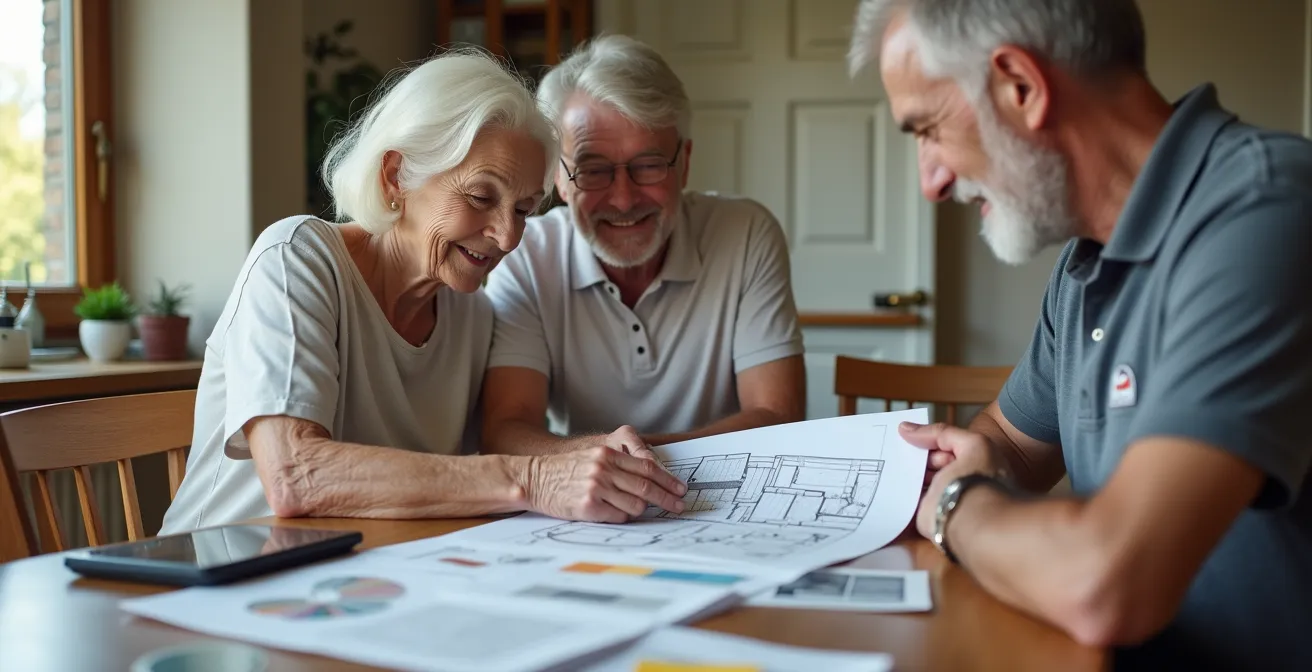
The long-term success of your accessibility renovation depends less on the total budget and more on a strategic, « future-proof » master plan.
- Success starts with prioritizing modifications based on statistical risk (like bathrooms), not just current inconvenience.
- Hiring a Certified Aging-in-Place Specialist (CAPS) is a critical investment in design expertise, not just a construction cost.
Recommendation: Audit your home not for your current needs, but for the person you will be in ten years, and use that vision to drive every decision.
The desire to age in place is nearly universal. Data from AARP confirms that an overwhelming 76% of adults aged 50 and above desire to stay in their homes throughout their senior years. Yet, the path to achieving this is often paved with piecemeal fixes, reactive changes, and costly mistakes. Many homeowners approach accessibility as a series of small projects—a grab bar here, a temporary ramp there. This approach fails to address the core challenge: creating a truly safe and comfortable environment for the long haul.
As a project manager specializing in these transformations, I see the same costly pattern: renovations are planned for the person you are today, not the person you might be in five, ten, or twenty years. The real key to a successful and budget-conscious accessibility master plan is not just about choosing the right fixtures. It’s about adopting a strategic mindset. It means shifting your focus from « What do I need now? » to « What will provide the most safety and independence for the next two decades? ». This isn’t an expense; it’s an investment in your future autonomy and a preventative measure against far greater costs down the road.
This guide provides a comprehensive project management framework for your renovation. We will move beyond simple checklists and delve into the strategic decisions that make or break an aging-in-place plan. You’ll learn how to prioritize, who to hire, how to fund the project wisely, and how to plan for a future that guarantees safety, comfort, and peace of mind.
Summary: A Project Manager’s Guide to Future-Proofing Your Home on a Budget
- Which Room Should You Make Accessible First if Budget Is Tight?
- How to Find a Contractor Who Actually Understands ADA Guidelines?
- The « Current Mobility » Mistake: Renovating for Now Instead of 10 Years Later
- Reverse Mortgage vs Home Improvement Loan: Which Funds Renovation Best?
- How to Schedule Renovation Stages to Live at Home During Construction?
- Why Stairs Become the Most Dangerous Feature After Age 75?
- Why Medicare Basic Plans Leave You Exposed to High Specialist Fees?
- How to Retrofit a 2-Story Home to Enable Seniors to Age in Place Safely?
Which Room Should You Make Accessible First if Budget Is Tight?
When every dollar in the renovation budget counts, the first decision is the most critical: where to start? From a project management perspective, you must allocate resources where they mitigate the greatest risk. The answer, backed by hard data, is unequivocally the bathroom. It’s not the most glamorous starting point, but it’s the most strategic. The combination of hard, slippery surfaces and the need to maneuver in a tight space makes it a high-risk zone for older adults.
The numbers are stark. According to the CDC, an astonishing 80% of falls among older adults happen in the bathroom. A fall can be a catastrophic event, leading to significant injury, loss of independence, and medical costs that dwarf any renovation budget. Therefore, prioritizing the bathroom is not just a safety measure; it’s a sound financial decision. By investing a small portion of your budget here first, you are actively preventing a future event that could derail your entire plan to age in place.
Focus on a « minimum viable » set of high-impact modifications to maximize your initial investment. The goal is to address the most common points of failure—getting in and out of the shower, using the toilet, and navigating wet floors. A few hundred dollars spent here yields a massive return in terms of risk reduction.
- Install screw-mounted grab bars: Place them near the toilet and in the shower/tub area. Avoid suction-cup models for long-term safety.
- Improve seating: A comfortable shower chair or a tub transfer bench significantly reduces the risk of slipping while bathing.
- Manage surfaces: Use high-quality non-slip mats both inside the shower and on the floor next to the tub or shower entrance.
- Raise the toilet: A raised toilet seat or a comfort-height toilet reduces the strain on knees and hips.
Addressing the bathroom first sets a solid foundation for the rest of your master plan, securing the most dangerous room in the house before you move on to other areas. This is your first major project win.
How to Find a Contractor Who Actually Understands ADA Guidelines?
Your master plan is only as good as the team you hire to execute it. A common and costly mistake is hiring a general contractor who sees accessibility as simply following a few ADA measurements. While the Americans with Disabilities Act (ADA) provides a baseline for commercial spaces, it doesn’t capture the nuances of creating a comfortable, functional, and aesthetically pleasing home for aging in place. You don’t just need a builder; you need a specialist.
The gold standard in this field is the Certified Aging-in-Place Specialist (CAPS) designation, offered by the National Association of Home Builders (NAHB). This isn’t just another certificate. To earn it, contractors must complete specialized courses in marketing, design, and business practices for the aging-in-place market. As the NAHB states, the CAPS credential offers reassurance that your contractor understands how to make choices that help you stay in your home « safely and securely. »
A CAPS professional thinks beyond code. They understand « universal design »—the practice of creating spaces usable by everyone, regardless of age or ability. They know how to install reinforced walls for future grab bars, how to create zero-threshold showers that don’t look clinical, and how to balance safety features with your home’s existing style. Hiring a CAPS-certified contractor is an investment in foresight and expertise that prevents you from having to re-do the work five years down the line.
When vetting potential contractors, go beyond the standard questions about licensing and insurance. You are hiring a strategic partner, and your interview process should reflect that. Use a structured audit to determine if they possess the right design philosophy, not just the construction skills.
Your Contractor Audit Checklist: 5 Key Questions to Ask
- Verify Certification: Ask for proof of their active CAPS certification from the NAHB. Don’t just take their word for it.
- Check Long-Term References: Request to speak with clients from projects completed 1-2 years ago. This reveals how well their work holds up and functions over time, not just on reveal day.
- Probe for Adaptability: Ask, « Describe a project where you had to adapt your plans because a client’s mobility changed during or after construction. » This tests their problem-solving skills and forward-thinking.
- Assess Design Sensibility: Inquire, « How do you balance critical safety features with maintaining a home’s aesthetic appeal? » Look for answers that mention universal design and « invisible » accessibility.
- Request a « Living Portfolio »: Ask to see photos or videos of their completed projects as they are currently being lived in, not just pristine, empty photos taken right after completion.
The « Current Mobility » Mistake: Renovating for Now Instead of 10 Years Later
The single most expensive error in an aging-in-place renovation is designing for your current level of mobility. A master plan must be a future-proof document. If your renovation only solves today’s challenges, you are simply postponing the next, more costly renovation. The goal is to renovate once, for good. This requires a mental shift from reactive fixes to proactive, universal design that anticipates future needs.
This means considering possibilities that may seem distant: What if you or your partner needs a walker or a wheelchair? What if a caregiver needs to assist you in the bathroom? Future-proofing involves building in solutions for these scenarios now, when it is far more cost-effective. A systematic review of home modification studies found that homes incorporating « invisible » preparations—like reinforced walls for future grab bars or wider doorways—had significantly better long-term outcomes for residents.
Key elements of a future-proof plan include:
- 36-Inch Doorways: The standard doorway is too narrow for a wheelchair. Widening them during a renovation is relatively simple; doing it later is a major, dusty, and expensive project.
- Zero-Threshold Showers: Removing the curb to a shower eliminates a primary trip hazard and makes access easy for anyone, from a person with a sore hip to someone in a rolling shower chair.
- Reinforced Walls: During construction, adding plywood backing in walls around toilets and showers costs very little. It allows you to install grab bars exactly where you need them in the future, without having to tear open the walls again.
- Lever-Style Handles: Replacing all round doorknobs and faucet handles with lever-style ones is a small change that makes a huge difference for someone with arthritis or reduced grip strength.
This forward-thinking approach doesn’t mean your home has to look like a hospital. The beauty of universal design is its subtlety, creating a space that is both beautiful and barrier-free.
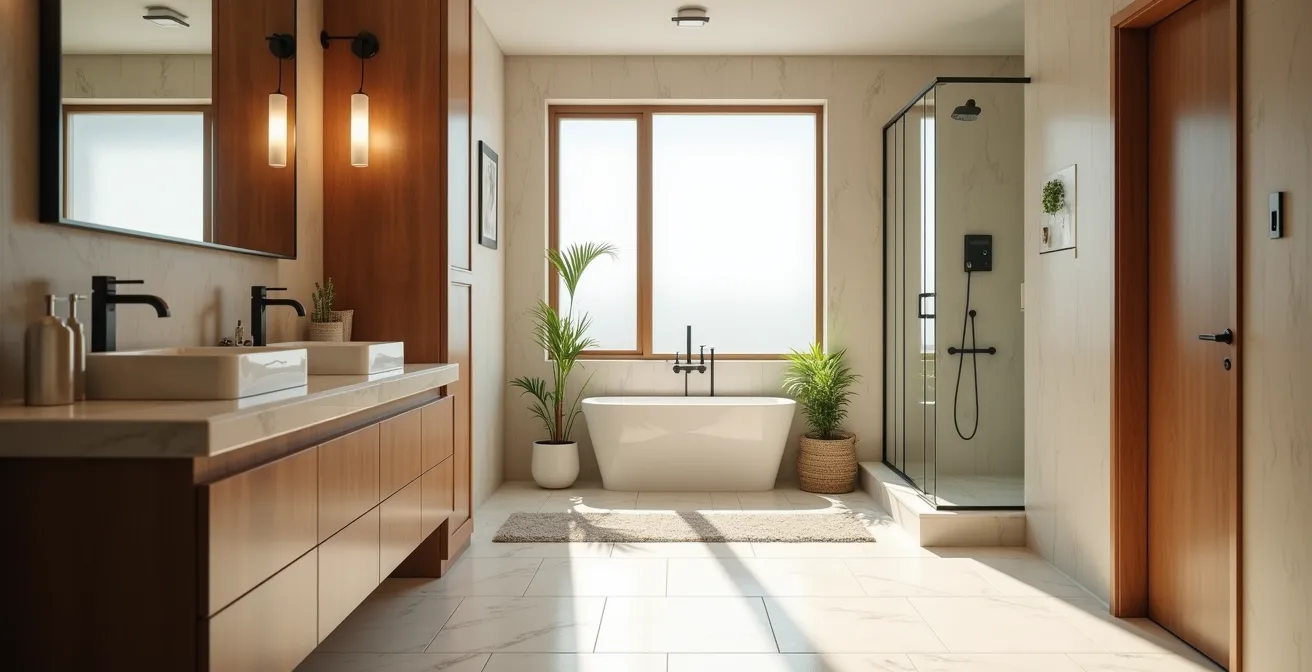
As you can see, a well-executed future-proof design is seamless. The wide doorway and zero-threshold shower in this example enhance the feeling of space and luxury while providing a level of accessibility that will serve the homeowners for decades. This is the essence of a successful master plan: creating a home that adapts to you, not the other way around.
Reverse Mortgage vs Home Improvement Loan: Which Funds Renovation Best?
Once your master plan is taking shape, the next project management task is securing funding. For many homeowners over 60, their home equity is their largest asset. The two most common financial tools for leveraging this asset are a home improvement loan (like a HELOC or home equity loan) and a reverse mortgage. Choosing the right one depends entirely on your long-term financial strategy and cash flow needs.
A home improvement loan or a Home Equity Line of Credit (HELOC) functions like a traditional loan. You borrow a lump sum or draw funds as needed, and you begin making monthly payments (principal and interest) almost immediately. This is an excellent option if you have a strong, steady income and prefer a structured repayment plan. It’s a straightforward transaction: borrow, improve, repay.
A reverse mortgage is fundamentally different. It allows homeowners 62 and older to convert part of their home equity into cash without having to make monthly mortgage payments. You can receive the funds as a lump sum, a line of credit, or monthly payments. The loan, plus accrued interest, is repaid when the last borrower sells the home, moves out, or passes away. This can be an ideal solution if your primary goal is to improve your home for aging in place while eliminating a major monthly expense and preserving your liquid assets for daily living.
The decision framework isn’t just about interest rates; it’s about the « cost of inaction. » Policy makers note that falls cost over $50 billion annually, with the majority of post-fall medical expenses falling on Medicare and Medicaid. A $40,000 renovation that prevents a fall—and a subsequent $35,000 hip fracture surgery—is a sound investment. Both loan types can be viewed as tools to fund this critical « preventative care » for your home, which is often not covered by basic insurance.
Consider your personal financial picture. If you want to pay off the debt within a specific timeframe and have the income to support it, a home improvement loan is clear-cut. If you want to maximize your cash flow during retirement and plan to stay in the home for the rest of your life, a reverse mortgage can provide the funds for the renovation while also improving your monthly financial stability.
How to Schedule Renovation Stages to Live at Home During Construction?
For most seniors, moving out during a renovation is not a viable or desirable option. This makes scheduling the most complex part of the project manager’s job. A successful « live-in » renovation requires meticulous planning to minimize disruption and maintain a safe living environment. The key is to create a « sanctuary » and phase the project logically around it.
Before any demolition begins, your first step is to establish a « Sanctuary Room. » This is typically a spare bedroom or den that can be sealed off from the construction zone. Equip it with everything you need for comfort: a comfortable chair, a television, books, a mini-fridge, a microwave, and a coffee maker. This space becomes your clean, quiet retreat from the noise and dust, ensuring your daily routine is disrupted as little as possible.
With your sanctuary established, work with your CAPS contractor to develop a phased schedule:
- Phase 1: Bathroom(s). Tackle the bathroom modifications first. If you have a second bathroom, this is straightforward. If not, the contractor must work to ensure you have a functional toilet available at the end of each workday.
- Phase 2: Kitchen and Main Living Areas. This is often the most disruptive phase. Schedule noisy work for midday when you might be out or resting elsewhere. Plan to rely on your sanctuary’s microwave and simple meals to get through this stage.
- Phase 3: Bedrooms and Secondary Spaces. These are typically the final and least disruptive areas of the project.
Throughout the process, safety is paramount. Insist on a clear, well-lit, and debris-free pathway from your sanctuary room to the main exit and the functional bathroom at all times. A critical part of this is providing your contractor with clear guidelines that go beyond standard worksite safety.
Providing a ‘Senior Health & Safety Protocol’ to contractors goes beyond typical site safety to address risks specific to older adults, such as managing airborne dust for respiratory health and scheduling noisy work around rest times
– Janet Engel, OT/L, CAPS, ECHM, Home Designs for Life
Finally, a crucial project management tip: make all your material selections—fixtures, tiles, paint colors, flooring—before Day 1 of construction. This prevents « decision fatigue » and keeps the project on schedule by avoiding delays while waiting for materials or decisions.
Why Stairs Become the Most Dangerous Feature After Age 75?
For decades, stairs are simply a way to get from one floor to another. But as we age, they can transform into the single most dangerous feature in a home. After age 75, a combination of physiological changes converges to dramatically increase the risk associated with stairs. This isn’t just about a fear of falling; it’s a statistical reality that must be addressed in any long-term aging-in-place plan for a multi-story home.
The risk is a multi-faceted problem. Vision changes, such as reduced depth perception and sensitivity to glare, can make it difficult to judge the edge of a step. A decline in balance, a natural part of aging, makes any misstep harder to correct. Reduced muscle strength in the legs makes lifting the feet high enough for each step more challenging, increasing the likelihood of catching a toe. Add in the potential side effects of medications, like dizziness, and you have a recipe for disaster. The CDC statistics are a sobering reminder of the consequences: in 2018 alone, approximately 32,000 deaths among older adults were related to falls.
A fall on a staircase is fundamentally more dangerous than a fall on a level surface. The potential for tumbling multiplies the impact and increases the likelihood of a severe injury, such as a hip fracture or head trauma. This is why addressing the « stair problem » is a non-negotiable part of a two-story home master plan.
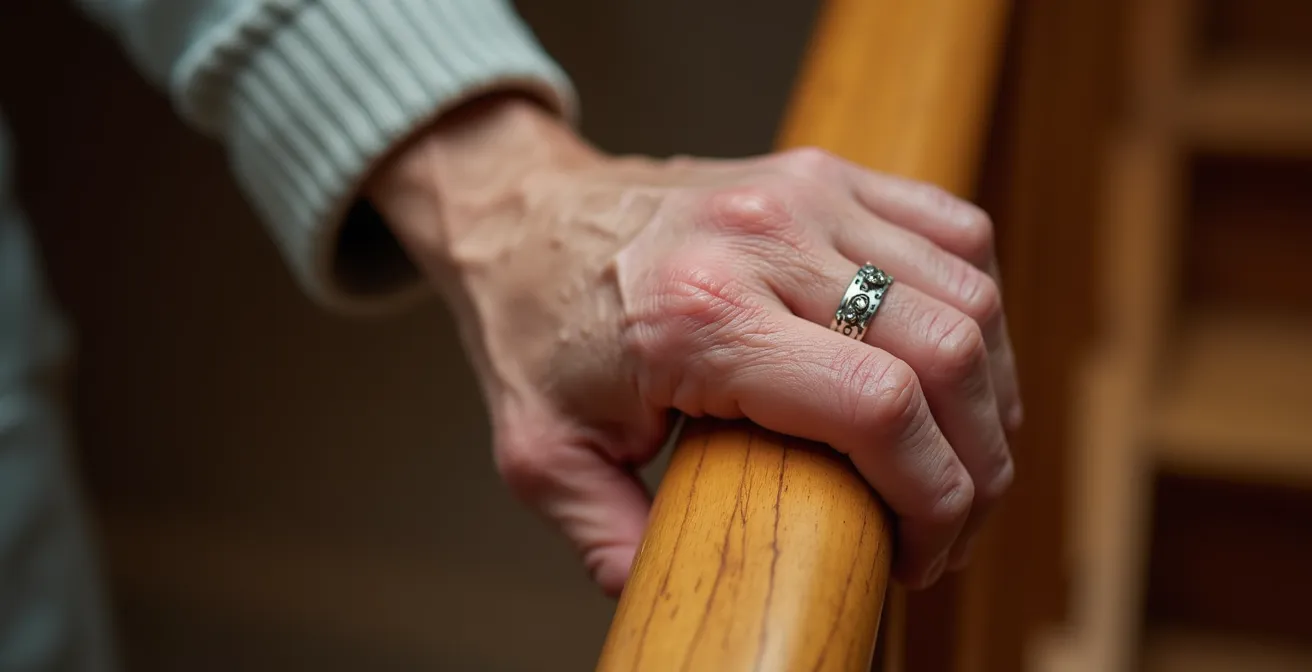
The connection between hand and handrail becomes a critical lifeline. But even with excellent handrails and good lighting, the inherent risk of vertical travel remains. The physical effort required to climb stairs can also become a significant barrier, leading to a situation where an individual becomes « trapped » on one floor of their own home, effectively cutting off half their living space. For a master plan to be truly comprehensive, it must present a clear, long-term solution for navigating or eliminating the home’s most dangerous feature.
Why Medicare Basic Plans Leave You Exposed to High Specialist Fees?
A crucial part of your renovation’s financial planning is understanding what happens if you *don’t* make these improvements. Many people assume Medicare will cover them in the event of a fall-related injury. While it covers a portion of « medically necessary » treatment, it leaves you dangerously exposed to the high costs of both the event and the recovery—and it covers almost none of the preventative measures.
Basic Medicare (Part A and Part B) is designed to treat illness and injury, not to prevent it. This means that home modifications—even when prescribed by a doctor to prevent falls—are almost never covered. The stairlift, the walk-in shower, the grab bars… these are considered « home improvements, » not « durable medical equipment, » and you will pay for them out of pocket. This creates a dangerous financial paradox: the very things that could prevent a costly injury are not covered, but the treatment for that injury is (partially).
The real financial exposure comes after a fall. While Medicare may cover 80% of a hip fracture surgery, the 20% copay on a $40,000 procedure is still $8,000, not including the anesthetist and other specialist fees. The subsequent rehabilitation care is also limited. The cost gap between proactive prevention and reactive care is immense, and your basic plan leaves you to bridge it.
The following table starkly illustrates the « invest now or pay much more later » reality. The out-of-pocket cost for preventative modifications is a fraction of the potential out-of-pocket expenses following a single fall.
| Intervention/Outcome | Average Cost | Medicare Coverage |
|---|---|---|
| Stairlift Installation | $3,000-$5,000 | Not covered |
| Bathroom Modification Package | $500-$2,000 | Not covered |
| Hip Fracture Surgery | $35,000-$40,000 | 80% after deductible |
| 90-Day Rehabilitation | $30,000+ | Limited to 100 days |
| Emergency Ambulance | $1,200+ | 80% if medically necessary |
Some Medicare Advantage (Part C) plans are beginning to offer more flexibility, sometimes providing benefits for things like grab bars or medical alert systems. However, this coverage varies dramatically by plan and location. It should be explored, but not relied upon as the foundation of your funding strategy. The core financial truth remains: basic Medicare protects you from catastrophic hospital bills, but it leaves you fully exposed to the costs that lead up to them.
Key takeaways
- Prioritizing the bathroom first is the most strategic use of a limited budget due to high fall risk.
- Hire a Certified Aging-in-Place Specialist (CAPS) for their design philosophy, not just their construction skills.
- A successful plan renovates for your future self (10+ years from now), not just your current mobility needs.
How to Retrofit a 2-Story Home to Enable Seniors to Age in Place Safely?
For owners of two-story homes, the « stair problem » is the ultimate strategic challenge. Your master plan must address it head-on with a permanent, reliable solution. Relying on sheer willpower or « being careful » is not a strategy. There are three primary solutions, each with a different budget, level of disruption, and long-term impact on your home’s value and functionality. Your role as project manager is to weigh these options against your specific home layout, budget, and future-proof goals.
The decision matrix for a two-story home essentially comes down to these « big three » options. Each solves the problem of vertical travel, but in a very different way.
This table compares the major solutions for a two-story home. As an analysis of home modifications shows, each has distinct implications for cost and home value.
| Solution | Cost Range | Power Outage Function | Wheelchair Compatible | Home Value Impact |
|---|---|---|---|---|
| Stairlift | $3,000-$15,000 | Battery backup standard | No (transfer required) | Neutral to slight negative |
| Residential Elevator | $20,000-$60,000 | Requires generator | Yes | Positive (adds value) |
| First-Floor Primary Suite | $15,000-$50,000 | Not applicable | Yes | Positive (adds bedroom) |
A stairlift is the most common and least expensive option. It solves the immediate problem of getting up and down the stairs. However, it doesn’t accommodate a wheelchair and can be a visual and physical obstruction in the stairway for other family members. It’s a good solution, but perhaps not a permanent one. An elevator is the most comprehensive solution, offering full accessibility and adding value to your home. However, its high cost and significant construction requirements put it out of reach for many budgets.
Case Study: The First-Floor Conversion Advantage
The third option, converting a first-floor space (like a den, dining room, or office) into a primary bedroom suite, is often the most strategic choice. It effectively turns a two-story house into a single-level home for all daily activities. This solution completely eliminates stair-related risks. A recent analysis of 113 home modification projects found that these conversions were rated most satisfactory by 87% of seniors after two years. Furthermore, they typically cost 40% less than installing an elevator while providing superior long-term accessibility and adding a valuable first-floor bedroom, which is a positive for resale value.
For many, this makes the first-floor conversion the sweet spot of cost, functionality, and future-proofing. It is often the ultimate expression of a well-executed master plan: a practical, elegant solution that ensures decades of safe and comfortable independent living.
Your home is more than an asset; it’s the anchor of your independence. Creating a master plan is the first and most important step to protecting that. By thinking like a project manager—prioritizing based on risk, investing in true expertise, and planning for the future—you can execute a renovation that secures your ability to live safely and comfortably in the place you love for years to come. The next logical step is to begin the audit process for your own home. Evaluate your space now to start building the plan that will serve you for the next 20 years.