In summary:
- Stop forcing a rigid routine; build an adaptive system that respects your daily energy and pain levels.
- Focus on « micro-consistency » (short, daily movements) over intense, infrequent workouts to prevent injury.
- Use tools like the « Traffic Light System » to choose the right activity for you each day.
- Embrace mobility aids and engaging activities as tools for empowerment, not signs of decline.
The desire to stay active and healthy doesn’t fade with age, but the body’s ability to cooperate often does. For many seniors facing limited mobility or chronic pain, the standard advice to « just exercise more » feels not only unhelpful but deeply frustrating. You’ve likely been told to « start slow » or to try generic chair exercises, yet these one-size-fits-all plans often crumble at the first sign of a bad pain day or a dip in energy, leading to a cycle of starting, stopping, and feeling defeated.
This cycle occurs because traditional fitness plans are rigid, demanding consistency from a body that is, by nature, variable. They fail to account for the daily fluctuations that are a reality for anyone with chronic conditions. But what if the goal wasn’t to find a perfect, unchangeable routine? What if the key to sustainable wellness was to throw out the rigid plan and instead build an intelligent, adaptive system? This guide is designed to show you exactly how to do that. We will move beyond the platitudes and give you a framework for creating a wellness practice that honors your body’s daily signals, turning movement from a source of dread into a source of empowerment and joy.
For those who prefer a visual demonstration of gentle, accessible movements, the following video offers an excellent starting point. It provides a clear guide to seated exercises that can be integrated into your adaptive plan.
This article will guide you through a new way of thinking about your health. We will explore how to set goals that work with pain, debunk the myth that it’s « too late to start, » and provide practical tools to build a truly sustainable and enjoyable wellness journey. You’ll find a structured path to reclaiming your strength and vitality, one manageable step at a time.
Summary: Your Adaptive Wellness System for Lasting Health
- How to Set Health Goals That Stick When You Have Chronic Pain?
- Why Thinking You Are « Too Old to Start » Is Scientifically Incorrect?
- Solo Routine vs Group Classes: Which Works Best for Introverted Seniors?
- The « New Year’s Resolution » Mistake That Causes Injury in Week Two
- How to Adjust Your Wellness Plan Weekly Based on Energy Levels?
- Maintenance Phase: How Often Should You See a PT to Prevent Decline?
- The « I’m Too Old for Gaming » Mistake That Keeps You Bored
- How to Select the Right Mobility Aids to Stay Active Outside the Home?
How to Set Health Goals That Stick When You Have Chronic Pain?
When you live with chronic pain, setting a health goal can feel like planning a picnic in a hurricane. How can you commit to a « 30-minute walk every day » when you don’t know if you’ll be able to get out of bed tomorrow? This is where traditional goal-setting fails. The secret isn’t grit; it’s flexibility. Instead of a single, rigid goal, you need a multi-tiered approach that adapts to your body’s reality. A « Plan A » for good days, a « Plan B » for moderate days, and a « Plan C » for the difficult days where even a little movement is a victory.
This approach shifts the definition of success from « did I hit my ambitious target? » to « did I do something for my wellness today? ». A Plan C might be as simple as five minutes of gentle, seated stretching. This creates motivational resilience, because even on a bad day, you can succeed. The goal becomes consistency, not intensity. The Central Baptist Village’s adaptive wellness program found success with this exact model, showing that residents who prioritized just 5-10 minutes of daily practice over intense goals had significant improvements in pain management. This proves that a small, consistent effort is far more powerful than a large, sporadic one.
To build this flexible approach, it’s crucial to connect your activities to a meaningful purpose. Don’t just « exercise »; move so you can continue to play with your grandchildren, tend to your garden, or maintain your independence. This transforms a chore into an act of self-preservation and joy.
Your FLEX Goal-Setting Framework for Chronic Pain
- Flexible goals: Define your « Plan A » (e.g., 20-min walk), « Plan B » (10-min seated strength), and « Plan C » (5-min breathing exercises) to adapt to daily pain levels.
- Life-enhancing activities: Choose movements that directly support a meaningful purpose, like improving balance for gardening or arm strength for holding a grandchild.
- Energizing movements: Start with just 2-3 minutes of an activity that builds, rather than depletes, your energy. The goal is to finish feeling better, not exhausted.
- X-ploratory mindset: Commit to trying one new gentle movement each week (like a new stretch or a balance exercise) to discover what feels good for your unique body.
- Track for consistency: Measure success by how many days you « showed up » (even for Plan C), not by minutes or intensity. Celebrate the act of participating.
Why Thinking You Are « Too Old to Start » Is Scientifically Incorrect?
One of the most pervasive myths in wellness is the idea that after a certain age, the body is in a state of irreversible decline. The thought « I’m too old for this » can be a powerful demotivator, but science tells a very different and much more hopeful story. While it’s true that we lose muscle mass as we age (a process called sarcopenia), it is absolutely not a one-way street. Research has repeatedly shown that you can build muscle and improve strength at any age, whether you’re 70, 80, or 90. The body’s ability to adapt and grow stronger in response to stimulus remains throughout life.
Furthermore, while some physical abilities may change, others can be preserved indefinitely. As mobility expert Dr. Kelly Starrett states in the « Chasing Life » podcast, your capacity for movement is far more resilient than you might think.
The one thing that doesn’t have to change over the whole lifespan is your range of motion.
– Dr. Kelly Starrett, CNN Health – Chasing Life Podcast
This is a profound concept. It means that with gentle, consistent practice, you can maintain or even improve your flexibility and joint health, which are fundamental to everyday activities like reaching for an item on a high shelf or bending down to tie your shoes. The CDC’s formal recommendation might seem daunting, suggesting that adults over 65 maintain 150 minutes of moderate activity weekly plus strength training. However, the key is to see this not as a strict rule but as a distant lighthouse. Your journey starts with a single step—perhaps just five minutes of movement today—knowing that every small effort is a scientifically-backed investment in a stronger, more capable future you.
Solo Routine vs Group Classes: Which Works Best for Introverted Seniors?
The image of a vibrant, chatty group fitness class is often presented as the ideal for senior wellness. While the social connection can be a powerful motivator for some, it can be an energy-draining nightmare for others, especially those who are more introverted. Forcing yourself into a highly social environment when you crave quiet can make exercise feel like a chore, dooming your routine before it even begins. Understanding your social energy is just as important as understanding your physical energy. There is no « better » option between solo and group settings; there is only what is better for you.
A solo routine offers complete control and freedom. You can focus deeply on the sensations in your body, move at your own pace without feeling watched, and exercise whenever it suits you. This is ideal for deep body awareness work and for those who find social interaction taxing. On the other hand, group classes provide external accountability and a shared energy that can be motivating. The key is to find a middle ground if neither extreme feels right.
This is where the innovative « hybrid » or « parallel play » approach comes in. The Live 2 B Healthy program, for instance, found a 40% increase in participation among self-identified introverts by offering choice-based classes. Participants could join a live class but stay in a designated « quiet zone, » use headphones, or even join virtually from home. This gives you the structure and environmental energy of a class without the pressure of forced interaction. The following table breaks down these options to help you find your best fit.
This comparative table helps clarify the trade-offs between different exercise environments, allowing for a more personalized choice.
| Aspect | Solo Routine | Group Classes | Hybrid ‘Parallel Play’ Approach |
|---|---|---|---|
| Social Energy Required | Minimal – complete control | High – constant interaction | Low – present but not engaged |
| Accountability | Self-directed or app-based | Peer and instructor pressure | Visual presence without interaction |
| Flexibility | Complete schedule freedom | Fixed class times | Drop-in when convenient |
| Motivation Source | Internal or digital tracking | Group energy and instructor | Environmental energy without social drain |
| Best For | Deep body awareness work | Social butterflies | Introverts who benefit from structure |
The « New Year’s Resolution » Mistake That Causes Injury in Week Two
The beginning of any new wellness journey is filled with enthusiasm. This initial burst of motivation is wonderful, but it’s also dangerous. It often leads to the « New Year’s Resolution » mistake: doing too much, too soon. You feel good, so you decide to go from zero activity to a 30-minute workout five days a week. For the first week, it feels great. But by week two, you’re sore, exhausted, and possibly injured. This is the single most common reason that well-intentioned wellness plans fail.
For seniors, especially those with limited mobility, this mistake is particularly risky. As falls are the leading cause of injury for people 65 and older, preventing over-exertion and maintaining balance is not just a good idea—it’s a critical safety measure. An injury can set you back for weeks or months and completely derail your confidence and motivation. The antidote to this « all-or-nothing » approach is a philosophy of gradual, methodical progression. It’s less exciting, but infinitely more sustainable.
A powerful strategy to prevent this is the « Rule of One. » This protocol forces you to build your routine slowly and safely, ensuring your body has ample time to adapt. It may feel frustratingly slow at first, but it is the surest path to creating a lasting habit without the risk of burnout or injury. Remember, the goal is to be moving consistently a year from now, not to be a hero in your first week.
- Week 1: Choose ONE single exercise (e.g., seated marches for 2 minutes) and do only that daily.
- Week 2: Add ONE more exercise OR extend the first by 1 minute—never both at the same time.
- Week 3: Implement your first « deload. » Maintain your Week 2 level without any progression to allow your body to consolidate its gains.
- Week 4: Add variety with ONE alternative movement that works the same muscle group to keep things interesting.
- Pre-Start Ritual: Before you even begin, set yourself up for success. Clear your exercise space, lay out tomorrow’s clothes tonight, and place a water bottle in plain sight.
How to Adjust Your Wellness Plan Weekly Based on Energy Levels?
The most significant flaw in any rigid fitness plan is its failure to account for one simple truth: your energy is not the same every day. A plan that felt great on Monday might feel impossible by Thursday due to poor sleep, increased pain, or emotional stress. Trying to force yourself through a high-energy routine on a low-energy day is a recipe for failure and frustration. The cornerstone of an adaptive wellness system is learning to listen to your body and adjust your activity accordingly. This isn’t « giving up »; it’s being smart and strategic.
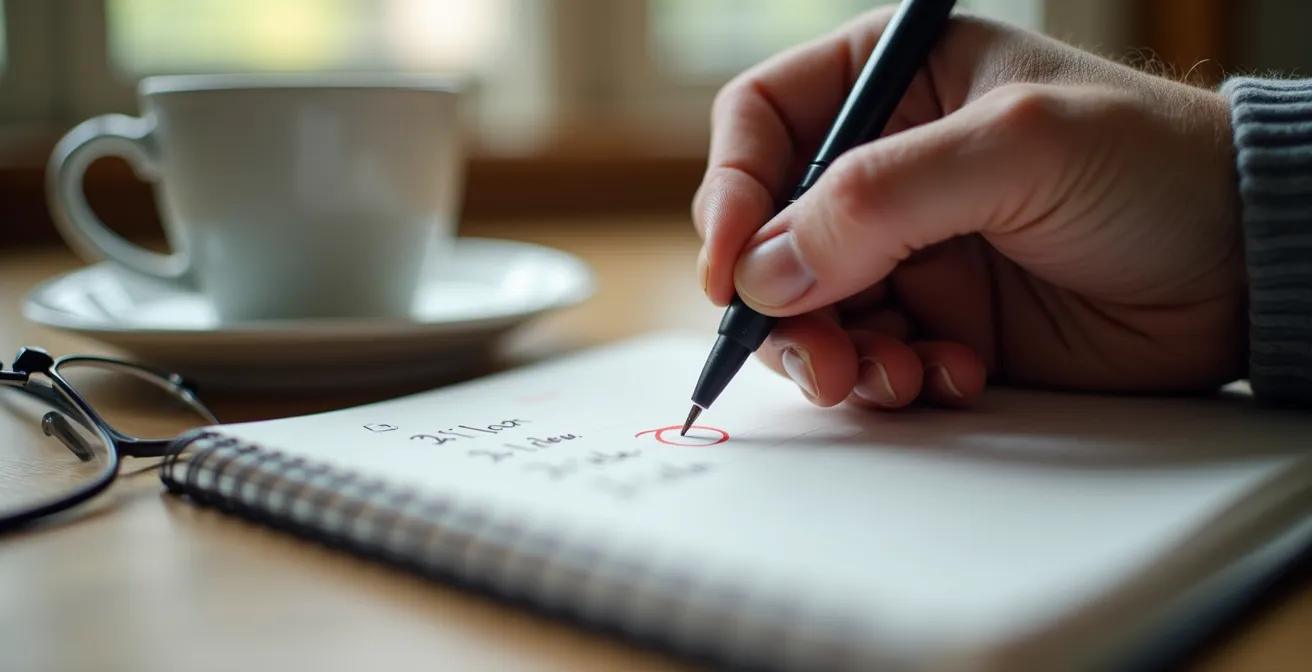
A simple yet powerful tool for this is the « Traffic Light System. » Each morning, you do a quick self-assessment and assign your day a color: Green for high energy, Yellow for medium energy, or Red for low energy. This color then dictates what kind of activity you’ll do. A « Red » day isn’t a « do nothing » day; it’s an « active recovery » day, focusing on gentle stretching or breathing exercises. This reframes rest as a productive part of your wellness plan. This approach is about working *with* your body, not against it.
Some forward-thinking communities, like SALMON Health, have implemented this concept through a « Wellness Menu ». Residents choose their daily activities like ordering from a menu: light « Appetizers » (5-minute stretches), more involved « Main Courses » (15-20 minute walks), and relaxing « Desserts » (meditation). This approach led to a 60% increase in adherence because it empowered residents, giving them a sense of control and choice. The following table provides a simple model you can adopt for your own traffic light system.
Using this energy-based model allows you to stay consistent while respecting your body’s daily fluctuations.
| Energy Level | Color Code | Recommended Activity | Duration | Focus Area |
|---|---|---|---|---|
| High Energy | Green | Full planned routine | 20-30 minutes | Strength + Cardio + Flexibility |
| Medium Energy | Yellow | Modified routine | 10-15 minutes | Flexibility + Light strength |
| Low Energy | Red | Rest as active recovery | 5-10 minutes | Breathing + Gentle stretching |
Maintenance Phase: How Often Should You See a PT to Prevent Decline?
Once you’ve established a consistent wellness routine, it’s easy to think you’re « cured » and no longer need professional guidance. However, the maintenance phase is where the real long-term work begins. A physical therapist (PT) isn’t just for recovering from an injury; they are an essential partner in preventing decline and safely progressing your fitness. Thinking of a PT as a mechanic for your body is a useful analogy: you don’t just go when the car is broken down; you go for regular tune-ups to keep it running smoothly for years to come.
For a senior on a maintenance plan, a proactive check-up with a PT every 3 to 6 months can be transformative. This isn’t about intensive rehabilitation. It’s a strategic wellness visit to fine-tune your routine. During these check-ups, a PT can assess your movement patterns, identify subtle imbalances before they become problems, and help you safely progress your exercises to avoid plateaus. This proactive approach is backed by evidence; research shows that structured exercise programs reduce fall risk by up to 30%, and a PT is your best resource for ensuring your program remains effective and safe over the long term.
To get the most out of these visits, you must come prepared. Don’t just show up and ask « how am I doing? ». Go in with specific questions about your daily life and your wellness goals. This turns the appointment into a collaborative strategy session, empowering you with the knowledge to manage your own health effectively between visits. Being an active participant in your care is key to long-term success.
- How can I safely progress from my current exercise level to prevent plateaus?
- What home environment modifications (e.g., rug placement, chair height) would optimize my exercise safety?
- Which specific movement patterns should I focus on for my daily activities, like getting out of a chair or carrying groceries?
- What are the early warning signs of pain or fatigue that indicate I need to modify my routine?
- Can you teach me simple self-assessment techniques to monitor my own progress in balance or strength?
The « I’m Too Old for Gaming » Mistake That Keeps You Bored
A sustainable wellness plan isn’t just about the body; it’s about the mind. One of the biggest threats to any routine is boredom. If your activities feel like a monotonous chore, you will eventually stop doing them. While physical movement is crucial, finding activities that are mentally engaging and genuinely fun is just as important. Yet, many seniors dismiss an entire world of engaging activity with a simple phrase: « I’m too old for gaming. » This is a profound mistake that can lead to a wellness plan that is physically effective but emotionally hollow.
Modern « gaming » is a universe away from the fast-paced, high-stress video games of the past. There is a growing genre of « cozy games » designed for relaxation, creativity, and gentle problem-solving. Games like *Unpacking* (a zen-like game about organizing a home) or *Dorfromantik* (a peaceful landscape-building puzzle) require no fast reflexes and provide a deep sense of satisfaction. Furthermore, technology like seated Virtual Reality (VR) is opening up new worlds for those with limited mobility. As a program at Liv Hospital discovered, offering virtual travel or painting in VR led to a 70% improvement in mood and motivation among participants, helping to combat the isolation and boredom that often accompany physical limitations.
Engaging in these activities can also be a powerful way to connect with younger generations. Playing a turn-based game like *Words with Friends* or online chess with a grandchild creates a shared experience that bridges the generation gap. It’s not about becoming a « gamer »; it’s about finding joyful, stimulating ways to keep your mind active and engaged, which is a critical component of holistic well-being.
- Start with tablets: Try « cozy games » like *Unpacking* or puzzle games that have no time pressure.
- Connect with family: Use turn-based games like *Words with Friends* or *Chess.com* to play with grandchildren remotely.
- Explore virtual worlds: Look into seated VR experiences like Google Earth VR for virtual travel or guided meditation apps.
- Find your community: Join online game communities designed for seniors that offer tutorials and patient support.
- Share the experience: Set up video calls with friends or family while playing the same game separately to create a sense of togetherness.
Key Takeaways
- Your wellness plan must be an adaptive system, not a rigid script. Use the « Traffic Light » method to adjust daily.
- Success is measured by « micro-consistency » (doing something small every day) rather than heroic, infrequent efforts.
- It is never « too late. » Your body can build strength and improve range of motion at any age.
How to Select the Right Mobility Aids to Stay Active Outside the Home?
For many, the thought of using a cane, walker, or other mobility aid feels like a surrender—a visible symbol of decline. This perspective is a critical mistake. A mobility aid is not a sign of weakness; it is a tool of empowerment. It is a device that grants you the freedom, safety, and confidence to stay engaged with the world outside your home. Choosing the right aid is an investment in your independence, allowing you to walk in the park, visit with friends, or go shopping with a greatly reduced risk of falling.
The selection process should be deliberate and ideally done with guidance from a physical or occupational therapist. The first step is to honestly assess your primary need. Is it stability (you feel unsteady but have decent strength) or endurance (you tire easily but are otherwise stable)? A simple cane might be perfect for a little extra stability, whereas a four-wheeled rollator with a seat is better suited for someone who needs to take frequent rests due to low endurance. Walkers provide a high degree of stability but are less maneuverable, while mobility scooters are best for longer distances when walking is not feasible.
Once you’ve identified the right type of aid, professional fitting is non-negotiable. An improperly sized walker or cane can create new problems, affecting your posture and increasing your fall risk. A PT can ensure the height is correct (the handle should be at wrist-crease level when you stand straight) and teach you how to use it safely, especially on stairs or uneven surfaces. Embracing a mobility aid is a proactive step toward maintaining an active, fulfilling life. It is not an admission of defeat, but a declaration of your intent to keep moving.
Building a sustainable wellness plan is not about finding a magic bullet, but about developing a deep, respectful partnership with your own body. By embracing flexibility, celebrating small wins, and using every tool at your disposal—from a PT to a walker—you can create a life of continued movement, strength, and vitality. Start today by choosing one small, energizing movement and take the first step in your adaptive wellness journey.