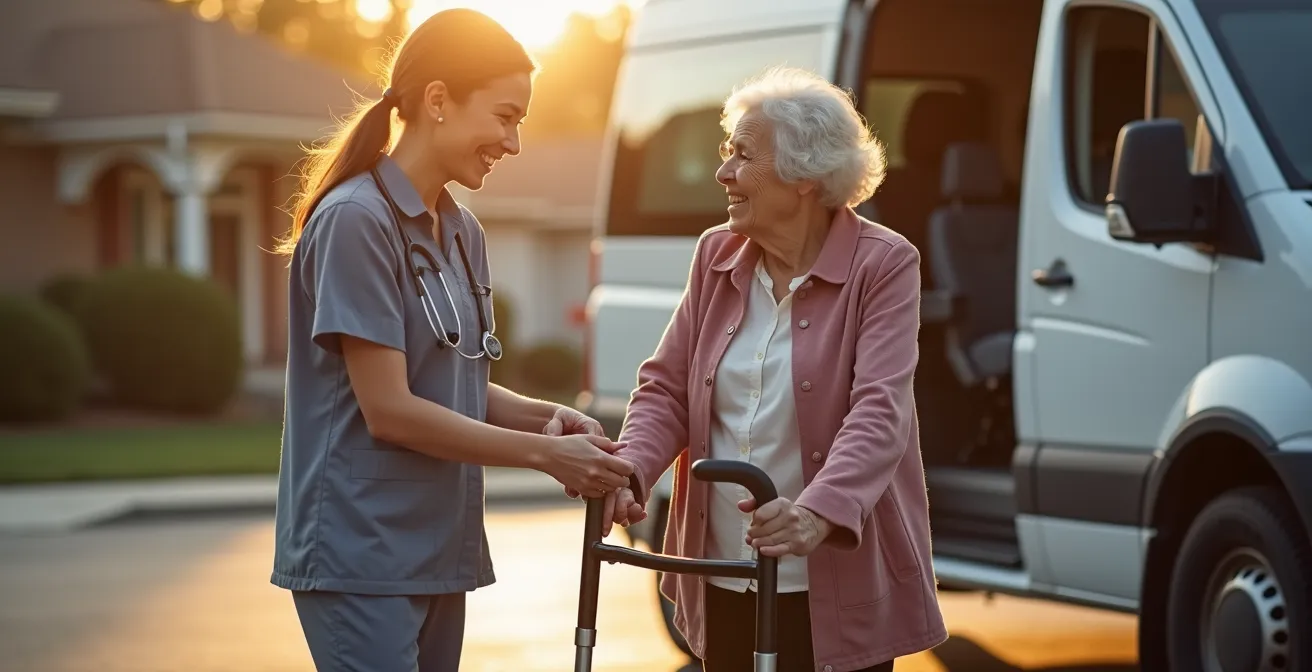
The fear of logistical nightmares shouldn’t shrink your world; the right support system makes safe, joyful travel entirely possible.
- Expert planning transforms overwhelming details, like bathroom access and transport, into a seamless « logistical choreography. »
- A Personal Support Worker (PSW) acts as a travel companion, providing not just physical assistance but also crucial emotional support and anxiety-calming techniques.
Recommendation: Start with small, well-planned « micro-adventures » with a PSW to rebuild confidence and rediscover the joy of being out in the world.
For many seniors with mobility challenges, the world can start to feel like it’s shrinking. The simple joy of an afternoon at the museum, a visit to family, or even a trip to the park can become overshadowed by a mountain of logistical worries. What if there’s no accessible restroom? What if I get too tired? What if I fall? This fear is valid, but it doesn’t have to be a life sentence confined to four walls. While well-meaning advice often centers on simply « planning ahead » or « packing your medications, » this overlooks the most critical element: confidence.
The true key to unlocking the world again isn’t just about avoiding risk; it’s about building a « scaffolding of confidence » around you. This is the specialized role of a Personal Support Worker (PSW). More than just a caregiver, a PSW acts as a dedicated travel companion and logistical expert, transforming daunting challenges into manageable, even exciting, adventures. They are the architects of your freedom, choreographing the details so you can focus on the experience itself.
This guide will walk you through the practical and emotional support system a PSW provides to facilitate safe and enriching outings. We will deconstruct the common fears associated with travel and show you how an expert partner can help you build the confidence to step outside and explore your world once more, one joyful trip at a time.
To help you navigate these solutions, this article covers the key strategies and considerations for planning successful outings. Explore the topics below to build your roadmap to renewed freedom and adventure.
Summary: A Guide to Outings for Seniors with Mobility Issues
- How to Pack a « Just in Case » Bag for Senior Outings?
- Why « Travel Is Too Dangerous » Is a Myth That Shrinks Your World?
- The Bathroom Planning Mistake That Ruins Senior Outings
- Wheelchair Van vs Standard Car: Which Is Better for a 2-Hour Trip?
- How to Calm Senior Anxiety During Car Rides or Crowded Events?
- How to Use Medical Transport Services When You Can’t Drive Mom Yourself?
- The Transport Weight Error That Leaves Seniors Stranded at Home
- How to Organize Accessible Community Outings for Groups With Mixed Mobility?
How to Pack a « Just in Case » Bag for Senior Outings?
The first step in any great adventure is being prepared. For a senior with mobility issues, a well-packed bag is more than just a collection of items; it’s a toolkit for confidence. It says, « Whatever happens, we have a solution. » A PSW elevates this preparation from a simple checklist to a professional, three-layered system designed for safety, comfort, and dignity. This systematic approach ensures that you’re ready for minor inconveniences and major emergencies alike, allowing you to relax and enjoy the outing. This is especially vital when you consider that, according to AARP’s 2025 travel trends survey, 17% of travelers 50-plus need accommodations for a disability or health condition, with a high demand for mobility support.
The first layer is the Medical Pouch. This is non-negotiable and includes all current prescriptions in their original bottles, a compact first-aid kit, and crucial emergency contact and medical alert information. A PSW ensures this information is clear, concise, and easily accessible for first responders.
Next is the Comfort Kit. This is where a PSW’s personal touch shines. It’s about managing the sensory experience of an outing. This kit may include items like a familiar scented hand lotion, noise-canceling earbuds for loud environments, or even a small weighted lap pad to provide calming pressure during anxious moments. Finally, the Dignity Pack discreetly handles personal care needs with items like incontinence products in opaque pouches, wet wipes, and a change of clothes. By planning for these needs with professionalism and privacy, a PSW ensures that a minor issue doesn’t derail the entire day, preserving dignity and peace of mind.
Why « Travel Is Too Dangerous » Is a Myth That Shrinks Your World?
One of the most pervasive myths that keeps seniors at home is the belief that the outside world is simply too dangerous. While caution is wise, letting fear dictate your life leads to isolation and a diminished world. A PSW helps to reframe this mindset by separating perceived risk from actual risk. They are experts in risk mitigation, not risk avoidance. Their role is to show that with proper planning and support, the world is far safer and more accessible than it may seem from behind a closed door.
Consider air travel, often seen as a significant hurdle. In reality, modern transportation is incredibly safe. As a testament to this, MIT research demonstrates that the risk of fatality from commercial air travel is now 1 per every 13.7 million passenger boardings globally. A PSW uses this kind of data to replace vague fears with concrete facts. They systematically address each « what if » with a « here’s how we handle that, » turning a mountain of anxiety into a series of manageable steps.
This confidence is built incrementally. The journey to reclaiming your freedom doesn’t have to start with a cross-country flight. As detailed in the following case study, the most effective approach is to begin with « micro-adventures. »
The Confidence Ladder Approach in Senior Travel
The travel organization Road Scholar champions the concept of starting with « micro-outings » to build confidence for larger trips. Their approach involves a gradual scaling of activity. A PSW can implement this by first planning a short trip to a local cafe, then a half-day at a nearby park, and eventually a full-day excursion. This method, as Road Scholar suggests, allows seniors to practice using mobility aids like rolling suitcases and crossbody bags for hands-free movement and to test their endurance in a low-stakes environment. Each successful outing becomes a rung on the ladder, building the physical and emotional stamina for more ambitious adventures.
The Bathroom Planning Mistake That Ruins Senior Outings
Of all the logistical challenges, none causes more anxiety or has more potential to ruin an outing than the fear of not finding a clean, accessible bathroom in time. This single worry can be so powerful that it prevents people from leaving home altogether. A common mistake is to simply hope for the best or assume a public venue will be accommodating. A PSW replaces this hope with a concrete strategy, approaching bathroom access with the precision of a military operation. This is « dignity by design »—the proactive and discreet planning that ensures a fundamental human need is met with respect and without stress.
This process begins long before leaving the house, using a digital scouting protocol. A PSW will use tools like Google Maps Street View to virtually inspect venue entrances and routes to facilities. They leverage apps like Wheelmap, which provide user-verified information on accessible restrooms. Crucially, they don’t rely solely on technology. A quick phone call to the venue manager can confirm cleanliness standards, the presence of grab bars, and the level of privacy available. This preemptive work eliminates surprises and builds a reliable plan.
Furthermore, a PSW works with the senior to establish a timed voiding schedule based on their typical patterns, creating predictable breaks. They also map out backup locations along the route, so there are always options B and C. This meticulous planning is the invisible scaffolding that supports a stress-free day.
Your Action Plan: The Digital Scouting Protocol for Bathroom Access
- Pre-Trip Digital Research: Use Google Maps Street View to virtually scout venue entrances and the path to bathroom facilities.
- Accessibility App Usage: Check apps like Wheelmap or AccessNow for crowd-sourced, verified information on accessible bathroom locations near your destination.
- Direct Venue Contact: Call the venue ahead of time. Ask specifically about the location of the accessible stall, its cleanliness, and any potential obstacles.
- Timed Voiding Schedule: Work with the senior to create a proactive schedule for bathroom breaks, rather than waiting for an urgent need.
- Backup Location Mapping: Identify at least two alternative, pre-vetted bathroom locations along your planned route as a contingency.
Wheelchair Van vs Standard Car: Which Is Better for a 2-Hour Trip?
Choosing the right vehicle is a critical decision that directly impacts the comfort, safety, and dignity of the senior—and the physical strain on the caregiver. For a short, 20-minute errand, a standard car might suffice. But as the trip duration extends, the calculus changes dramatically. For a journey of two hours, the benefits of a specialized wheelchair-accessible van often far outweigh its higher cost. A PSW is trained to assess these trade-offs not just in terms of money, but in terms of energy, dignity, and safety.
The most significant factor is the transfer energy cost. Getting into a standard car requires multiple pivots, lifting, and twisting—a physically demanding process for both the senior and the PSW. Over a long day, this repeated strain can lead to exhaustion and increase the risk of injury. A wheelchair van with a ramp or lift eliminates this entirely. The senior can simply roll on and off, preserving their energy for the destination itself. This also profoundly impacts dignity, as it allows the senior to remain seated and maintain a greater sense of autonomy throughout the transport process.
Another key consideration is equipment storage. A standard car’s trunk may not have space for a walker, oxygen tanks, and the « just in case » bag. A van offers ample room, ensuring all necessary equipment can be brought along without compromise. A PSW helps families weigh these factors to make the best choice for each specific outing, sometimes recommending a hybrid approach: using a standard car for short, simple trips and investing in a specialized service for longer, more complex adventures.
The following table breaks down the key differences, providing a clear framework for making an informed decision.
| Factor | Wheelchair Van | Standard Car | PSW Recommendation |
|---|---|---|---|
| Transfer Energy Cost | Minimal – roll-on access | High – multiple pivot transfers | Van for trips >1 hour |
| Equipment Storage | Ample space for walkers, oxygen | Limited trunk space | Van for equipment-heavy outings |
| Dignity & Comfort | Maintains seated position | Requires physical assistance | Van preserves autonomy |
| Cost per Trip | $150-300 specialized service | $30-50 standard transport | Hybrid approach optimal |
| Caregiver Strain | Minimal physical effort | Risk of injury during transfers | Van protects both parties |
How to Calm Senior Anxiety During Car Rides or Crowded Events?
Even with perfect logistical planning, the sensory experience of a car ride or a crowded event can trigger significant anxiety. The feeling of being trapped in traffic or overwhelmed by noise and people can quickly escalate into a panic. A PSW is trained to act as an « anxiety circuit-breaker, » using specific techniques to de-escalate stress before it becomes a crisis. Their approach is proactive, compassionate, and focused on maintaining the senior’s sense of control.
This process starts with pre-event preparation. A PSW will review the full agenda of the outing with the senior beforehand, creating a sense of predictability. They will pre-identify « strategic retreat » zones at the venue—a quiet corridor, a small cafe, or an outdoor bench—where they can go for a break if things get overwhelming. This simple act of having a planned escape route can dramatically lower anticipatory anxiety.
During the event, a PSW uses a sensory toolkit and specific communication strategies. The toolkit might contain a lavender-scented cloth to smell, a weighted lap pad to provide grounding pressure, or a pre-loaded playlist of favorite calming music. They use validation language like, « I can see this is a lot right now. Let’s just focus on getting to that bench over there. » Most importantly, a PSW practices shared control, constantly offering small choices (« Would you prefer to sit here or by the window? ») to reinforce the senior’s autonomy and prevent them from feeling like a passive participant.

These techniques are not just about comfort; they are about empowerment. They teach the senior that their feelings are valid and manageable, building the emotional resilience needed for future adventures. By providing a calm, steady presence, the PSW becomes a sensory anchor in a potentially chaotic environment, making it possible to enjoy experiences that once seemed impossible.
How to Use Medical Transport Services When You Can’t Drive Mom Yourself?
There comes a time when driving a loved one is no longer feasible, whether due to your own schedule, the inadequacy of your vehicle, or the complexity of their mobility needs. This is where Non-Emergency Medical Transportation (NEMT) services become an essential part of the support system. However, not all transport services are created equal. A PSW can act as your professional advocate, vetting these services to ensure they meet the highest standards of safety, reliability, and compassionate care.
Handing over the care of a loved one to a stranger can be nerve-wracking. A PSW uses a professional vetting checklist to ask the tough questions you might not think of. They go beyond just checking for a license and insurance. They will ask a provider, « What is your specific protocol for a passenger medical event during transport? » or « Are your drivers trained in dementia communication techniques? » They’ll inquire about vehicle maintenance schedules and what emergency medical equipment is standard in each van. This thorough process ensures you’re choosing a partner in care, not just a taxi service.
This professional oversight provides immense peace of mind. As the experts at SelectaCare note, this kind of support is about more than just logistics:
Seniors may struggle with transportation due to vision, mobility, or cognitive challenges. A PSW for seniors provides door-to-door assistance. This service reduces dependency on family members and public transit, promoting freedom and control.
– SelectaCare, Benefits of Hiring a PSW for Senior Care at Home
By using a PSW to manage these services, you ensure your loved one receives seamless, door-to-door assistance that is safe, comfortable, and dignified, freeing you from logistical stress and promoting their independence.
The Transport Weight Error That Leaves Seniors Stranded at Home
One of the most underestimated reasons seniors become homebound is not a single, dramatic event, but the crushing « transport weight » of an outing. This isn’t about the senior’s physical weight, but the cumulative physical and logistical burden of everything involved: lifting a wheelchair into a car, carrying an oxygen tank, managing multiple bags, and providing constant physical support. This total weight becomes so exhausting for family caregivers that outings become less frequent and eventually stop altogether. This is the critical error that strands seniors at home: underestimating the total effort required.
A PSW is trained to see and manage this entire ecosystem of effort. Their role in providing mobility support—assisting with transfers from a bed to a wheelchair, ensuring stability during walking, and preventing falls—is just one piece of the puzzle. They also provide the companionship and emotional support that lightens the psychological load of an outing. By taking on the logistical choreography and the heavy lifting, a PSW allows family members to simply enjoy the time with their loved one, rather than acting as a stressed-out porter and safety monitor.
This support is crucial because the desire to travel and engage with the world does not fade with age. In fact, recent travel statistics reveal that 37% of all travelers were seniors in 2024, with many planning multiple trips. A PSW acts as the bridge between this desire and the reality of mobility challenges. They distribute the « transport weight, » making outings sustainable, repeatable, and joyful. They ensure that the effort of getting there never outweighs the pleasure of the destination.
Key Takeaways
- Planning is Empowerment: Meticulous planning for details like bathroom access and transport isn’t about limitation; it’s about creating a « scaffolding of confidence » that enables freedom and preserves dignity.
- Start with Micro-Adventures: Rebuilding the « travel muscle » is a gradual process. Begin with short, successful local outings with a PSW to build the physical and emotional stamina for bigger journeys.
- A PSW is a Partner, Not Just a Helper: A Personal Support Worker’s role extends beyond physical assistance to include logistical choreography and emotional support, transforming them into a true companion for adventure.
How to Organize Accessible Community Outings for Groups With Mixed Mobility?
The ultimate goal of rebuilding travel confidence is often to reconnect with a community. Organizing an outing for a group of seniors with varying levels of mobility, however, presents a complex challenge. How do you create an experience that is engaging for the active walker, comfortable for the wheelchair user, and safe for someone with high support needs? The key is a « Layered Itinerary » approach, a flexible framework that allows everyone to participate at their own comfort level.
This framework, as detailed in the table below, designs the day around a central « Core Path » that is accessible to everyone. This might be the main exhibit at a museum or a seated presentation. From there, optional « Extended Paths » are offered for those with more energy and mobility, such as a walk through an adjacent garden or a visit to an upper-floor gallery. The itinerary is also punctuated with planned rest stops in quiet, comfortable areas where the group can reconvene. For those who cannot or do not wish to participate in a physical activity, alternative seated activities can be planned, such as exploring a virtual tour on a tablet or a simple craft related to the venue.
As the experts at Travelstride point out, clear communication about activity levels is crucial. Categorizing parts of the tour as « Very Easy, » « Easy, » or « Moderate » helps individuals make informed choices and alleviates the stress of the unknown. A PSW team is essential to execute this layered plan, with some companions assisting those on the extended paths while others provide support at rest stops or with alternative activities. This ensures no one is left behind and that the outing is a shared success.
Understanding physical requirements is crucial for travelers with limited mobility. Tours are categorized into five levels… providing clarity on activity involved and helping alleviate stress by informing packing decisions.
– Travelstride, Senior Travel Accessible & Limited Mobility Tours
| Activity Level | Duration | Support Needed | Example Activities |
|---|---|---|---|
| Core Path (All) | 30-45 minutes | Minimal – seated options | Main exhibits, presentations |
| Extended Path | 60-90 minutes | Moderate – walking aids OK | Additional galleries, gardens |
| Rest Stops | 15-20 minutes | Full support available | Cafe areas, quiet rooms |
| Alternative Activities | Variable | Individual PSW support | Virtual tours, seated crafts |
Your world doesn’t have to be defined by limitations. It can be a place of discovery, connection, and joy. Take the first step towards your next adventure by exploring how a specialized travel companion can design a safe and enriching outing tailored just for you.