
The cure for retirement emptiness isn’t a busy schedule; it’s a purpose-driven life architecture.
- The loss of a work routine often creates a void of identity and purpose, which can lead to significant mental health challenges.
- Building a « Joy Schedule » that balances active, engaging leisure with intentional rest is more effective than simply filling time with obligations.
Recommendation: Start by designing a 90-day transition plan that moves from simple observation to intentional commitment, allowing you to consciously build your new life phase.
For decades, your life has been governed by a rhythm not entirely of your own making: the morning commute, project deadlines, the Friday afternoon wind-down. Then, one day, it all stops. The silence can be deafening. This newfound freedom, so long-awaited, can paradoxically manifest as a profound sense of emptiness. Many new retirees attempt to combat this by frantically filling their calendars, volunteering for everything, and saying « yes » to every request, only to find themselves exhausted and unfulfilled.
The common advice to « find a hobby » or « stay busy » often misses the point. These are superficial fixes for a much deeper issue: the loss of a built-in structure that provided not just a schedule, but also identity, purpose, and social connection. The challenge isn’t merely to fill 40+ newly free hours a week; it’s to become the architect of a new life, one designed around personal values and joy, not external demands.
What if the true key isn’t just about managing your time, but about redesigning your life’s purpose? This guide moves beyond simple scheduling. We will explore a structured, inspiring framework to help you build a new ‘Life Architecture’. You will learn not just how to fill your days, but how to infuse them with meaning, balancing energizing activities with essential rest, and ultimately transforming the retirement ‘void’ into a landscape of opportunity.
This article provides a complete roadmap for this transformation. We will explore why this transition can be so challenging, how to create a structure that brings you joy, the crucial difference between types of leisure, and the practical steps to build new routines and community connections.
Summary: A Coach’s Blueprint for a Purposeful Retirement Structure
- Why 40% of Retirees Experience Depression Within the First Year?
- How to Create a « Joy Schedule » That Balances Rest and Activity?
- Passive vs Active Leisure: Which Actually Increases Life Satisfaction?
- The « Yes Man » Mistake That Leads to Retirement Burnout
- The First 90 Days: A Roadmap to Launch Your New Life Phase
- How to Create a 15-Minute Morning Routine That Wakes Up Your Body Gently?
- How to Start Your Own Interest Group If None Exists in Your Area?
- How to Foster a Sense of Belonging in Your Neighborhood After Retirement?
Why 40% of Retirees Experience Depression Within the First Year?
The transition to retirement is often portrayed as a golden era of relaxation, but for many, it triggers a significant mental health crisis. The abrupt disappearance of a professional identity, daily routines, and workplace social circles can lead to a profound sense of loss and disorientation. It is not just the work that is gone, but a primary source of purpose and self-esteem. This sudden vacuum is a major contributing factor to the emotional challenges many face.
The statistics are sobering. Research highlights a stark reality where the incidence of depression can rise by 40% among adults after they retire. This isn’t a sign of personal failure; it’s a predictable response to one of life’s most significant upheavals. Without the external structure of a job, individuals are left to confront a void they may be unprepared to fill, leading to feelings of irrelevance, boredom, and isolation. It is normal to feel lonely or adrift during this period as you navigate this new, unstructured landscape.
Understanding this phenomenon is the first step toward preventing it. The key is to recognize that the challenge is not a lack of things to do, but a lack of meaningful structure. Simply filling time is a temporary distraction. Building a new Life Architecture—a conscious framework of purpose, engagement, and connection—is the essential work of a successful retirement. This involves proactively redesigning your identity around new roles and passions, rather than mourning the one you left behind.
How to Create a « Joy Schedule » That Balances Rest and Activity?
The antidote to the retirement void isn’t a rigid, corporate-style schedule, but a flexible, personalized framework I call a « Joy Schedule. » The goal is not to replicate the pressure of a 9-to-5 but to intentionally design a week that aligns with your energy, passions, and well-being. This is your personal blueprint for a fulfilling life, moving you from a reactive state of « what should I do today? » to a proactive state of « what do I get to do today? »
Start by identifying your core priorities. These are the pillars of your new Life Architecture. They might include physical health, creative pursuits, social connections, lifelong learning, or spiritual practice. Instead of a random to-do list, consider creating « theme days » to provide a gentle rhythm to your week. For example, you might designate a « Makers Monday » for projects and hobbies, a « Wellness Wednesday » for health appointments and exercise, and a « Friendship Friday » for social outings.
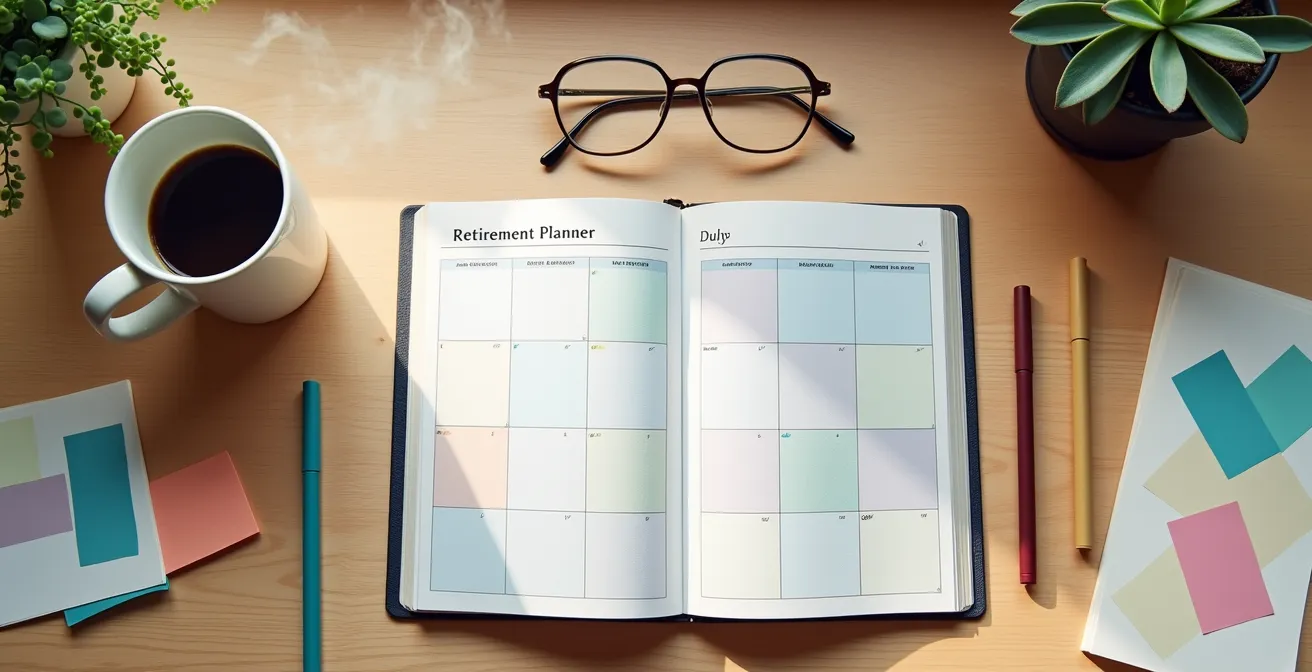
As the image above suggests, this is a creative and personal process. A crucial element of the Joy Schedule is the inclusion of intentional downtime. In our productivity-obsessed culture, we often view rest as laziness. In retirement, it’s an essential component of well-being. Schedule time to simply be—to read, to listen to music, to sit in the garden. This balance between active engagement and restorative rest is what prevents burnout and cultivates lasting satisfaction.
Your Action Plan: Designing Your First Joy Schedule
- Identify Priorities: List your non-negotiable activities and responsibilities (e.g., exercise, socializing, hobbies, volunteering) that form the foundation of your week.
- Create Theme Days: Assign a general focus to each day (e.g., ‘Makers Monday’ for projects, ‘Wellness Wednesday’ for health) to build a predictable and enjoyable rhythm.
- Schedule Intentional Downtime: Block out specific times for relaxation and recharging. Actively protect this time from other commitments to avoid overscheduling.
- Balance Your Energy: Ensure your week includes a healthy mix of physical activity, mental stimulation, social events, and quiet rest.
- Anchor Your Days: Schedule key activities like meal preparation or social calls with loved ones to create purpose and reliable touchpoints throughout the week.
Passive vs Active Leisure: Which Actually Increases Life Satisfaction?
Not all free time is created equal. A key component of your new Life Architecture is understanding the profound difference between passive and active leisure. Passive leisure involves consumption with minimal effort—like watching TV or scrolling through social media. While it provides temporary distraction, it rarely contributes to long-term fulfillment or self-esteem. It fills time, but it doesn’t build anything.
In contrast, active leisure requires engagement, skill, and concentration. This includes activities like gardening, playing a musical instrument, learning a new language, or engaging in a competitive sport. These are the pursuits that build your « Purpose Portfolio » and generate a powerful psychological state known as « flow. » As the renowned psychologist Mihaly Csikszentmihalyi described it, flow is the key to genuine happiness.
Flow is the mental state in which a person is fully immersed in a feeling of energized focus, full involvement, and enjoyment. Flow is characterized by complete absorption and is used as a coping skill for stress and anxiety.
– Mihaly Csikszentmihalyi, Flow (psychology) – Wikipedia
Achieving a state of flow is the optimal manifestation of enjoyment. When you are deeply absorbed in a challenging yet achievable task, your self-consciousness fades, your perception of time alters, and you experience a deep sense of accomplishment. This is where true life satisfaction is cultivated. Your Joy Schedule should be intentionally designed to create regular opportunities for flow, prioritizing activities that challenge you and ignite your passion over those that simply help you pass the time.
The « Yes Man » Mistake That Leads to Retirement Burnout
In the initial rush to fill the void left by a career, many retirees fall into a dangerous trap: becoming the « Yes Man » (or « Yes Woman »). Eager to feel needed and stay busy, they agree to every request, join every committee, and offer to help with every family project. While this stems from a positive impulse, it’s a direct path to a phenomenon known as retirement burnout. This is a state of emotional and physical exhaustion caused by over-commitment without a clear sense of personal priority.
This self-imposed pressure can be just as damaging as the emptiness it’s meant to prevent. In fact, studies indicate that nearly 28% of retirees experience symptoms of depression, and burnout from a poorly structured new life can be a significant contributing factor. When your schedule is dictated by others’ needs rather than your own « Joy Schedule, » you trade one form of obligation for another, leaving no room for the intentional rest and active leisure that generate fulfillment.
The solution lies in learning the art of the « graceful no. » This isn’t about being unhelpful; it’s about being strategic with your most valuable resource: your time and energy. A powerful tool for this is to craft a one-sentence Personal Retirement Mission Statement. For example: « My mission is to cultivate my health, creativity, and close relationships. » When a request comes in, you can filter it through this mission. If it doesn’t align, you have a clear, guilt-free reason to decline. A simple, « Thank you for thinking of me, but my schedule is focused on my key projects right now, » is both respectful and firm.
The First 90 Days: A Roadmap to Launch Your New Life Phase
The first three months of retirement are a critical window for your Identity Redesign. Instead of jumping into major commitments, treat this period as a structured orientation for your new life. Trying to build your final Life Architecture on day one is like trying to build a house without surveying the land. A phased approach allows for discovery, experimentation, and a much more sustainable outcome. On your very first day of retirement, the best thing to do is often nothing—simply observe and allow yourself to decompress.
This 90-day transition can be broken down into three distinct phases. This framework provides a clear roadmap, moving you from observation to intentional action, ensuring the choices you make are aligned with who you are now, not just who you were in your career.
| Phase | Timeline | Focus | Key Activities |
|---|---|---|---|
| Decompression & Observation | Month 1 (Days 1-30) | Rest and self-discovery | No new commitments, observe natural rhythms, journal feelings |
| Low-Stakes Experimentation | Month 2 (Days 31-60) | Exploration | Try drop-in classes, one-off volunteer days, test new hobbies |
| Integration & Routine Building | Month 3 (Days 61-90) | Commitment | Select best-fit activities, build sustainable schedule, establish new identity |
During the Decompression phase, your only job is to rest and shed the stress of your working life. In the Experimentation phase, you « date » new activities without the pressure of long-term commitment. This is the time to explore your curiosities. Finally, in the Integration phase, you take what you’ve learned and begin to build the recurring routines and commitments that form the sturdy foundation of your Joy Schedule and new identity.
How to Create a 15-Minute Morning Routine That Wakes Up Your Body Gently?
With no morning commute or early meetings, it’s tempting to let your wake-up time slide. However, a consistent morning routine is one of the most powerful anchors you can create for your new life. It sets the tone for the entire day, boosts your mood, and reinforces your sense of purpose. It doesn’t need to be long or complicated; a simple, 15-minute framework focused on Mind, Body, and Purpose can be transformative.
The key to a successful routine is consistency. As research from the University of Pittsburgh reveals, older adults who wake up early and maintain an active, consistent morning routine perform better on cognitive tests. Lead author Stephen Smagula emphasizes that a predictable daily rhythm is a protective factor for brain health. This starts with waking up at the same time each day, even on weekends.

Your 15-minute routine should be a sanctuary. Start by leaving your phone in another room to avoid the trap of morning news or emails. Then, divide your time:
- Minutes 1-5 (Mind): Begin with quiet reflection. This could be a short meditation, a gratitude practice where you name three things you’re thankful for, or simply setting a single, positive intention for the day.
- Minutes 6-10 (Body): Gently awaken your physical self. Engage in simple stretches, practice a few gentle yoga poses, or just sit and enjoy a full glass of water to hydrate your body.
- Minutes 11-15 (Purpose): Connect with your « why. » Briefly review your Joy Schedule for the day, or simply write down one thing you are looking forward to. This small act reinforces that your day has direction and meaning.
How to Start Your Own Interest Group If None Exists in Your Area?
One of the best ways to engage in active leisure and build community is to join a group centered around a shared interest. But what if a group for your passion—be it 19th-century poetry, urban birdwatching, or classic film noir—doesn’t exist in your area? The answer is simple and empowering: start it yourself. This proactive step is a cornerstone of building your new Life Architecture, transforming you from a passive consumer of community to an active creator of it.
The thought of starting a group can be intimidating, but it’s far easier than you might think. You don’t need a crowd or a formal charter. The most successful groups often begin with the « Minimum Viable Group » concept: just you and one other person who shares your interest. This immediately removes the pressure of recruitment and allows the group to grow organically. Your « co-founder » can be a friend, a neighbor, or someone you meet at a local coffee shop.
Once you have your co-founder, leverage free and simple tools to find others. Local community Facebook Groups, the neighborhood-focused app Nextdoor, or even a simple flyer at the library or community center can be surprisingly effective. The key is to be clear and specific about the interest. Instead of « starting a book club, » try « starting a historical fiction book club. » This clarity attracts the right people. Structure your first few meetings to be welcoming and collaborative, focusing on connection first and the activity second.
Key takeaways
- Retirement emptiness stems from a loss of identity and purpose, not just a lack of activities.
- Design a « Joy Schedule » with themed days and intentional rest rather than just filling your calendar.
- Prioritize « active leisure » (e.g., hobbies, learning) over « passive leisure » (e.g., TV) to cultivate « flow » and deep satisfaction.
How to Foster a Sense of Belonging in Your Neighborhood After Retirement?
While interest groups build connections around a passion, fostering a sense of belonging right where you live is the final, crucial piece of your Life Architecture. Your neighborhood is an ecosystem of potential relationships waiting to be nurtured. After retirement, when you’re spending more time at home, these local ties become more important than ever. They are the fabric of daily support, casual interaction, and a feeling of being rooted in a community.
The impact of this connection cannot be overstated. We must start treating social engagement as an essential need, on par with nutrition and shelter. The consequences of isolation are severe; as one powerful report highlights, the reduction in lifespan associated with senior social isolation is comparable to smoking 15 cigarettes a day. Building local connections is not a trivial pursuit; it is a critical health-promoting activity.
Fostering this belonging doesn’t require grand gestures. It’s built through small, consistent actions. Be the person who says hello to everyone on your daily walk. Spend time on your front porch or in your front garden instead of the backyard. Offer to collect a neighbor’s mail when they’re away. Attend local farmers’ markets, library events, or town hall meetings. These simple acts of visibility and friendliness signal that you are an open and engaged member of the community, creating a positive feedback loop of connection.
Your neighborhood is the everyday stage for your new life. By actively participating in its rhythm and contributing to its social well-being, you not only combat loneliness but also solidify your new identity as a valued, connected, and integral part of your community.
Frequently Asked Questions on How to Structure Your Retirement Week to Avoid the « Emptiness » Syndrome?
How many people do I need to start a group?
You can start with just two people – yourself and one ‘co-founder’ for your interest. This Minimum Viable Group concept makes it less intimidating than trying to recruit a crowd initially.
What platforms can I use to find and manage members?
Use free tools like Meetup for organizing events, local Facebook Groups for community reach, or Nextdoor for neighborhood connections. Each platform has pros and cons for the senior demographic.
How should I structure the first meetings?
Meeting 1: Focus on icebreakers and co-creating the group’s vision. Meeting 2: Engage in the core activity in its simplest form. Meeting 3: Gather feedback and collaboratively plan next steps.