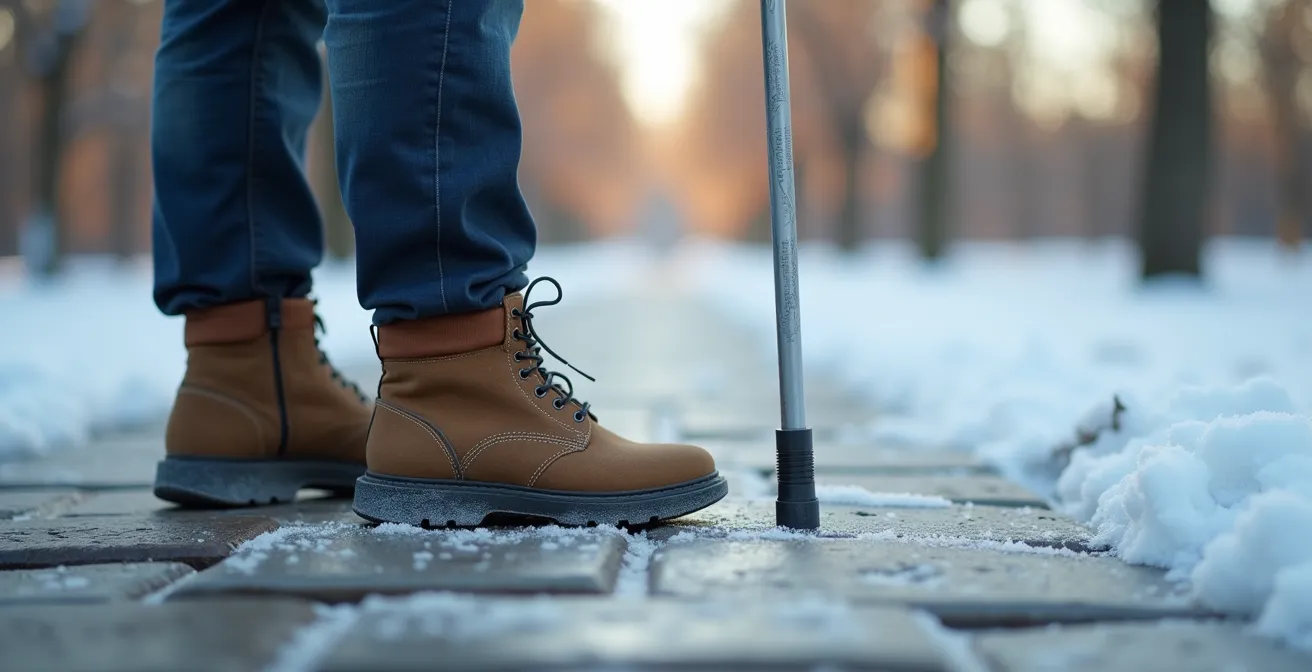
The key to preventing dangerous slips is not a single accessory, but an integrated safety system from the cane’s tip to its grip, engineered for specific environmental conditions.
- Retractable 5-prong ice tips offer the best grip on ice by creating multiple points of pressure, functioning like studded tires for your cane.
- Proper cane height, measured to the wrist crease to achieve a 20-30 degree elbow bend, is critical for distributing weight correctly along the load-bearing axis.
Recommendation: Regularly inspect your cane’s ferrule (rubber tip) for wear and replace it every 6-12 months to maintain maximum coefficient of friction on wet surfaces.
For seniors who rely on a walking cane, the fear of a slip on an icy sidewalk or a wet tile floor is constant and valid. This single moment of instability can lead to serious injury, eroding confidence and limiting independence. The common advice is often to simply « be careful » or buy a generic accessory. From an engineering perspective, this approach is flawed because it fails to treat the user, the cane, and the environment as an integrated system. A fall is a system failure, and preventing it requires a systematic approach to enhancing stability at every point of contact.
The solution lies not in one magic bullet, but in understanding the principles of friction, pressure distribution, and material science. The most effective accessory for sheer ice is a retractable, multi-pronged ice grip. As confirmed by field testing, these attachments function like studded snow tires, biting into the ice to provide multiple, secure anchor points. However, this single component is only part of the equation. Its effectiveness is directly impacted by the condition of the standard rubber tip (the ferrule), the biomechanical efficiency determined by the cane’s height, and the user’s ability to apply pressure comfortably through an ergonomic grip.
This guide deconstructs the cane as a piece of safety equipment. We will analyze each component, from the ground up, to provide a detailed, product-focused roadmap for building a truly slip-resistant mobility system. By understanding the ‘why’ behind each component’s function, you can make informed choices to maximize your safety in any weather.
This article provides a detailed breakdown of each critical component for cane safety. Explore the sections below to understand the engineering principles that ensure your stability on any surface.
Summary: A Component-by-Component Guide to Cane Stability
- Why Standard Cane Tips Fail on Wet Tile and Ice?
- How to Measure Cane Height Correctly to Prevent Shoulder Strain?
- The Worn-Out Ferrule Mistake That Turns Your Cane Into a Skate
- Quad Base vs Single Point: Which Offers Better Stability for Balance Issues?
- How to Modify Cane Grips to Reduce Hand Pain for Arthritis Sufferers?
- Why Throw Rugs Are the Number One Enemy of Senior Safety?
- Aluminum vs Treated Wood: Which Ramp Material Survives Winter Best?
- Rollator or Walker: Which Device Best Suits a Senior Living in a Small Apartment?
Why Standard Cane Tips Fail on Wet Tile and Ice?
The standard rubber ferrule on a walking cane is designed to provide a high coefficient of friction on dry, flat surfaces. However, its performance degrades dramatically when encountering water or ice. The fundamental engineering problem is hydroplaning. When a layer of water is present, the smooth surface of a standard tip can fail to displace the liquid, causing it to ride on top of the water film instead of making firm contact with the ground. This results in a near-total loss of grip, similar to a car tire hydroplaning on a wet road.
On ice, the problem is compounded. The pressure from the cane tip can slightly melt the surface layer of ice, creating the same slick film of water that causes hydroplaning. A standard tip lacks the mechanical design to penetrate this layer. Its effectiveness relies on a large, flexible contact patch to maximize friction, but on a hard, slick surface like ice, this design is a liability. The risk is significant; CDC data shows that falls affect over 14 million adults aged 65+ fall each year, and poor equipment performance is a major contributing factor.
Truly effective all-weather tips incorporate specific engineering solutions. Tips with deep, circumferential grooves or sipes are designed to channel water away from the center of the contact patch, maintaining grip on wet surfaces. For ice, the only reliable solution is a tip with integrated metal prongs or cleats. These penetrating points bypass the slippery surface entirely, biting into the solid ice below to create a secure anchor point. Therefore, a specialized ice-grip attachment is not a luxury but an essential piece of safety equipment for winter conditions.
How to Measure Cane Height Correctly to Prevent Shoulder Strain?
Proper cane height is not a matter of comfort; it is a critical biomechanical specification that dictates the stability of the entire user-cane system. An incorrectly sized cane forces compensatory postures that lead to shoulder, wrist, and back pain, and more importantly, compromises the cane’s function as a stable, load-bearing device. The goal is to align the user’s weight directly over the cane shaft, creating a stable load-bearing axis.
The industry-standard method, confirmed by clinical research, is to measure the cane to the user’s wrist crease. To do this, stand straight with your arms hanging naturally at your sides while wearing your typical walking shoes. The top of the cane handle should align perfectly with the crease of your wrist. This method is highly effective because it naturally produces the optimal biomechanical elbow angle when you hold the grip. A study of 52 volunteers found this method achieved the ideal elbow angle in 94.3% of participants. The optimal elbow angle for cane use is between 20-30 degrees, a standard confirmed by clinical research on cane height.

This 20-30 degree bend allows the arm to absorb shock and apply downward pressure effectively without locking the elbow (which transmits jarring forces to the shoulder) or bending too much (which reduces leverage and stability). A cane that is too high forces the shoulder to hunch, causing strain, while a cane that is too low forces the user to stoop, compromising balance and posture. Adjusting your cane to this precise specification is one of the most important safety modifications you can make.
The Worn-Out Ferrule Mistake That Turns Your Cane Into a Skate
The rubber ferrule at the bottom of a cane is a consumable component, much like the tires on a car. Yet, it is the most commonly neglected part of the entire safety system. Over time, the rubber compound undergoes two forms of degradation: mechanical wear and material hardening. Mechanical wear smooths out the tread, reducing its ability to channel water and decreasing the contact patch’s friction. This is the most visible sign of a failing tip.
Less obvious, but more dangerous, is material hardening. Exposure to UV light, ozone, and temperature fluctuations causes the polymers in the rubber to break down. The material loses its pliability and its surface becomes slick and glassy. This change in durometer hardness means the tip can no longer deform slightly to grip microscopic irregularities in the floor surface. A hardened ferrule, even one with visible tread, has a drastically reduced coefficient of friction and can slip unexpectedly on surfaces like polished tile or linoleum. This single point of failure contributes to the staggering $80 billion spent annually in healthcare costs for non-fatal falls.
A proactive inspection and replacement schedule is non-negotiable from a safety engineering standpoint. A ferrule should be considered for replacement every 6 to 12 months, regardless of visible wear. A simple « fingernail test » can reveal hardening: if you cannot easily press your nail into the rubber and leave a temporary indent, the material has lost its grip and must be replaced immediately.
Checklist: Your Ferrule Safety Inspection
- Check ferrule wear: If the rubber tip is worn smooth with no visible tread patterns, replace it immediately.
- Perform the fingernail test: Press your nail into the rubber; if it doesn’t indent easily, the material has hardened and lost its grip.
- Look for glazing or UV damage: A shiny, slick surface indicates a decreased grip capacity and requires replacement.
- Inspect for micro-cracks or visible metal shaft exposure: These are signs of critical failure; replace the tip without delay.
Quad Base vs Single Point: Which Offers Better Stability for Balance Issues?
The choice between a single-point cane and a quad-base cane is a classic engineering trade-off between static stability and dynamic maneuverability. A quad cane, with its four small feet, provides a significantly wider base of support. This makes it exceptionally stable when stationary, allowing it to stand on its own and provide a firm anchor for users who need significant help transitioning from sitting to standing. It excels in providing static stability for users with major balance impairments or weakness on one side.
However, this stability comes at a cost. The wide base that is an asset on flat, indoor surfaces becomes a liability on uneven terrain. If all four points of the base cannot make contact with the ground simultaneously, the cane can pivot unpredictably, creating a severe fall risk. Furthermore, the wide footprint requires a larger turning radius and a « pick up and place » walking pattern that disrupts a natural gait. Analysis of seniors in apartments found that quad canes often increase tripping hazards in cluttered homes and make navigating tight spaces, like bathrooms, extremely difficult.
A single-point cane, by contrast, promotes a more natural, reciprocal gait. Its single contact point allows for fluid movement and a zero-radius turn, making it far more maneuverable in confined spaces. While it offers less static stability, modern advancements like pivoting, wide-foot single tips provide a hybrid solution, offering a larger contact patch than a standard tip while retaining the maneuverability of a single point. The final decision must be based on a careful analysis of the user’s primary environment and specific stability needs.
| Feature | Single Point Cane | Quad Base Cane |
|---|---|---|
| Indoor Stability | Good | Excellent |
| Outdoor/Uneven Terrain | Good | Poor (pivot risk) |
| Natural Gait Support | Excellent | Limited |
| Storage/Portability | Excellent | Poor |
| Self-Standing | No | Yes |
| Turning Radius | Zero (can lift) | Wide arc required |
How to Modify Cane Grips to Reduce Hand Pain for Arthritis Sufferers?
The cane grip is the primary user interface, and for individuals with arthritis or limited hand strength, it can be a significant source of pain and instability. A standard, hard plastic grip concentrates the user’s entire body weight onto a few pressure points in the palm and fingers. This can be excruciatingly painful, causing the user to grip the cane improperly or less firmly, which compromises the stability of the entire system.
The engineering solution is to increase the surface area and add shock-absorbing materials to distribute pressure more evenly across the hand. There are two main approaches: modifying an existing grip or choosing a cane with a specialized ergonomic grip. For modification, several off-the-shelf products can dramatically improve comfort:
- Build up grip diameter: Applying tennis overgrip tape or self-adhesive foam tape in spirals can increase the grip’s diameter, allowing for a more relaxed, open grip that reduces strain.
- Add cushioning: Gel padding sleeves designed for bicycle handlebars or specialized gel cane grip covers provide excellent shock absorption, dampening the jarring forces transmitted up the cane shaft with each step.
- Use ergonomic materials: Cork wrap is an excellent choice as it naturally warms to the hand’s temperature and molds slightly to the user’s specific grip over time.
For those purchasing a new cane, selecting a model with an ergonomic grip from the start is ideal. As experts from the Medical Alert Buyers Guide note, different designs address specific needs:
Offset grips feature a forward-bending handle that aligns the user’s weight over the cane shaft for enhanced stability, while palm grips spread pressure evenly across the palm, reducing strain on the hand
– Medical Alert Buyers Guide, The 10 Best Walking Canes for Elderly Women
An offset grip is an excellent all-around choice for stability, while a large-surface palm grip is specifically engineered for maximum pressure distribution to accommodate arthritic hands.
Why Throw Rugs Are the Number One Enemy of Senior Safety?
From a safety engineering perspective, throw rugs are a predictable and preventable hazard. They introduce an unstable, high-friction element onto a low-friction surface, creating a perfect scenario for a trip and fall. The danger comes from two primary failure modes: the edge of the rug catching the toe of a shoe or a cane tip, and the entire rug sliding out from underfoot. These incidents are a major contributor to the estimated 3 million emergency department visits annually due to falls among older adults.
The curled edge of a throw rug presents a minimal but sufficient vertical obstacle to catch a foot during the swing phase of walking, especially for individuals with a shuffling gait. A cane tip can also easily get caught under the edge, causing an abrupt stop and loss of balance. The second failure mode, slipping, occurs when the rug lacks adequate non-slip backing. The force of a footstep can easily overcome the static friction between the rug and the floor, causing the rug to function like a skateboard.
Eliminating throw rugs entirely is the single most effective home modification for fall prevention. If a rug is deemed absolutely necessary for warmth or comfort, it must be secured with the same rigor as any other piece of safety equipment. This means using full-coverage, high-tack rug tape or a full-sized, high-friction rug pad underneath. However, safer alternatives that eliminate the hazard altogether are far superior:
- Install wall-to-wall low-pile carpeting, which provides a uniform, stable surface.
- Apply non-slip floor treatments or coatings directly to existing hard surfaces.
- Use industrial-grade floor mats with beveled edges and full adhesive backing in high-traffic areas like entryways.
- Add high-visibility contrast strips at transition points between different flooring types to increase awareness.
In a safely engineered environment, there is no place for unsecured, high-profile floor coverings.
Aluminum vs Treated Wood: Which Ramp Material Survives Winter Best?
Choosing a material for an accessibility ramp in a winter climate is a critical decision involving a trade-off between maintenance, cost, and safety performance under icy conditions. Aluminum and pressure-treated wood are the two most common options, each with distinct engineering properties that affect their winter durability and grip.
Aluminum ramps are lightweight, strong, and highly resistant to corrosion from road salt, giving them a lower long-term maintenance cost. However, their primary drawback is thermal conductivity. Metal chills very quickly, making it highly susceptible to flash freezing. Rain or melting snow can turn into a sheet of ice almost instantly on an aluminum surface. While many aluminum ramps feature grooved or textured surfaces, these offer limited grip on solid ice. Furthermore, using a metal snow shovel can easily gouge or damage the ramp’s surface.
Treated wood ramps have lower thermal conductivity, meaning they are less prone to rapid ice formation. Wood is also more resilient to damage from plastic or even metal shovels. Its key advantage is the flexibility in applying high-friction surfaces. Wood can be painted with slip-resistant paint containing grit additives, or high-traction adhesive grit strips can be applied. The main disadvantage is maintenance; wood is susceptible to rot and warping if not properly sealed and is vulnerable to corrosion from salt and de-icing chemicals, requiring periodic re-sealing to survive winter conditions.
| Factor | Aluminum Ramps | Treated Wood Ramps |
|---|---|---|
| Ice Formation Risk | High (flash freezing) | Moderate |
| Salt Corrosion | Resistant | Susceptible |
| Snow Shovel Damage | Metal shovels damage | More resilient |
| Grip Options | Limited (grooves) | Flexible (grit strips, paint) |
| Thermal Properties | High conductivity (cold) | Low conductivity (warmer) |
| Long-term Winter Cost | Lower (less maintenance) | Higher (resealing needed) |
Ultimately, a wooden ramp offers more options for creating a high-traction surface for winter, but an aluminum ramp provides a more durable, lower-maintenance solution if icing is managed with salt alternatives like sand.
Key takeaways
- True slip prevention requires a systems approach, analyzing the cane, user, and environment as interconnected parts.
- Retractable, multi-pronged ice tips are the most effective accessory for solid ice, while specialized ferrules with deep grooves are best for wet surfaces.
- Regular inspection and replacement of the rubber ferrule (every 6-12 months) is a critical, non-negotiable safety procedure to prevent loss of grip.
Rollator or Walker: Which Device Best Suits a Senior Living in a Small Apartment?
The selection of a mobility aid for a confined living space like a small apartment requires a detailed analysis of spatial constraints versus user needs. Standard walkers and rollators, while serving a similar purpose, have fundamentally different engineering designs that make them suitable for different indoor environments. The decision hinges on factors like doorway width, hallway turning radius, and the need for dual functionality.
A standard walker (without wheels) offers maximum stability for weight-bearing. Its key advantage in a small apartment is its zero-radius turning capability. Because it must be lifted and placed with each step, a user can turn it on the spot, making it far superior for navigating extremely narrow hallways or tight bathroom spaces. Its narrower frame is also more likely to clear standard interior doorways. However, it requires significant upper body strength and promotes a slower, less fluid gait.
A rollator, with its wheels and hand brakes, promotes a more natural and faster walking pattern. Its primary advantages are speed and dual functionality. As an analysis by Canadian medical alert provider Life Assure found, the built-in seat is a highly valued feature in studio apartments, serving as temporary seating or a tray to transport meals. The main drawback is its larger footprint and wider turning radius. A rollator cannot be turned on the spot and requires more space to maneuver around furniture, making it challenging in cluttered or very compact layouts. Before purchase, it is essential to measure key doorways and turning spaces in the apartment to ensure the chosen device will be a help, not a hindrance. This is especially critical as a recent CDC analysis reveals that fall mortality rates increased by 70-75% for seniors aged 65-84, making the right equipment choice paramount.
By applying this engineering-based, systematic approach—analyzing each component from the ice tip to the hand grip and assessing the environment—you transform a simple cane into a reliable, all-weather safety system. To implement these principles effectively, the next step is to conduct a thorough audit of your current mobility equipment against these safety specifications.